sales@bonporaparts.com
0086-10-64988621
English
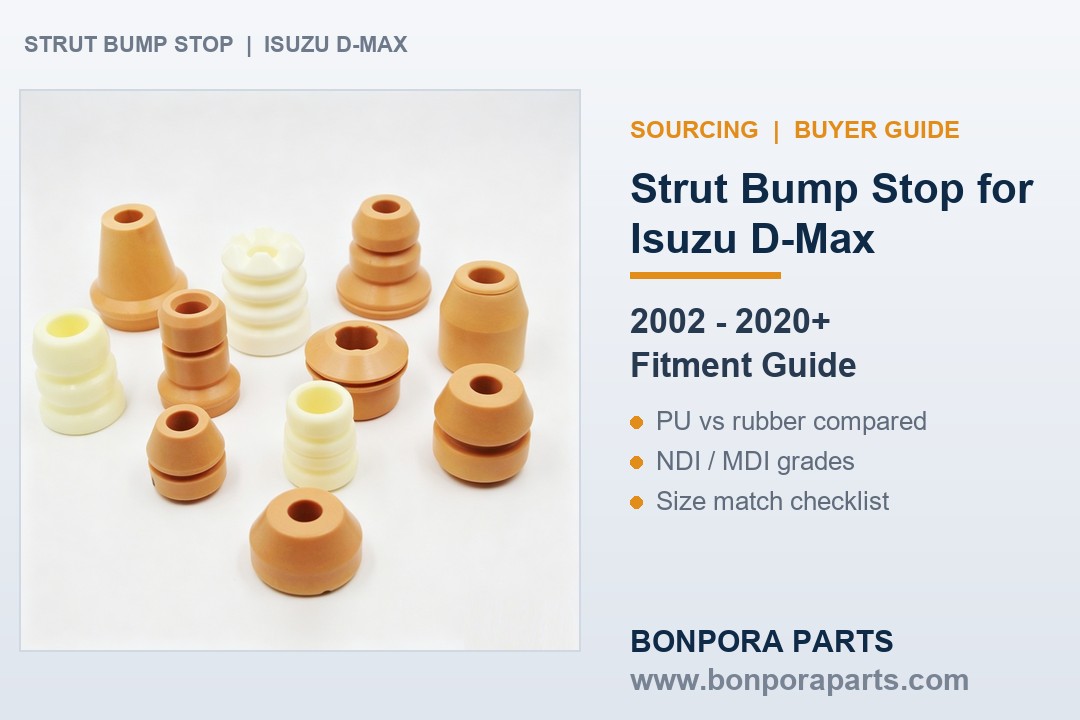
Strut bump stop for Isuzu D-Max is a small component with a disproportionate effect on ride quality, suspension life and warranty cost. The D-Max has been built since 2002 and is used worldwide as a mining patrol vehicle, farm utility and light delivery truck, so its strut bump stops (also called jounce bumpers or 缓冲限位块) work far harder than those on an average passenger car. This guide explains how the part functions on the D-Max, how fitment changes across the three main generations, why microcellular polyurethane outperforms conventional rubber in pickup duty, and what a distributor or fleet buyer should check before confirming an order. As a polyurethane bump stop manufacturer, Bonpora Parts (邦博润(北京)汽车零部件有限公司) supplies microcellular PU bump stops in NDI and MDI grades together with a full range of shock absorber parts and chassis and suspension components.
On the front MacPherson struts and rear leaf springs of an Isuzu D-Max, the bump stop is the last line of defence before metal contacts metal. When the suspension reaches full compression, over a pothole, a loaded bed or a hard kerb strike, the bump stop engages between the strut body (or axle housing) and the chassis, absorbing the final energy spike in a controlled way.
A well-designed microcellular PU bump stop delivers three things:
Progressive engagement. The closed-cell microcellular structure stiffens gradually as it compresses, so the driver feels a firm but not harsh end-of-travel.
Protection of adjacent parts. Without an effective stop, shock loads travel into the piston rod, the internal valve plate and the nitrogen gas chamber of the damper, shortening damper life and causing seal leakage.
Consistent ride height behaviour. A stop that has collapsed or crumbled lets the suspension bottom out repeatedly, which then accelerates wear on the spring seat, dust cover and surrounding bushings.
Because the D-Max regularly carries loads at or above its rated payload in mining and agricultural service, its bump stops compress more often and at higher energy levels than those of a light-duty passenger car. That is exactly the condition where material choice matters most.
D-Max production spans more than two decades, and aftermarket catalogues usually split fitment by generation. The table below summarises the generations and the typical strut bump stop considerations for each. Always confirm the original part number and the physical dimensions of the worn part before ordering, because engines, gross vehicle weights and suspension refreshes within a generation can change the mounting interface.
| Generation | Approx. years | Front suspension | Bump stop notes |
|---|---|---|---|
| First generation | 2002–2012 | Independent double wishbone / coil-over strut | Older fleets often run collapsed rubber stops; upgrading to microcellular PU restores ride height control. |
| Second generation | 2012–2020 | Coil-over MacPherson strut | Widest aftermarket volume; shared platform with the related BT-50 model, so cross-references are common. |
| Third generation | 2020–present | MacPherson strut, revised knuckle and damper | Newer OE references; dimension checks are essential as some variants use taller stop profiles. |
For rear axles, leaf-sprung D-Max variants use an axle-mounted bump stop that contacts the chassis rail. Off-road builds that add long-travel dampers or lift kits frequently replace the rear stops with taller polyurethane versions, a pattern Bonpora also sees in accessory kits for related pickup platforms such as the Hilux and Ranger.
Mining patrol D-Maxes run hundreds of kilometres per day on corrugated gravel. Each corrugation cycle drives the suspension toward full compression, so the bump stop cycles thousands of times per shift. Conventional rubber stops in this duty often show permanent set, cracking at the base and eventual detachment. A microcellular PU formulation with good compression set resistance keeps its shape and damping behaviour for far longer, which also protects the damper piston rod from side-load shock and the dust cover (防尘罩) from tearing.
Trades versions with trays, tipper bodies or towing equipment concentrate mass over the rear axle. When the bed is fully loaded, rear bump stops carry static compression as well as dynamic impacts. Stops made from low-grade material slowly squash flat, letting the chassis rail sit closer to the axle and transmitting more noise and harshness into the cabin. PU stops with higher load capacity maintain clearance and protect both comfort and payload ratings.
Most OE and cheap aftermarket stops for the D-Max are moulded from filled natural or synthetic rubber. Microcellular polyurethane, produced by a controlled foaming process, offers a different balance of properties. The comparison below reflects typical supplier data and field experience; actual figures depend on the specific formulation.
| Property | Microcellular PU bump stop | Conventional rubber bump stop |
|---|---|---|
| Damping curve | Progressive, rising stiffness with compression | Stiffens late, harsher end stop |
| Compression set | Low; recovers shape after repeated cycles | Higher; permanent sag over time |
| Heat ageing and ozone | Good resistance in NDI grades | Cracks at base and flex zones |
| Weight | Lighter for the same energy capacity | Heavier |
| Consistency | Closed-cell structure, batch-to-batch controlled | Varies with filler content |
| Unit cost | Moderate | Low |
For fleet buyers the deciding factor is rarely the unit price of the stop itself. It is the combined cost of damper failures, cabin complaints and vehicle downtime caused by worn stops, which in heavy service usually exceeds the price difference many times over.
Bonpora moulds polyurethane bump stops (聚氨酯缓冲块) in two isocyanate systems, and choosing between them is the most common technical question from distributors.
NDI (1,5-naphthalene diisocyanate) systems offer outstanding dynamic performance: high resilience, low heat build-up under rapid cycling and excellent rebound behaviour. For a D-Max that cycles its bump stops continuously on corrugations at highway speed, NDI grades maintain consistent damping without softening. This is the grade Bonpora recommends for mining, border patrol and other high-cycle applications.
MDI (diphenylmethane diisocyanate) systems provide strong static load capacity and stable properties at moderate cost. For general transport, urban delivery and farm use where compression events are less frequent, MDI grades deliver reliable performance and an attractive price point. Many distributors stock both grades and let the end user choose by duty cycle.
Neither grade is universally better. The correct answer depends on the compression frequency, ambient temperature range and expected service life of the vehicles in question, and Bonpora can advise based on the application profile described by the buyer.
When bump stops are worn, adjacent suspension parts have usually absorbed the same shock history. Experienced workshops replace or inspect them together. As a shock absorber parts manufacturer, Bonpora supplies most of these components, which makes one-stop sourcing practical:
Spring seat (弹簧座). A cracked or corroded seat lets the coil move under load and changes the strut geometry.
Dust cover / shock absorber boot (防尘罩、减震护罩). Torn boots allow grit onto the piston rod, which then scores the seal and causes oil leakage.
Piston rod and piston ring. Damaged rods and worn piston rings show up as knocking noises and reduced damping force.
Valve plate set. Fatigued valve plates in the damper reduce control at exactly the frequencies where the bump stop is already working hardest.
Nitrogen gas chamber condition. Loss of gas charge leads to foaming and inconsistent damping after hard use.
Steering tie rod ends (转向拉杆) and ball joints. Repeated bottom-out impacts accelerate wear in the steering linkage, so these should be checked on the same lift inspection.
The most common cause of returns in this product family is not material failure but dimensional mismatch. Because D-Max variants differ by market, year and trim, catalogue numbers alone are not sufficient. Bonpora recommends confirming the following before placing an order:
| Parameter | How to check |
|---|---|
| Original part number | Read from the worn stop or the OE parts catalogue for the exact VIN |
| Free height and compressed height | Measure the new-spec stop with a caliper; note the design compression length |
| Top and bottom diameter | Measure the seating diameters; tapered profiles must match the seat |
| Mounting type | Slip-on rod, threaded stud or captive plate; note thread size if applicable |
| Hole diameter and depth | Confirm the centre bore fits the strut rod or stud without play |
| Hardness / density band | Match the OE feel or choose a PU grade for the duty cycle |
Bonpora engineers review drawings or samples before quoting. Where an OE number is unavailable, a simple set of dimensions and photographs is usually enough to identify or reproduce the part, and samples can be produced for validation before volume supply.
Bump stops look deceptively simple, and quality problems only appear after months in service. Distributors evaluating a new supplier should ask for:
Density and compression set test reports for the specific grade, not generic material certificates.
Batch traceability and consistent foaming process control, visible as uniform cell structure on cut samples.
Dimensional inspection records against the approved drawing, including hole position and taper.
Heat ageing data, because pickup engines bay and brake heat can elevate local temperatures well above ambient.
Sample parts for fitment trials on real vehicles before bulk orders.
Bonpora supports this process with in-house moulding, and details of custom development steps are described on the custom parts page.
Beyond catalogue references, many D-Max programs need tailored parts: taller stops for lifted suspensions, firmer grades for mining build specifications, or private-label packaging for regional brands. Bonpora offers OEM bump stop private label development covering drawing review, tooling, grade selection in NDI or MDI, sample validation and volume production. The company also manufactures precision metal components such as spring seats and valve hardware, so complete strut kits can be sourced from a single supplier instead of coordinating several vendors.
For a full overview of the four product families, including shock absorber parts, chassis and suspension components, steering parts and custom polyurethane solutions, visit the product centre.
There is no fixed interval. Inspect them at every damper service or tyre rotation. Replace when the stop shows permanent set (visible sag), surface cracking, crumbling edges or when the vehicle bottoms out more noticeably than before. In mining duty, inspection every 20,000 to 30,000 km is a sensible practice.
Yes, provided the dimensions and mounting type match the original part. Microcellular PU stops are dimensionally interchangeable with rubber equivalents in most applications and typically improve progressive damping. Off-road builds sometimes deliberately choose taller PU stops, but this should follow suspension travel calculations rather than guesswork.
The bump stop (缓冲限位块) is the elastic element that absorbs compression energy at full suspension travel. The dust cover (防尘罩) or shock absorber boot (减震护罩) is the accordion-shaped shield that keeps dirt and water away from the piston rod. They are separate parts, often sold together as a strut kit, and both should be inspected when a strut is serviced.
Bonpora supports sample and trial quantities so buyers can validate fitment and performance before committing to volume. For catalogue items, standard packing and labelling apply; for private-label programs, minimum order quantities are agreed during the custom development discussion.
If you are sourcing a strut bump stop for Isuzu D-Max or building a broader range of polyurethane bump stops, shock absorber parts and chassis and suspension components, Bonpora (邦博润(北京)汽车零部件有限公司) can support catalogue supply, custom development and private-label programs covering European, American, Korean and Japanese vehicle platforms. Send your drawings, samples or target part numbers through the contact page on www.bonporaparts.com and the engineering team will respond with a quotation and material recommendation.
