sales@bonporaparts.com
0086-10-64988621
English
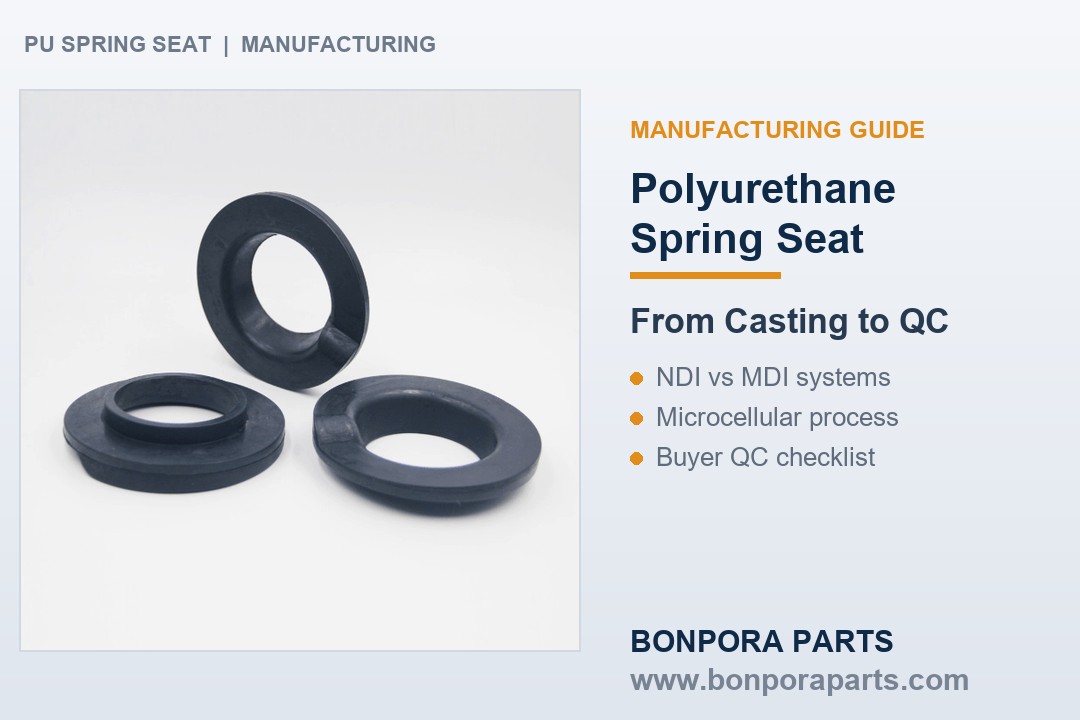
In a coil spring suspension, the spring seat (弹簧座) sits between the helical spring and the strut body or mount. It spreads the spring load, stops the end coil from biting into the mount, and keeps the spring centred as the suspension travels up and down. Buyers often focus on the damper and the jounce bumper (缓冲限位块), yet a worn or deformed spring seat produces coil noise, uneven spring seating and accelerated wear on neighbouring parts. For distributors and aftermarket brands, the polyurethane spring seat has become a high-frequency replacement item and a natural extension of a shock absorber parts programme.
This guide explains how a professional polyurethane spring seat is made, how material grade and process control shape the final quality, and what importers should check before placing an OEM order.
On a typical MacPherson strut, the assembly stack looks like this from top to bottom: strut mount, bearing, upper spring seat, coil spring, lower spring seat, then the damper cartridge inside. Inside the damper, the piston rod (活塞杆) carries the piston ring (活塞环) and valve plates (阀片) that meter oil flow, while a nitrogen gas bladder (氮气气囊) compensates volume changes. Around the rod, the dust cover (防尘罩) and shock guard (减震护罩) keep abrasive media away from the seal, and at full compression the polyurethane bump stop (聚氨酯缓冲块, NDI/MDI grades) engages to limit travel.
The spring seat is the load-transfer interface in this stack. If its contact face is out of tolerance or its material collapses under heat, the spring loses stable seating: drivers hear clicking on turns or rattling over bumps, and the misaligned load accelerates wear on the mount bearing and the insulation rings. That is why spring seat quality is measured not only by dimensions but also by load-bearing behaviour over temperature cycles.
Traditional spring seats were moulded from filled rubber or from hard thermoplastics. Microcellular polyurethane (微孔聚氨酯) occupies a middle position: it compresses elastically like an elastomer but supports load like an engineering plastic. The practical differences show up in four areas.
| Property | Polyurethane spring seat | Rubber spring seat | Hard plastic seat |
|---|---|---|---|
| Load capacity at thickness | High, stable under repeated compression | Medium, creep under sustained load | High but no damping, transmits noise |
| Wear and cut resistance | Excellent, resists coil-end abrasion | Abrasion scratches grow into tears | Scratches become crack starters |
| Noise behaviour | Damps coil chatter effectively | Good when new, hardens with age | Tendency to click and rattle |
| Heat and ageing | Stable across -40 to +120 °C range | Ozone and heat ageing, hardens | Stable but brittle at low temperature |
For the buyer, the summary is simple: polyurethane keeps its geometry and damping feel through the largest share of real-world conditions, which is exactly what a replacement part needs. The same logic explains why polyurethane has taken over in bump stops and rebound bumpers across European, American, Korean and Japanese vehicle platforms.
Two isocyanate systems dominate premium polyurethane suspension parts: NDI (naphthalene diisocyanate) and MDI (methylene diphenyl diisocyanate). They are not interchangeable, and a serious manufacturer will match the system to the working condition of the part.
| Criterion | NDI elastomer | MDI elastomer |
|---|---|---|
| Dynamic resilience | Very high rebound, low hysteretic heat build-up | Good rebound, moderate heat build-up |
| Best suited for | Continuous dynamic parts: spring seats, bump stops on heavy-load struts | Parts balancing cost and performance; medium-load applications |
| Temperature behaviour | Remains resilient in sustained compression | Slightly stiffer feel as temperature rises |
| Processing window | Narrower, demands tight metering and fast casting discipline | Wider, easier for volume production |
| Typical use in catalogue | Premium jounce bumpers, commercial vehicle seats | Passenger car spring seats, dust cover kits |
Density matters as much as chemistry. Microcellular PU spring seats are usually produced in the 0.45 to 0.70 g/cm3 range: low enough to compress without bottoming out, high enough to carry coil loads for years. Hardness is tuned with polyol blend and cure schedule, commonly falling between 60 and 90 Shore A equivalents depending on the seat profile.
A polyurethane spring seat looks like a simple annular ring, but each stage of production has tolerance traps. Here is how a qualified line runs it.
Prepolymer and curative are conditioned to a controlled temperature, then blended at a fixed ratio and vacuum degassed. Any trapped air becomes a void in the microcellular structure, and a void under a coil end turns into a crack path. Reputable plants meter with gravimetric dosing units rather than manual bucket mixing, because ratio drift of a few percent changes hardness measurably.
The liquid mix is cast or injected into aluminium moulds whose cavities define the seat diameter, chamfer and locating tab geometry. Closed-mould foaming builds the microcellular structure: millions of sealed cells that give the part its compression set resistance. Mould temperature and demould time are recorded per batch; a seat stripped too early springs back and loses dimensional accuracy at the seating face.
Demoulded seats post-cure on racks so the polymer network completes its development before any machining. Finishing then trims the parting line, drills or deburrs the locating features, and 100 percent checks the critical dimensions: inner diameter against the damper housing, outer diameter against the spring end coil, thickness under specified load, and the tab position that locks the seat rotationally.
Each batch is sampled for density, hardness, compression set and ageing behaviour. Serious suppliers retain samples per lot so that a field claim years later can be traced back to its production record.
Whether you audit a factory in person or evaluate samples on your bench, the following checkpoints separate consistent spring seat suppliers from opportunistic traders.
| # | Checkpoint | What good looks like |
|---|---|---|
| 1 | Dimensional report per drawing | Critical dimensions listed with CMM or gauge results, not just a visual pass |
| 2 | Load-deflection curve | Seat stiffness measured under load, consistent batch to batch |
| 3 | Compression set data | Low permanent set after standard heat and deflection cycle |
| 4 | Material declaration | NDI or MDI system and density range declared on request |
| 5 | Fitment validation | Sample seats trial-mounted with actual spring and strut parts, not only gauge checks |
| 6 | Batch traceability | Date and lot codes moulded or printed on the part |
Checkpoint 5 deserves emphasis. A spring seat can pass every dimension check and still disappoint in the field if its contact chamfer does not match a specific spring end geometry. Ask the supplier how they validate fitment before committing to a private-label programme.
Replacement demand rarely arrives alone. When a strut is opened for service, the workshop typically finds an aged bump stop, a cracked dust cover and a flattened spring seat at the same time. Distributors therefore stock these items as matched kits, and the catalogue logic matters: the same NDI microcellular compound that makes a durable jounce bumper makes a durable spring seat, and sourcing both from one manufacturer keeps the feel consistent across the assembly.
Bonpora Parts and Components Co., Ltd. (邦博润(北京)汽车零部件有限公司) produces polyurethane bump stops in NDI and MDI grades together with a full shock absorber parts and chassis and suspension line, covering European, American, Korean and Japanese mainstream platforms. Spring seats, rebound bumpers, nitrogen gas bladders and dust covers are developed on the same quality system, which simplifies qualification for buyers who prefer a single-source programme.
Custom spring seats are routine work for an experienced moulding plant. To quote accurately and move fast, the manufacturer needs three inputs: a drawing or a physical sample of the original seat, the working condition (vehicle class, spring load, temperature exposure), and the target annual volume. From there the development path is short.
Typical timeline: drawing or sample review and feasibility confirmation, prototype tooling, first articles measured against the drawing, then production tooling with cavity-level inspection. Buyers who supply the mating spring end and damper housing dimensions get the fastest and most accurate first article, because the seat can be tuned to the actual interface instead of a nominal one. Companies that already manage bump stop private-label projects will recognise this workflow immediately, since spring seats follow the same five-stage path from enquiry to mass production.
Edge collapse under the coil end: caused by insufficient density or an undercut chamfer; prevented with correct microcellular density and a reinforced contact face.
Rotation loss: the seat spins with the spring and chews its locating tab; prevented by a properly positioned tab geometry matched to the mount pockets.
Heat hardening near the damper: sustained proximity to a hot damper body stiffens low-grade material; prevented by choosing NDI or a high-grade MDI system with low heat build-up.
Water retention and corrosion staining: a seat that traps moisture between coil turns accelerates spring corrosion; profile design with drainage relief handles this.
Understanding these modes helps buyers read a supplier quotation more critically: a quote that is significantly cheaper usually means thinner walls, lower density, or a cheaper isocyanate system. The saving shows up later as warranty returns.
Often yes, but not automatically. Bump stops are mainly compression-energy parts while spring seats carry static-plus-dynamic loads at the coil interface. Many manufacturers use one NDI or MDI family with different densities and hardness for each part. Ask the supplier to declare density and hardness per part number rather than marketing one universal grade.
Measure and photograph the seat, note the vehicle make, model and year, and if possible send the used original by courier. Manufacturers that support custom development (来图、来样定制) can reverse the profile from the sample, cut a prototype tool and quote against measured drawings. A scanned dimension sheet with inner diameter, outer diameter, thickness and tab position accelerates the first reply considerably.
MOQ depends on tooling amortisation and colour or packaging requirements. For a standard profile retooled in your brand colour, volumes are typically modest because the tool already exists in similar geometry; a fully new profile needs a new mould and a higher opening quantity. Discuss annual volume split by vehicle platform, since that is how tooling cost is normally justified.
Microcellular PU is dimensionally stable but surfaces can mark. Standard practice is polybag per piece with size-separated cartons, plus moulded-in part numbers for warehouse sorting. If the seats ship as part of a kit with bump stops and dust covers, request that the kit carton be drop-tested or at least stacked per your pallet specification.
The polyurethane spring seat is a small component with a large effect on strut noise, spring life and customer perception of quality. Its performance is decided by three things: the isocyanate system (NDI for the most demanding dynamic duty, MDI for balanced cost and performance), the microcellular density and hardness matched to the coil load, and the discipline of the casting, curing and inspection process. Evaluate suppliers with the checklist above, and prefer a partner who can supply the whole strut wear set - spring seats, polyurethane bump stops, dust covers and rebound bumpers - from one quality system.
Bonpora Parts and Components Co., Ltd. develops and manufactures polyurethane spring seats, jounce bumpers and shock absorber parts in NDI and MDI grades, with OEM drawing and sample based custom development for distributors and brands worldwide. Send your drawing, sample or vehicle application list, and the engineering team will respond with a feasibility assessment and quotation.
