
- 1. Jounce Bumper Manufacturer: What Testing Reveals Before You Place an Order
- 2. What the Jounce Bumper Does Inside the Strut Assembly
- 3. Why Testing Separates a Real Manufacturer from a Trader
- 4. Material Selection: NDI vs MDI Microcellular Polyurethane
- 5. Laboratory Tests Every Production Batch Should Pass
- 6. Dynamic Validation: From Fatigue Rig to Vehicle Fitment
- 7. Quality Documentation a Buyer Should Request
- 8. Common Failure Modes and the Tests That Catch Them
- 9. From Sample Approval to Serial Production
- 10. Source Jounce Bumpers Together with the Neighbouring Parts
- 11. Frequently Asked Questions
- 11.1. Q1: What is the difference between a jounce bumper and a rebound bumper?
- 11.2. Q2: Can I order custom jounce bumpers without an original part number?
- 11.3. Q3: How can I verify test reports before committing to an order?
- 11.4. Q4: Which material should I choose for a heavy-duty pickup programme?
Jounce Bumper Manufacturer: Testing and QC Guide
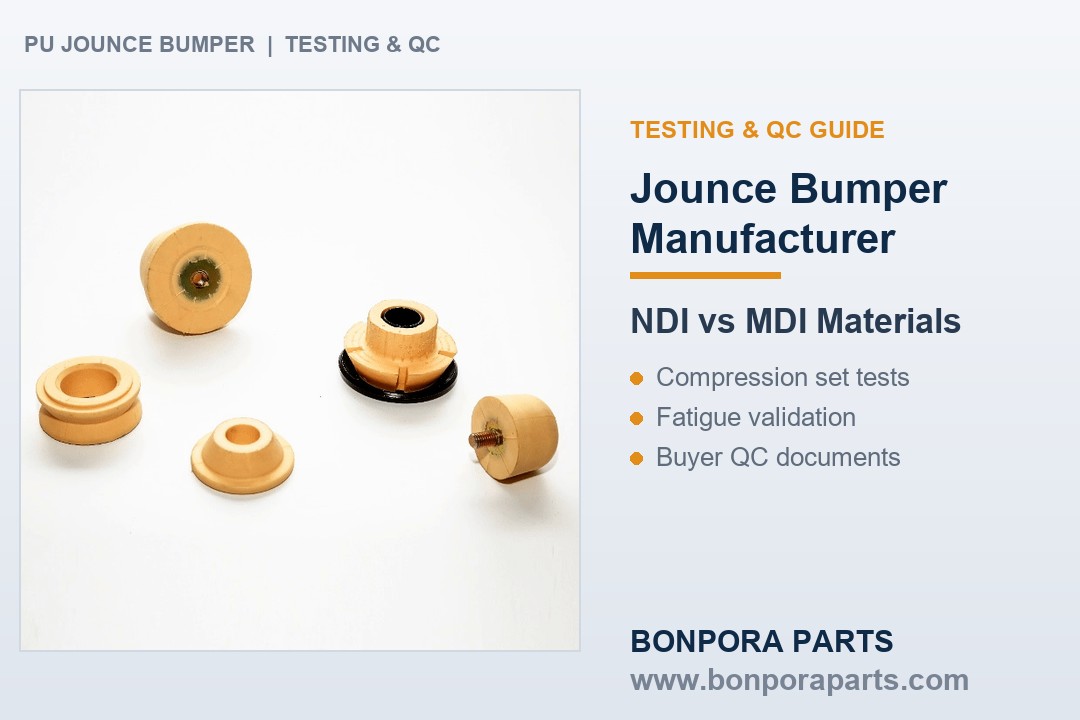
Jounce Bumper Manufacturer: What Testing Reveals Before You Place an Order
A jounce bumper (缓冲限位块), also called a compression bump stop, is the last line of defence inside a suspension strut. When the wheel hits a deep pothole and the damper reaches full compression, this small polyurethane component absorbs the residual energy so that metal never meets metal. The microcellular polyurethane bump stop has replaced crude rubber blocks on most modern platforms because it combines progressive damping with long service life. For importers and aftermarket brands, however, the difference between a good jounce bumper and a poor one is invisible on the surface. It only shows up in testing, which is why the testing capability of a jounce bumper manufacturer deserves as much attention as its price list.
This guide walks through what a qualified polyurethane jounce bumper manufacturer actually tests, how NDI and MDI material systems are matched to working conditions, and which documents a buyer should request before committing to an order.
What the Jounce Bumper Does Inside the Strut Assembly
On a MacPherson strut or a twin-tube damper, the assembly stack around the jounce bumper looks like this: the piston rod (活塞杆) carries the piston ring (活塞环) and the valve plates (阀片) that meter oil flow, while a nitrogen gas bladder (氮气气囊) compensates for rod displacement. Around the rod sit the dust cover (防尘罩) and the shock guard (减震护罩), which block abrasive media from the rod seal. At the top of the travel, the spring seat (弹簧座) supports the coil, and near full compression the jounce bumper engages on the rod to limit travel softly.
When the bumper works correctly, the driver feels a firm but progressive end-of-travel stop. When it fails, the symptoms are harsh clunking over sharp impacts, accelerated seal wear, bent piston rods and, in severe cases, damaged strut mounts or chassis brackets. A failed bumper can also silently shorten damper life, because every bottoming-out event transfers full impact load into the shock absorber parts (减震器配件) that were never designed to take it. That system-level role is why chassis engineers treat the bumper as a tuning part, not a filler.
Why Testing Separates a Real Manufacturer from a Trader
Microcellular polyurethane looks the same from the outside whether it is formulated well or badly. Both versions can be moulded into the same shape, painted the same colour and packed in the same box. The differences live in the cell structure, the polymer network and the curing discipline of the production line, and none of these can be judged by eye. A genuine manufacturer proves quality with instruments: density meters, durometers, compression set fixtures, fatigue rigs and temperature chambers. A trading company can only forward samples and repeat whatever the molders report.
For buyers, this has a practical consequence: ask every candidate supplier to describe its in-house test equipment and to explain the numbers on its test reports. The answers reveal within minutes whether you are dealing with a factory that controls its own process or an intermediary that controls only the paperwork.
Material Selection: NDI vs MDI Microcellular Polyurethane
The 聚氨酯缓冲块 (NDI、MDI) systems are the two premium chemistry routes for jounce bumpers. They are not interchangeable, and a capable manufacturer matches the system to the working condition rather than defaulting to whichever is cheaper.
| Criterion | NDI elastomer | MDI elastomer |
|---|---|---|
| Rebound and heat build-up | Very high resilience, low hysteretic heating under repeated impact | Good resilience, moderate heat build-up |
| Best working condition | Heavy-load and high-frequency impact: trucks, SUVs, commercial vehicles, rough-road markets | Passenger cars with moderate duty cycles, balanced cost and performance |
| Compression set behaviour | Excellent recovery after sustained compression | Good, tuned by density and cure schedule |
| Processing window | Narrow, demands gravimetric metering and strict casting discipline | Wider, suits high-volume moulding |
| Typical catalogue use | Premium jounce bumpers, truck bump stops | Passenger bump stops, spring seats, dust cover kits |
Density is the second lever. Microcellular PU bump stops usually sit between 0.45 and 0.70 g/cm3, and the stiffness curve of the finished part is tuned by combining density with hardness. A reputable supplier declares both values per part number instead of selling one anonymous universal compound.
Laboratory Tests Every Production Batch Should Pass
Serial production quality is proven in four core tests. Any supplier that skips them is asking the buyer to become the test laboratory.
Density and hardness verification
Density is measured per batch with standardized specimens cut from production, because it directly controls the energy absorption curve. Hardness is checked with a Shore durometer on the moulded part. Together they confirm that the metering ratio and foaming process stayed inside specification. A drift of a few percent in density is often the earliest visible sign that a mixing head or a mold temperature controller needs attention.
Compression set
Compression set measures how much permanent deformation remains after the material is held compressed at elevated temperature for a standard period. For a jounce bumper this is the single most predictive laboratory test: a bumper with poor set behaviour flattens within months, loses its travel reserve and lets the strut hit metal. Low-grade material often passes a first-day hardness check yet fails compression set badly.
Resilience and heat build-up
Under repeated impacts, hysteretic losses inside the polymer turn into heat. A ball-rebound test quantifies resilience, and a dynamic cycling test tracks temperature rise. NDI compounds keep their rebound at low heat build-up, which is why they dominate heavy-duty applications. A bumper that heats up excessively stiffens, ages faster and can eventually crack at the mounting boss.
Ageing and temperature cycling
Jounce bumpers work from arctic winters to desert summers. Ageing chambers expose specimens to elevated temperature and ozone-like conditions, and temperature cycling moves parts between cold and hot extremes. The pass criteria are small hardness drift, no surface cracking and stable dimensions. Parts that pass fresh but fail after ageing will generate warranty claims two winters later, long after the shipment has been paid for.
Dynamic Validation: From Fatigue Rig to Vehicle Fitment
Laboratory tests characterise the material; dynamic validation characterises the part.
Fatigue cycling on the rig
A finished bumper is compressed at representative stroke and frequency for tens or hundreds of thousands of cycles, then inspected for height loss, cracking and bond integrity around any metal insert. Well-formulated microcellular PU retains most of its height and stiffness after the cycle count that simulates a realistic service life. Fatigue data, expressed as height retention after a defined cycle count, is the number buyers should compare between suppliers.
Fitment and vehicle-level checks
A bumper must match the rod diameter, the dust cover inner profile and the available travel of the specific strut. Qualified manufacturers trial-mount first articles with real damper parts and check engagement, clearance at full extension and progressive feel through the stroke. On the vehicle level, repeated full-compression events on test track confirm that noise and harshness stay acceptable. This is the same fitment-first logic that governs chassis and suspension parts (底盘悬挂件) such as steering tie rods (转向拉杆), where interface geometry matters as much as material strength.
Quality Documentation a Buyer Should Request
Test capability only helps the buyer if it is documented. The following checklist converts testing claims into verifiable paperwork.
| # | Document | What good looks like |
|---|---|---|
| 1 | Batch test report | Density, hardness and compression set per lot, with specimen details and test methods stated |
| 2 | Material declaration | NDI or MDI system declared, density and hardness ranges stated per part number |
| 3 | Fatigue summary | Height and stiffness retention after a defined number of compression cycles |
| 4 | Dimensional report | Critical dimensions measured on first articles and periodically in serial production |
| 5 | Fitment validation record | Trial mounting with actual strut parts, not only gauge checks |
| 6 | Traceability | Date or lot codes on the part or packaging linking any claim back to production records |
Documents also protect the buyer commercially. When two quotations differ by a double-digit percentage, the cheaper supplier almost always lacks one or more rows in this table, and the missing rows describe exactly the risks the buyer would absorb.
Common Failure Modes and the Tests That Catch Them
Permanent flattening in service: caused by poor compression set or under-dimensioned material; caught by compression set and fatigue testing.
Cracking at the mounting boss: caused by high heat build-up or voids in the microcellular structure; caught by dynamic cycling and density verification.
Harsh engagement feel: caused by a stiffness curve that is too abrupt; caught by progressive load-deflection testing and vehicle fitment.
Loose or rattling fit on the rod: caused by tolerance drift in the bore; caught by first-article dimensional reports and trial mounting.
Early hardening after one or two winters: caused by inadequate ageing resistance; caught by heat ageing and temperature cycling.
Reading failures this way in reverse is a useful negotiation tool: ask the supplier which specific test in its programme prevents each mode. Confident, specific answers indicate a factory that has seen and solved these problems on its own line.
From Sample Approval to Serial Production
Once testing and fitment are agreed, the development path for a custom jounce bumper is short and well defined. The custom parts development workflow runs through five stages: drawing or sample review, material and density selection against the working condition, prototype tooling with first-article measurement, customer validation, then serial production with cavity-level inspection and batch testing. Buyers who supply the mating rod diameter, dust cover profile and available travel get the most accurate first article, because the bumper can be tuned to the real interface instead of nominal dimensions.
Minimum order quantities for custom mouldings are typically modest once tooling exists, and reorders run against retained formulations and lot records, so consistency does not depend on the memory of any individual engineer. This matters for aftermarket brands whose catalogue lives for a decade or more.
Source Jounce Bumpers Together with the Neighbouring Parts
Replacement demand rarely arrives as a single part. When a strut is opened for service, workshops commonly find an aged bumper, a cracked dust cover and a tired spring seat at the same time. Sourcing the whole service kit from one manufacturer keeps the material feel and the quality system consistent across the kit. Bonpora Parts and Components Co., Ltd. (邦博润(北京)汽车零部件有限公司) produces polyurethane bump stops in NDI and MDI grades alongside a full shock absorber parts and chassis and suspension line covering European, American, Korean and Japanese mainstream platforms, and supports drawing-based and sample-based custom development for OEM and private-label programmes. Bump stops, spring seats, rebound bumpers, nitrogen gas bladders and dust covers are developed and batch-tested on the same quality system, which simplifies qualification for buyers who prefer a single-source programme.
Frequently Asked Questions
Q1: What is the difference between a jounce bumper and a rebound bumper?
A jounce bumper controls compression travel, absorbing the final impact when the strut bottoms out. A rebound bumper limits extension travel and is usually a lighter part mounted on the rod or inside the dust cover. Both are made from microcellular polyurethane, but their stiffness curves and densities are tuned differently, so they are specified as separate part numbers.
Q2: Can I order custom jounce bumpers without an original part number?
Yes. Suppliers work routinely from drawings, physical samples, or even the mating strut parts themselves. Providing the rod diameter, dust cover inner profile, available travel and the vehicle working condition is enough to start engineering; the manufacturer then proposes material system, density and hardness and confirms them with first articles.
Q3: How can I verify test reports before committing to an order?
Ask which equipment produced each number, request the test method references, and cross-check one or two values yourself on received samples with a local laboratory. A manufacturer with in-house testing answers these questions fluently; hesitation or vague method descriptions are a clear signal to audit more deeply before mass production.
Q4: Which material should I choose for a heavy-duty pickup programme?
For trucks, SUVs and vehicles used on rough roads with high payload, NDI-based microcellular polyurethane is usually the better match thanks to its high resilience and low heat build-up under repeated impacts. For passenger cars with moderate duty cycles, a well-tuned MDI compound balances cost and performance. State the working condition to the supplier and let the declared density and hardness data drive the final choice.
- Prev.:Polyurethane Spring Seat Manufacturing Guide
- Next.:Strut Bump Stop for Mazda BT-50 | Buyer Guide