
- 1. Why the Mazda BT-50 Deserves a Dedicated Bump Stop Spec
- 2. Three Generations of BT-50 Suspension
- 3. Cross-Reference Buying: The Right Way and the Wrong Way
- 4. Duty Cycles: Where BT-50 Bump Stops Work Hardest
- 5. Microcellular Polyurethane vs Rubber
- 6. NDI vs MDI: Choosing the PU Grade
- 7. Dimension Matching Checklist Before You Order
- 8. Related Parts to Inspect at the Same Time
- 9. How Bonpora Supports BT-50 and Mixed-Fleet Programmes
- 10. Frequently Asked Questions
- 11. Get a Quotation for Your BT-50 Programme
Strut Bump Stop for Mazda BT-50 | Buyer Guide
Why the Mazda BT-50 Deserves a Dedicated Bump Stop Spec
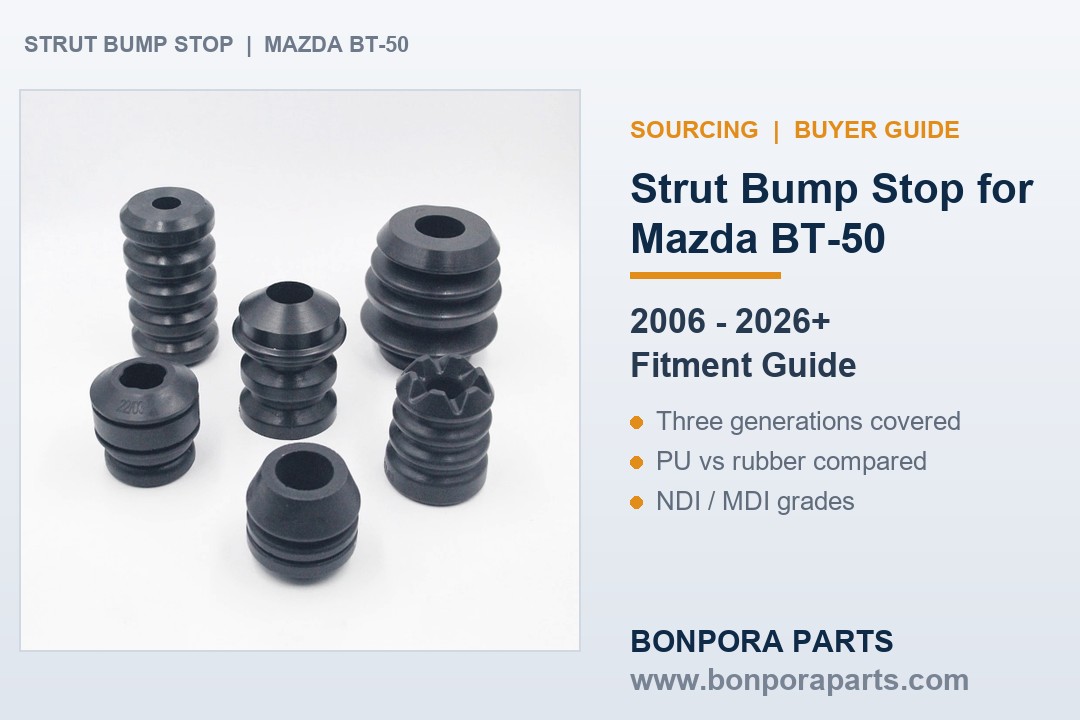
The Mazda BT-50 is one of those pickups that looks simple on a parts catalogue page and turns complicated the moment you handle real orders. It has been built on two completely different platforms during its life, it is sold across Australia, Southeast Asia, Latin America, Europe and the Middle East, and fleet buyers routinely mix first, second and third generation trucks in the same yard. For importers and distributors, the practical question is straightforward: which strut bump stop for Mazda BT-50 fits which build year, and how should the part be specified before a purchase order is signed? This guide works through the three generations, the cross-referencing logic, the material decision between microcellular polyurethane grades, and the dimension checks that keep warranty claims off your desk.
First, a quick reminder of what the part does. The bump stop — also called a jounce bumper or 缓冲限位块 — is the final cushion in the suspension travel. When the strut bottoms out under payload, a pothole or an off-road hit, the stop compresses progressively and absorbs the energy the damper cannot. A worn, hardened or wrongly sized stop lets the spring seat strike metal, hammers the piston rod (活塞杆) and top mount, and shows up in the workshop as harsh clunking complaints. In the markets where BT-50s work hardest — mine sites, farms, unpaved rural routes — this small foam part is effectively a consumable.
Three Generations of BT-50 Suspension
First Generation (2006–2011): Ford Ranger Derived Platform
The original BT-50 shared its platform with the Ford Ranger of the same era. The front end uses an independent double wishbone layout with torsion bars on many variants, and the rear is a rigid axle on leaf springs. In this architecture the front bump stop is a separate cylindrical or tapered microcellular pad mounted on the frame or control arm strike zone, and the rear uses its own rectangular jounce bumper between axle and frame. Replacement parts for this generation are defined by mounting style, free height and taper geometry rather than by any strut-integrated package, so dimension checks matter more than catalogue photos.
Second Generation (2011–2020): Isuzu D-Max Platform
From 2011 the BT-50 moved to the Isuzu D-Max platform, with independent double wishbone front suspension and coil-over strut assemblies. The front bump stop sits inside the strut package, typically as a cellular rod or ring around the piston rod, working together with the dust cover (防尘罩) that shields the rod and seal. The rear remains a leaf-sprung rigid axle with a frame-mounted jounce bumper. Suspension parts for this generation cross-reference heavily with the contemporary D-Max, which is exactly why careful part number verification — discussed below — becomes essential.
Third Generation (2020–present): Latest D-Max Architecture
The current BT-50 continues on the newest D-Max architecture. The front strut package is again MacPherson-type with a coil spring seat (弹簧座) integrated into the top mount, and the stop is specified together with the boot and internal damper hardware. Although the layout looks similar to the previous generation at first glance, mounting interfaces and stop dimensions changed, and the two generations are not interchangeable. Distributors should treat 2011–2020 and 2020+ as separate product lines even though the vehicle badge is the same.
Cross-Reference Buying: The Right Way and the Wrong Way
Because BT-50 and D-Max share platforms, many aftermarket catalogues list one part number for both nameplates — and for the most part that is legitimate. The wrong way, however, is to assume that sharing means every chassis part transfers automatically. A disciplined cross-reference workflow looks like this:
Verify by OE number, not by silhouette. Two stops can look identical and differ in density, hardness or stem length. Confirm the OE reference on both vehicles before treating them as one SKU.
Check the build-year cutoff, not the registration year. A truck registered in 2021 may be a run-out second generation; VIN or chassis prefix confirmation avoids the most common mis-ship.
Treat market variants separately. BT-50s built for different regions can carry different payload and suspension options; heavy-duty variants may use taller or stiffer stops than base models.
Sample-verify dimensions before bulk orders. Free height, diameter, mounting hole and stem measurements against a physical sample take minutes and prevent container-scale returns.
Suppliers who maintain genuine application engineering behind their catalogue — rather than copying numbers between nameplates — are worth their price premium on mixed-fleet programmes.
Duty Cycles: Where BT-50 Bump Stops Work Hardest
Specifying a strut bump stop for Mazda BT-50 fleets is less about the badge and more about the duty cycle. Australian outback and mining-spec trucks see sustained corrugated roads and repeated full-compression events, which punishes the stop with heat build-up. Southeast Asian and Latin American urban-rural mixed use produces fewer extreme hits but far more total cycles in hot, humid conditions where aging resistance matters. Cold-climate European or high-altitude South American use adds low-temperature stiffness to the list. Each of these profiles pushes the material decision in a slightly different direction, which is why a supplier offering more than one PU grade — instead of a single universal compound — gives the buyer real options.
Microcellular Polyurethane vs Rubber
Quality original-equipment and aftermarket bump stops use microcellular polyurethane (微孔聚氨酯), a closed-cell elastomer foam whose cells collapse progressively under load. Compared with conventional rubber stops, the differences are decisive in exactly the conditions BT-50s face:
| Property | Microcellular PU | Conventional Rubber |
|---|---|---|
| Load–deflection curve | Progressive; energy absorbed across the full stroke | Stiffens abruptly near full compression |
| Low-temperature behaviour | Stays compliant in cold climates | Hardens and transmits harsh impacts |
| Compression set | Low; recovers shape after repeated hits | Permanent flattening over time |
| Heat build-up under repeated loading | Controlled with the right grade | High; accelerates degradation |
| Weight and aging resistance | Lighter; strong ozone and aging resistance | Heavier; surface cracking possible |
For a BT-50 running corrugated outback tracks, the progressive curve of microcellular PU protects the strut internals and the cabin ride quality together; for cold regions, the low-temperature compliance alone usually settles the decision.
NDI vs MDI: Choosing the PU Grade
Within polyurethane chemistry, the isocyanate system sets the performance envelope. Bonpora manufactures 聚氨酯缓冲块 (polyurethane bump stops) in both NDI-based and MDI-based systems, so a single supplier can serve different duty tiers:
| Attribute | NDI-based PU | MDI-based PU |
|---|---|---|
| Heat build-up resistance | Excellent; suits mining, haul roads, repeated heavy hits | Moderate |
| Dynamic load capacity | Higher; retains damping under sustained abuse | Good for standard duty |
| Cost position | Higher raw material cost | More economical |
| Typical use | Mining and heavy-duty fleets, off-road kits | Standard road-use replacement, volume programmes |
A practical sourcing rule: NDI for BT-50 fleets on sustained heavy payloads and rough roads, MDI for standard replacement volumes where landed cost is the priority. Offering both tiers from one quality system simplifies your supplier base and your incoming inspection.
Dimension Matching Checklist Before You Order
Dimensional mismatch is the most common cause of bump stop warranty claims. Before confirming a purchase order, check:
| Check | Why It Matters |
|---|---|
| Free height and diameter | Wrong height shifts the engagement point; oversize diameter prevents seating in the retainer |
| Mounting interface (stem / press-in / retainer ring) | Generations use different mounting styles; assume nothing across model years |
| Stem diameter and length | Loose fit causes rattle; over-length preloads the stop and shortens life |
| Density and hardness grade | Defines the load–deflection curve; match OE or fleet specification |
| Cross-referenced OE numbers | Confirms application coverage, especially for shared-platform D-Max parts |
Send the checklist to your supplier with the enquiry. A manufacturer with in-house tooling and application data will answer it line by line; a trader will not.
Related Parts to Inspect at the Same Time
The bump stop never fails in isolation, and a professional distributor sells the whole strut package rather than a lone foam part:
Dust cover (防尘罩) and shock absorber boot (减震护罩): a torn boot lets grit attack the piston rod, seal wear follows, strut travel changes and the stop gets hit more often.
Spring seat (弹簧座): a deformed seat tilts the spring and loads the stop unevenly, causing side wear and premature failure.
Damper internals — piston ring (活塞环) and valve plate (阀片): worn internals reduce damping, so the strut reaches full compression far more frequently and the stop becomes the only working damper.
Nitrogen gas chamber (氮气气囊): lost gas pressure in gas-charged struts weakens rebound control and again transfers impact energy into the stop.
Steering tie rod (转向拉杆) and ball joints: harsh bottom-out events feed shock loads into steering components; repeated failures here often trace back to a collapsed bump stop.
This is why Bonpora supplies bump stops within a complete shock absorber parts and chassis suspension programme — replacing the stop while ignoring a leaking boot or a weak strut simply moves the failure to the next component in the line.
How Bonpora Supports BT-50 and Mixed-Fleet Programmes
Bonpora (邦博润) manufactures microcellular PU bump stops in NDI and MDI grades, alongside shock absorber parts, chassis and suspension components and precision metal parts, covering European, American, Korean and Japanese vehicle applications including the BT-50 and its platform relatives. For distributors building a dedicated BT-50 line, two services matter most. First, catalogue coverage with verified OE cross-references across all three generations, supported by dimension sheets that match the checklist above. Second, custom development: send a drawing or a sample — 来图来样定制 — and the engineering team can reproduce or improve the part, from tooling through batch inspection, under OEM private label if required. For fleet customers, matched kits of bump stop, dust cover and spring seat reduce part numbers and simplify inventory.
You can browse the product ranges on the product centre, review the dedicated polyurethane bump stop category for NDI and MDI grade details, and read about the custom parts development process for sample-based projects. For complete strut hardware, see the shock absorber parts programme.
Frequently Asked Questions
Are BT-50 and D-Max bump stops the same part?
On shared-platform generations many suspension parts cross-reference between the two nameplates, and quality suppliers list verified equivalents. However, trim, payload and market variants can change stop height or density. Always confirm by OE number and dimension sample rather than by appearance alone.
How often should bump stops be replaced on a BT-50?
There is no fixed interval; replacement is condition-based. Inspect for compression set, surface cracking or collapsed sections at every damper or boot service. Fleets on corrugated or mine roads should check at shorter intervals, since heat build-up and repeated full-compression events age the foam faster.
Which grade should I stock, NDI or MDI?
Match the grade to your customer base. MDI suits standard road-use replacement where cost matters; NDI suits mining, heavy payload and off-road fleets where heat build-up resistance pays for itself. Stocking both lets one catalogue serve retail and fleet tiers.
Can Bonpora produce a bump stop from a used sample only?
Yes. Sample-based development is a core service: the part is measured, material-grade analysed, tooled and validated in-house, with batch inspection documentation supplied with production. Finished parts can carry your own brand under private label terms.
Get a Quotation for Your BT-50 Programme
Whether you need catalogue replacement stops across the three BT-50 generations, NDI-grade parts for mining-spec fleets, or a private label line developed from your sample, the Bonpora team can quote from a part number, a drawing or a physical sample. Send your requirement through the website contact form and receive application-matched recommendations, dimension sheets and batch documentation with your offer.
- Prev.:Jounce Bumper Manufacturer: Testing and QC Guide
- Next.:Shock Absorber Valve Plate Manufacturing Guide