sales@bonporaparts.com
0086-10-64988621
English
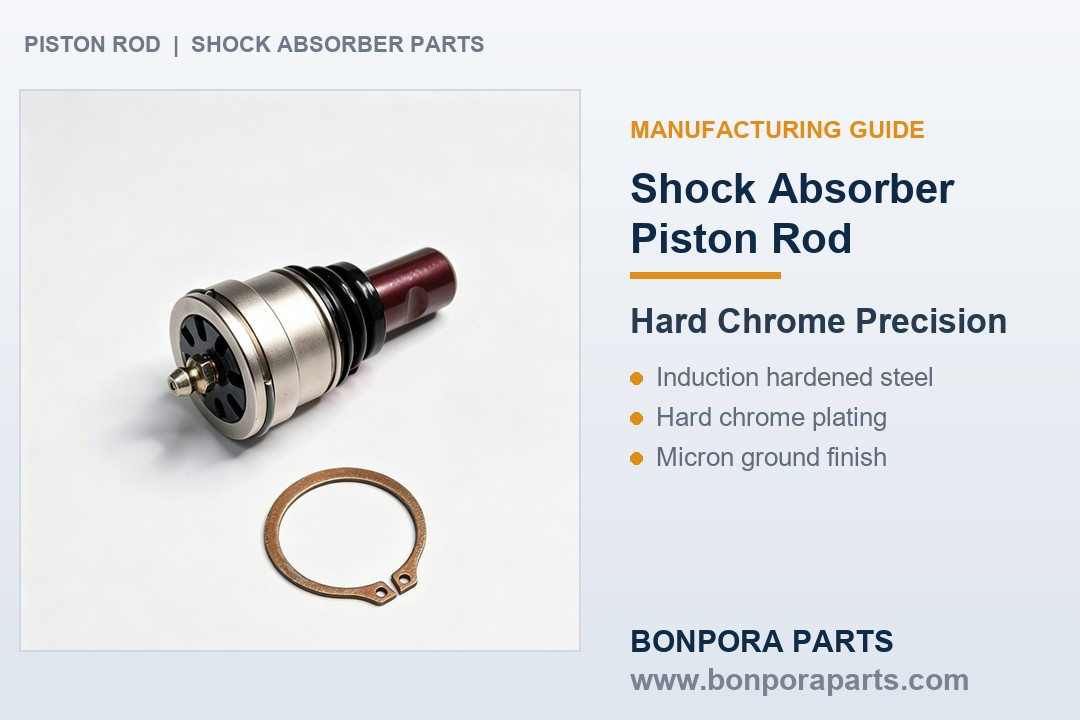
A telescopic damper can only control a wheel as well as its moving parts allow, and no part moves more, seals harder, or fails more visibly than the piston rod. For importers, distributors and aftermarket brands, understanding how a shock absorber piston rod is made is not academic: rod material, surface hardness and finish quality decide whether a damper survives 60,000 km of corrugated gravel roads or starts leaking after one winter. This guide walks through the full manufacturing chain of shock absorber piston rods and piston assemblies, the specification parameters that matter when comparing suppliers, and the QC checks that separate a reliable shock absorber parts manufacturer from a reseller with a catalogue.
Inside a twin-tube or mono-tube damper, the piston rod connects the piston to the suspension arm or strut mount. Every bump input the wheel sends upward passes through this rod before it reaches the valving inside the damper. The rod performs three jobs at once:
Force transmission. It carries the full compression and rebound load between the piston and the chassis interface, alternating between tension and compression millions of times over the service life of the damper.
Precision guiding. The rod surface is the running track for the rod guide bushing and the oil seal. Its roundness, straightness and surface roughness directly control seal wear and oil leakage.
Corrosion barrier. The rod is the only major damper component permanently exposed to spray, salt and stone impact. Once the protective chrome layer is compromised, rust wipers destroy the seal within weeks.
Because the rod sits at an angle in many strut layouts, it also takes significant side loads. This is why a bent or under-hardened rod is one of the most common root causes behind noise, uneven tire wear and premature damper failure reported in the field.
Sourcing teams frequently mix up three related terms, which leads to wrong inquiries and misquoted prices. In a complete damper cartridge:
The piston rod (活塞杆) is the polished, chrome-plated shaft described in this guide.
The piston is the disc fixed to the end of the rod. It carries the valve stack: thin spring steel valve plates (阀片) arranged as compression and rebound shim stacks, plus a PTFE piston ring (活塞环) that seals against the inner tube wall.
Above the piston sits the rod guide with its oil seal, and in gas-charged designs the nitrogen gas chamber (氮气气囊) that keeps oil under pressure and suppresses foaming.
Outside the working tube, a dust cover (防尘罩) or shock absorber boot (减震护罩) shields the rod from grit, while a polyurethane bump stop (聚氨酯缓冲块, made in NDI or MDI grades) acts as the final cushioned travel limiter. When you inquire about piston rods, state clearly whether you need the rod alone, a piston rod assembly with piston and valving, or a complete cartridge.
Damper rods start as cold-drawn steel bar. The base material sets the ceiling for everything that follows: heat treatment response, straightness stability and fatigue strength. Typical choices include:
| Material | Type | Typical Use | Key Characteristic |
|---|---|---|---|
| C45E / S45C | Medium-high carbon steel | Passenger car rods, mainstream aftermarket | Good induction hardening response, stable cost |
| 40Cr | Chromium alloy steel | Heavy-duty and commercial vehicle rods | Higher core strength and hardenability |
| 42CrMo | Cr-Mo alloy steel | Off-road, performance and truck dampers | Best fatigue resistance under high side loads |
A serious manufacturer will declare the steel grade on the drawing and keep mill certificates traceable by heat number. If a quotation cannot name the base steel, treat that as a screening signal.
The rod surface must resist wear from the seal and guide bushing, which is why the bar is induction hardened after rough machining. The surface layer is rapidly heated and quenched to a typical hardness in the HRC 55 to 60 range, with a hardened case depth commonly between 1 and 2.5 mm, while the core stays tougher to absorb impact. An under-hardened surface wears into an egg-shaped profile that no seal can follow; excessive case depth, on the other hand, makes the rod brittle against stone impact.
After grinding, the rod receives a hard chrome layer, typically in the 10 to 25 micron range depending on application and market requirements. The chrome adds corrosion resistance and an extremely hard, low-friction running surface. Quality here depends on pre-plating cleanliness, bath control and post-plating polishing. The finished roughness usually targets Ra values at or below 0.1 micron on passenger car rods, because seal lip life falls steeply as roughness rises. Chrome micro-cracks or porosity that looks cosmetic on the bench becomes a rust path in salt-spray regions.
From raw bar to packed rod, a disciplined production line follows these stages:
Bar preparation. Cold-drawn bar is cut to length, end-faced and center-drilled. Consistent incoming straightness at this stage reduces downstream correction work.
CNC machining. Threaded ends, wrench flats, circlip grooves and welding journals are turned. For cartridge designs, the rod may be welded to a piston-end fitting; weld penetration and concentricity are inspected 100 percent on safety-relevant lines.
Induction hardening and tempering. Surface hardening as described above, followed by a low-temperature temper to relieve stress and stabilize the microstructure.
Cylindrical grinding. Rough and fine grinding bring the diameter into final tolerance and the runout under control. Straightness is commonly verified with a runout limit at the level of a few hundredths of a millimetre over the full length.
Plating, polishing and final inspection. Hard chrome plating, followed by superfinishing or belt polishing to target roughness, then cleaning, rust-preventive oiling and visual inspection under defined lighting.
Each stage has measurable outputs. Ask suppliers which parameters are inspected in-line and which are sampled per batch, and request those records with every shipment.
| Parameter | Typical Range | Why It Matters |
|---|---|---|
| Rod diameter | 12 mm to 45 mm | Must match rod guide, seal and piston bore sizes |
| Surface hardness | HRC 55 to 60 | Controls seal and bushing wear life |
| Chrome thickness | 10 to 25 microns | Corrosion protection vs. brittleness balance |
| Surface roughness | Ra 0.1 micron or lower | Directly drives oil seal life |
| Straightness / runout | Per drawing, commonly under 0.05 mm/m | Prevents seal wander and rod bending noise |
| Corrosion test | Neutral salt spray per agreed hours | Predicts performance in coastal and winter-salt markets |
Use these values as a framework rather than universal rules. The correct specification always depends on the vehicle platform, the market climate and the damper architecture, so the safest route is to share the original part drawing or a sample and let the manufacturer quote against measured data.
A perfect rod cannot rescue a badly built piston assembly. When sourcing rods together with pistons, verify how the supplier controls the valving stack: shim thickness, diameter, temper and slot geometry of the valve plates, the preload set by the valving nut, and the fit of the PTFE piston ring against the working tube. In gas-charged designs, confirm the nitrogen charging method and pressure window, because an under-charged nitrogen gas chamber allows oil foaming and fades damping under hard use. Assembly torque, circlip seating and thread locking should all be process-controlled, not left to operator habit. A manufacturer that produces rods, pistons and valve shims in-house can tune these elements together, which is a genuine advantage for buyers seeking consistent rebound and compression characteristics across a product family.
Bent rod. Usually caused by side loads beyond the design envelope, severe impact events, or insufficient core strength. Check straightness data, not only hardness.
Chrome pitting or flaking. Root causes include poor pre-plating preparation, bath contamination or excessive thickness. Inspect returned parts under magnification before blaming the seal supplier.
Oil leakage at the seal. Frequently traceable to roughness above specification, grinding burns, or a rod guide seal that was never matched to the rod finish.
Rust under the boot. A torn dust cover lets abrasive grit turn the rod into a grinding lap. Always pair rod replacement with boot inspection.
Damping fade. Often a valving or gas charge issue rather than a rod issue, which is why complete-assembly testing matters during development.
Before placing a first order, request and review the following documentation from your supplier:
| Check Item | Document or Test | Frequency |
|---|---|---|
| Base steel grade | Mill certificate with heat number | Every batch |
| Surface hardness | HRC report on hardened case | Every batch |
| Chrome thickness | Cross-section or eddy-current measurement | Per plating lot |
| Roughness and runout | Ra and dial-gauge runout records | Per batch, sampled |
| Corrosion resistance | Neutral salt spray test report | Periodic, per agreement |
| Endurance | Dynamic seal and rod durability bench test | Per new design approval |
| Packaging | Rod protection tubes, oiling, moisture barrier | Every shipment |
Rods are finished parts, not forgings: a single scratch across the chrome during packing can undo every upstream quality investment, so packaging inspection belongs in your incoming checks too.
The piston rod is the chrome-plated shaft that moves in and out of the damper and carries the load to the suspension. The piston is the disc fixed to the rod end that houses the valve plates and piston ring and meters oil flow through the valving. They are separate components, usually quoted and replaced as a matched assembly.
The chrome layer provides the hard, smooth, corrosion-resistant surface on which the oil seal runs. Without adequate hardness, thickness and finish, the seal wears rapidly, oil leaks out and the damper loses its damping force well before its design life.
Yes. Many buyers source rods and piston assemblies separately for cartridge repair programs. Provide the OE reference, tube inner diameter, rod diameter and valving requirements, and the manufacturer can match components or develop equivalents based on your drawings or samples.
The minimum set is the OE number or original drawing, rod diameter and length, end fitting details, target vehicle applications and any market-specific corrosion requirements. With a sample, the manufacturer can reverse-measure and confirm all critical dimensions before tooling.
Bonpora (Beijing) Auto Parts Co., Ltd. manufactures and supplies four product families for the European, American, Korean and Japanese vehicle aftermarket: polyurethane bump stops in NDI and MDI grades, shock absorber parts, chassis and suspension components, and precision metal parts. Our piston rods, pistons, valve plates and related components are produced under controlled processes with full material traceability, and we support both standard catalog references and fully custom development from customer drawings or samples.
Explore our range of shock absorber parts and chassis and suspension components, or browse the complete product center to see how the parts work together. To request a quotation for custom piston rods or complete damper assemblies, send us the OE number, your drawing or a physical sample, and our engineering team will respond with a detailed proposal and sample plan.
