sales@bonporaparts.com
0086-10-64988621
English
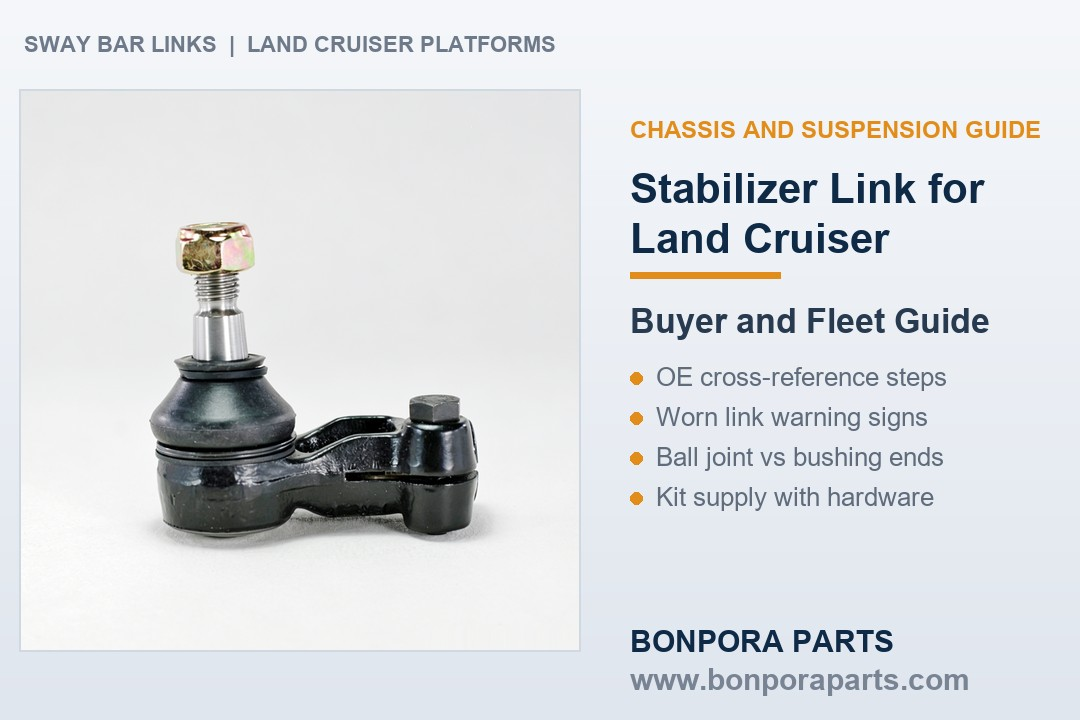
The Toyota Land Cruiser has earned its reputation on every continent, from mine sites in Australia to safari fleets in East Africa to family driveways in the Gulf. Fleets keep them running past 300,000 km, which means the chassis hardware underneath gets replaced several times over the life of the vehicle. One of the most frequently ordered steering and suspension items in that mix is the stabilizer link, also called the sway bar link or drop link (稳定杆连接杆). This guide explains what the part does on Land Cruiser platforms, how to match it by OE number, what separates a good replacement from a short-lived one, and how importers can source it alongside related chassis parts such as the polyurethane jounce bumper and shock absorber components.
The stabilizer bar (anti-roll bar) is a torsion spring mounted across the axle or subframe. When one wheel rises relative to the other, the bar twists and resists body roll. The stabilizer link is the mechanical bridge between the end of that bar and the strut, knuckle, or axle bracket. On a Land Cruiser the link carries three jobs at once:
Transmit roll force from the suspension to the bar so body lean stays controlled during lane changes and cornering.
Allow full vertical travel of the axle without binding, thanks to a ball joint or bushing at each end.
Keep bar preload predictable so the vehicle does not pull or lean unevenly under crosswinds or loaded conditions.
Because the link moves on every bump, not only in corners, it is a wear item like a ball joint or tie rod end (转向拉杆球头). Duty cycle, not mileage alone, decides its life: a mining Land Cruiser on corrugated dirt roads may wear links three times faster than a city vehicle.
Buyers often search stabilizer links by OE number because Toyota changed layouts across generations. Knowing the platform prevents the most common ordering error: sending a front link for an independent front suspension truck to a customer with a solid axle 70 Series.
| Platform | Years | Front Suspension | Link Layout Notes |
|---|---|---|---|
| 70 Series (incl. 76, 78, 79) | 1984 to present | Live solid axle, leaf springs | Straight or slightly bent links connect the bar to the axle housing; heavy-duty versions common |
| 80 Series | 1990 to 1997 | Live solid axle, coil springs | Links attach bar to axle; longer travel demands good ball articulation |
| 100 / 105 Series | 1998 to 2007 | Torsion bar IFS (100) or solid axle (105) | 100 Series uses strut-mounted links; 105 Series keeps axle-mounted links |
| 200 Series | 2008 to 2021 | Double wishbone IFS, coil springs | Compact links with ball joints at both ends on the lower arm side |
| 300 Series | 2022 to present | Double wishbone IFS, optional E-KDSS | Links interact with hydraulic stabilizer disconnect hardware; verify variant before quoting |
Front links see the highest side loads and usually fail first. Rear links on coil-sprung models are simpler and often bushing-type. Distributors should stock front and rear positions separately rather than assuming one part covers the axle pair, and should confirm left versus right variants where Toyota distinguishes them.
Workshop complaints follow a predictable pattern. The most reported signs are:
A hollow knock or clunk over small bumps and speed humps, often from the front axle area.
Rattle that changes when the body is pushed down at each corner during inspection.
Increased body roll and slower steering response, noticeable when lane changing with a roof rack or towing.
Uneven tire wear on the shoulders after the bar stops contributing to roll control.
A failed link rarely disables the vehicle, which is why fleets defer replacement. The cost shows up later as driver fatigue, accelerated bushing wear, and inspection failures in markets where the anti-roll system is checked.
Front-end clunks get misdiagnosed constantly. Use this comparison before quoting:
| Component | Test That Isolates It | Typical Wear Evidence |
|---|---|---|
| Stabilizer link (稳定杆连接杆) | Push the body down at a corner and listen near the bar end; the clunk appears with wheels on ground | Ball stud play, torn boot, grease loss, rusted journal |
| Ball joint (球头) | Jack the wheel and check vertical versus horizontal play separately | Vertical play, boot rupture, corroded seat |
| Tie rod end (转向拉杆球头) | Rock the steering wheel and watch the joint; play moves the knuckle | Horizontal play, steering wander, feathered tire wear |
| Strut mount or bearing | Clunk heard with wheels turned while stationary | Bearing roughness, rubber separation |
Importers who serve mixed Land Cruiser fleets should treat OE cross-referencing as a process, not a guess. A workflow that holds up in practice:
Confirm model code (VDJ76, UZJ100, GRJ200 and so on), build date, and market. Gulf and Australian specifications sometimes differ in bar diameter and link length even within one generation.
Toyota stamps or casts identifying numbers on many brackets, but the fastest path is a parts catalog lookup using the chassis code and production month. Record the OE number together with installed length measured between mounting centers, since bent bars and aftermarket bars shift this dimension by a few millimeters.
Compare center-to-center length, stud thread size and pitch, ball stud taper diameter, and the offset or bend direction of the link body. A link that is 5 mm short will preload the bar and transmit noise into the cabin.
For new suppliers, fit one set on a fleet vehicle before committing to volume. Check that the ball joint articulates through full travel without contact between the link and the strut spring seat (弹簧座) or the shock absorber dust cover (防尘罩).
Stabilizer links look simple, but three details dominate service life on a heavy 4x4.
The ball stud is typically forged from medium-carbon or alloy steel, induction hardened at the seat area, then seated in a polymer or sintered bearing cup with a preload spring or washer. On corrugated roads the joint sees high-frequency reversal loads; a joint with insufficient preload will develop play within months. The sealing boot (防尘罩) is equally important: once it splits, grease washes out and the joint wears at an accelerated rate. Quality boots use reinforced EPDM or TPE compounds with a sealing lip that stays elastic across desert and cold climates.
Link bodies are cold-formed or forged steel rod, threaded at one or both ends depending on the design. Welded fittings must show full-penetration welds without undercut, because fatigue cracks start at weld toes. Zinc plating or geometric coating protects the threads; examine plating thickness on samples rather than trusting catalog photos.
Rear links and some commercial variants use bonded rubber or polyurethane bushings instead of ball joints. Polyurethane bushings resist oil, gravel impact, and compression set better in heavy-duty use, at the cost of slightly higher transmitted noise. Fleets running armored or continuously loaded vehicles often specify polyurethane for this reason, matching the material logic used in modern microcellular PU bump stops (聚氨酯缓冲块, NDI and MDI grades).
| Check Item | Method | Pass Criterion |
|---|---|---|
| Ball stud hardness | Hardness tester on sample cut or certificate review | Induction-hardened surface per drawing range; core unchanged |
| Articulation torque | Torque wrench through full sweep | Smooth, no notchy zones, within supplier declared range |
| Boot material and fit | Bend and inspect lip contact | Continuous lip contact, no flash blocking the seal |
| Thread quality | Go and no-go gauge on stud and nut | Full engagement without slop; nut turns by hand to seating |
| Length and offset | Caliper against OE sample | Within declared tolerance, bend direction correct per side |
| Coating | Visual plus thickness gauge | Uniform plating, threads covered, no bare weld zones |
| Hardware completeness | Kit contents check | Nuts, washers, cotter pins or lock plates included as specified |
When a Land Cruiser arrives at a workshop for clunk diagnosis, several adjacent items are usually at or near the end of life. Importers who bundle these lines win the whole repair order instead of one SKU:
Stabilizer link kits with hardware, both axles and both sides where applicable.
Lower ball joint kits with snap rings, castle nuts, and cotter pins.
Strut bump stops and rebound bumpers in microcellular polyurethane, matched to NDI or MDI grade by climate and load.
Shock absorber dust covers and boots that protect rods and joints from grit.
Spring seats and isolators that quiet the coil spring interface.
This bundling mirrors how the parts age together on the vehicle: dust intrusion and hard compression events stress the link boots, the jounce bumper, and the ball joint seals in the same service window.
Beyond catalog replacement parts, Bonpora supports buyers who need application-specific development. The company produces polyurethane bump stops in NDI and MDI microcellular grades, shock absorber parts, chassis and suspension components, and precision metal parts, covering European, American, Korean, and Japanese vehicle platforms. Development runs from customer drawings or samples: incoming samples are measured and material-tested, tooling is quoted, first articles are verified for geometry and hardness, and batch production follows documented inspection. For stabilizer links this means buyers can request OE-number cross-references, custom lengths or stud configurations for lifted or armored Land Cruiser variants, and packaging under their own brand for private label programs. Buyers can browse the product range on the product center or review the chassis and suspension line at chassis and suspension parts.
There is no fixed interval; replacement follows inspection. On sealed-road fleet vehicles links commonly last well past 100,000 km, while vehicles on corrugated gravel may need links every 40,000 to 60,000 km. Replace links in axle pairs when one side shows play, so bar preload stays even.
Lifted suspensions change the bar angle, and adjustable-length links exist for that purpose. However, an incorrectly sized link preloads the bar, transmits noise, and can contact the spring seat at full compression. Confirm travel clearance across the full suspension stroke, and check the jounce bumper engagement at bump, before finalizing any lifted-application link.
Only where the OE design allows it. Ball joint links permit rotation in all directions and suit high-articulation front suspensions; bushing links control motion in a defined arc and are common on rear axles. Substituting one type for the other changes the force path into the bar and can cause noise or premature bushing wear.
Provide the chassis code and generation, build year and market, front or rear position, the OE number if known, and the measured center-to-center length with stud thread size. A photo of the old part with its mounting points visible shortens the confirmation cycle considerably.
Stabilizer links are low-cost parts with outsized influence on how a Land Cruiser drives and how its tires wear. Treat them as engineered items: verify platform and OE number, check ball joint preload and boot quality on samples, and stock them together with the bump stops, ball joints, and dust covers that wear in the same duty window. To discuss stabilizer links, polyurethane bump stops, or a full chassis hardware program for your market, contact Bonpora through the custom parts page with your drawings, samples, or OE references.
