sales@bonporaparts.com
0086-10-64988621
English
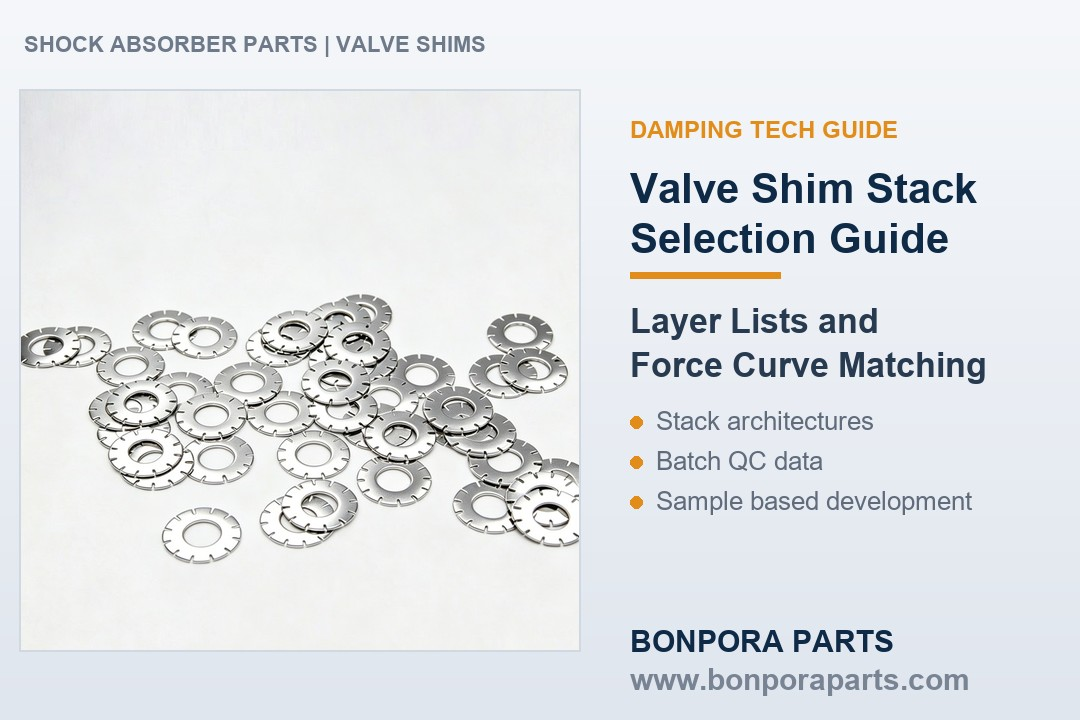
When a damper is rebuilt or a force curve has to be matched, the component that receives the most engineering attention is rarely the tube or the piston rod (活塞杆). It is the shock absorber valve shim stack (阀片堆) - the thin steel discs stacked on the piston and the base valve that open and close millimetre by millimetre of oil flow. Change one thickness in the stack and the whole force-versus-velocity curve moves. For damper rebuilders, motorsport teams and aftermarket assemblers, selecting and matching shim stacks is therefore a daily technical decision, not a catalogue lookup. This guide explains how a stack is constructed, how each parameter changes the curve, and what buyers should specify before ordering shock absorber parts from a manufacturer.
A twin-tube or monotube damper has two valve stations. On the piston (活塞), which slides inside the tube sealed by the piston ring (活塞环), separate rebound and compression stacks meter oil through the piston ports. At the bottom of the reservoir, the base valve meters compression flow and works against the nitrogen gas bladder (氮气气囊) that compensates rod displacement. Each station holds a stack: a sequence of discs, typically 0.10 to 0.50 mm thick, clamped between a valve seat and a nut or a cored piston.
The behaviour is mechanical and repeatable. At low shaft speed only the softest part of the stack deflects; as speed rises, progressively stiffer discs lift and the opening area changes. The stack is, in effect, an adjustable spring system built from washers. Around it sit the protection parts buyers already know: the dust cover (防尘罩) and shock guard (减震护罩) that keep the rod surface clean, the spring seat (弹簧座) that carries the coil, and the polyurethane bump stop (聚氨酯缓冲块, NDI/MDI grades) acting as the final jounce bumper (缓冲限位块) at full compression. The shim stack is what shapes ride quality across every millimetre between those end stops.
A typical stack combines three families of discs, and understanding their roles is the first step in selecting or specifying one.
| Disc type | Geometry | Function in the stack |
|---|---|---|
| Ported disc | Ring with large obround ports | Sets the main flow area once the stack opens |
| Notched shim | Ring with small edge notches | Provides the low-speed bleed and pre-opening flow |
| Flat shim | Plain annular disc | Adds stiffness, closes the stack, controls lift height |
| Lift / spacer disc | Thicker flat or dished disc | Limits total deflection and prevents over-stroking |
Order matters as much as thickness. Discs are usually arranged from the seat outward with the thinnest, most flexible shims against the port face so they open first, followed by stiffer shims that engage at higher pressure, and closed by a fulcrum disc or nut that defines the clamp diameter. Reversing a single notched shim changes the low-speed bleed and can turn a comfortable damper into a harsh one. Reputable suppliers therefore ship stacks as photographed, layer-numbered sets, or provide a build sheet listing each layer by diameter, thickness and orientation rather than loose mixed discs.
Buyers who can predict the effect of a parameter change hold far more productive conversations with a manufacturer. The relationships below are the working rules used in damper tuning practice.
| Parameter changed | Effect on damping force | Typical intent |
|---|---|---|
| Thinner first-stage shim | Opens earlier, softer initial slope | Comfort, small-bump control |
| Thicker first-stage shim | Later opening, firmer low speed | Body control, load carrying |
| More flat shims added | Higher mid and high-speed force | Performance and track use |
| Larger ported disc area | Lower peak force once open | Blow-off character, big-hit absorption |
| Smaller clamp diameter | Stack flexes further, softer curve | Ride tuning without new discs |
| Higher preload (stiffer top disc) | Raises cracking pressure | Delaying opening for support |
Two cautions apply. First, effects interact: clamp diameter and shim thickness together decide the effective stiffness, so single-parameter conclusions are only starting points. Second, disc quality decides whether the tuning is real - a shim with thickness variation across its surface behaves like an unpredictable extra layer, which is why batch-level flatness and thickness reports from the manufacturer matter as much for stacks as for single valve plates.
For rebuilders and assemblers, a disciplined workflow avoids the most expensive mistake - ordering discs that fit the piston but do not match the intended curve.
Define the symptom and target. Record the vehicle platform, axle, damper type and the ride or handling complaint, plus the target force curve if a dyno chart exists.
Measure the hardware. Record piston diameter, port layout, seat diameter, available stack height and the thread or nut type that clamps the stack.
Establish the baseline. List the original stack layer by layer if the damper is an original unit; if not, request a recommended baseline stack from the manufacturer for that piston family.
Choose the tuning direction. Translate the complaint into curve language: softer low speed, firmer mid range, higher blow-off, and so on.
Select thickness and orientation changes. Apply the parameter rules above, changing one variable per iteration.
Validate on a dyno or road test. Compare measured force against the target, then freeze the stack as a documented build sheet for production.
Suppliers who support this dialogue - answering with layer lists, hardness values and measured stack data rather than a box of assorted shims - are the ones whose stacks reproduce the intended behaviour batch after batch.
Beyond individual parameters, the overall architecture of the stack defines its character. Three architectures cover most damper work.
| Architecture | Construction | Curve character | Typical use |
|---|---|---|---|
| Linear (tapered) stack | Thickness decreases smoothly outward | Progressive, predictable opening | General passenger car replacement |
| Staged stack | Two clusters separated by a lift disc | Two-stage force: soft then firm | Load-adaptive and heavy-duty dampers |
| Progressive / port-assisted stack | Notched shims plus ported discs | Low bleed, high flow when open | Off-road and performance dampers |
For replacement-market production, the linear architecture dominates because it behaves close to original equipment across the widest range of vehicles. Staged stacks suit commercial vehicles where empty and laden conditions differ sharply - a delivery van or a light truck running unladen in the morning and fully laden in the afternoon. Progressive architectures are specified where large hits must be absorbed without harshness, such as rally, mining and pickup truck rear axles.
The same piston can carry very different stacks depending on the duty cycle. The table below summarises common starting points used in the aftermarket.
| Application | Stack tendency | Reason |
|---|---|---|
| Compact and mid-size passenger cars | Soft low speed, moderate mid range | Comfort priority on city roads |
| SUVs and light trucks | Firmer low speed, staged compression | Load variation and body mass |
| Commercial vans and trucks | High force levels, durable staged stacks | Payload range and continuous duty |
| Off-road and lifted vehicles | Progressive stacks, large port area | Absorbing large hits without harshness |
| Electric vehicles | Firmer low speed, controlled rebound | Battery mass and regenerative pitch control |
Whichever direction the application pulls, the surrounding parts must keep pace. A stack tuned for a loaded van still depends on a rod surface protected by an intact dust cover, a piston ring that seals consistently, and a bump stop in NDI grade where compression set resistance matters - or MDI grade where cost and moderate duty allow.
Before committing to an order, ask the manufacturer to state these items explicitly. A supplier who cannot document them will not hold stack-to-stack consistency either.
Thickness tolerance per disc, measured at multiple points, reported batch by batch in microns.
Flatness, specified and measured, since out-of-flat shims leak at unpredictable pressures.
Hardness range with per-batch test results after quench and temper.
Edge quality: burr-free sheared edges, because a die mark becomes a fatigue crack starter under millions of flex cycles.
Layer documentation: a build sheet listing diameter, thickness and orientation for every layer in the recommended stack.
Traceability: retained samples and furnace batch records linking any claim back to the production run.
Replacement demand arrives as assemblies. A workshop opening a worn damper typically finds a scored piston rod, a fatigued piston ring, aged guides, and on the suspension side a collapsed bump stop and a cracked dust cover at the same time. Distributors therefore build programmes around complete part families instead of single items. Bonpora Parts and Components Co., Ltd. supplies valve plates and shim stack components together with piston parts, nitrogen gas bladders, polyurethane bump stops in NDI and MDI grades, spring seats, dust covers and a full chassis and suspension range covering European, American, Korean and Japanese mainstream platforms. Sourcing the stack and the surrounding wear parts from one quality system keeps the rebuilt damper consistent and simplifies incoming inspection.
Shim stacks are a classic build-to-print product, and development from a drawing or a physical sample is routine work for an equipped plant. To quote quickly, the manufacturer needs three inputs: the port and seat geometry it must match, the working condition and target curve, and the annual volume. Where only a used original exists, plants offering custom development from drawings or samples can measure the sample layer by layer, rebuild the stack list, and confirm the dimension sheet before tooling. Buyers who also supply the mating piston or base-valve dimensions receive the most accurate first article, because clamp diameters and port areas can be tuned to the real interface. Development typically runs: sample or drawing review, prototype discs, dyno verification against the target curve, then production with batch-level inspection.
Yes. Measure the seat and piston geometry, count and measure the original layers by thickness, photograph both faces of each disc, and send the used stack if possible. A manufacturer offering sample-based development can reverse the layer list and confirm it in writing before production. The mating piston diameter is the single most useful dimension to include.
MOQ depends mainly on whether existing dies and standard strip can be reused. A common outer diameter with a new layer combination often runs on existing tooling at modest quantities, while a new diameter with a new port pattern requires new dies and a higher opening order. Discuss the annual volume split by damper family, since tooling cost is normally justified over the year rather than the first shipment.
Best practice is layer-numbered, size-separated sealed packs with anti-rust protection, labelled by diameter and thickness, then packed in cartons with a moisture barrier for sea freight. Because discs are thin, stacking height and pallet specification matter. Request that pack quantities match your picking sizes so sealed bags are not reopened in the warehouse.
They need to match the piston and base-valve geometry and the intended force curve, not a brand as such. Providing the mating hardware dimensions and the target behaviour lets the manufacturer select thickness, hardness and layer order to reproduce it. The same engineering dialogue applies to neighbouring parts such as piston rings and nitrogen gas bladders.
The shock absorber valve shim stack is the tuning heart of the damper: a few grams of hardened steel that decide how the vehicle rides. Successful sourcing rests on four habits - documenting the stack as a layer list rather than a loose assortment, checking thickness, flatness and hardness data at batch level, matching the stack architecture to the vehicle duty cycle, and buying the stack together with the surrounding wear parts from one quality system. Evaluate suppliers with the specification checklist above, and prefer one who answers with measured data and build sheets instead of general assurances.
Bonpora Parts and Components Co., Ltd. manufactures valve plates and shim stack components, polyurethane bump stops in NDI and MDI grades, and a complete shock absorber parts and chassis and suspension range, with OEM drawing and sample based custom development for distributors, rebuilders and brands worldwide. Send your stack list, sample or application description, and the engineering team will respond with a feasibility assessment and quotation.
