sales@bonporaparts.com
0086-10-64988621
English
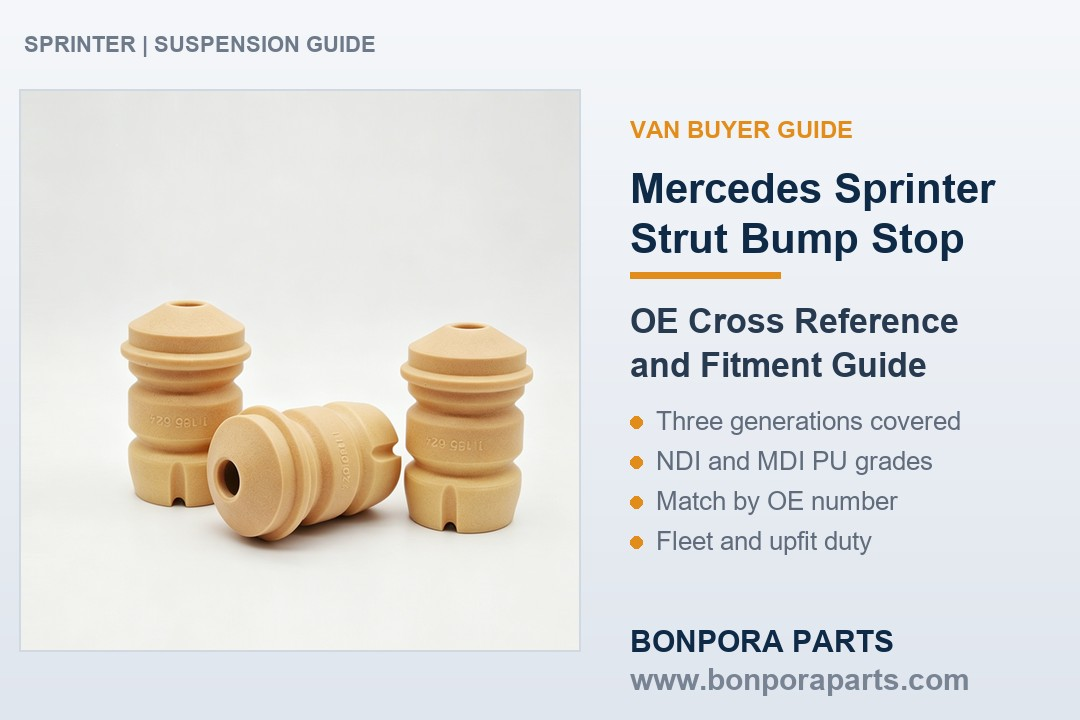
The Mercedes Sprinter is one of the most widely used light commercial vans in the world, running delivery routes, camper conversions, ambulance bodies and tradesman fleets across Europe, North America and Asia. Among the many chassis and suspension parts that keep a Sprinter ride controlled, one small foam component works silently at the top of every compression stroke: the strut bump stop, also called the jounce bumper or 缓冲限位块. When it is in good condition, passengers and cargo barely notice it. When it crumbles, drivers feel harsh clunks, and the strut itself starts to fail early. This guide explains how the strut bump stop works on Sprinter axles, how the three Sprinter generations differ, how to match a replacement by part number, and what to check before ordering from a polyurethane bump stop supplier.
The Sprinter front axle uses a strut type layout with a coil spring mounted around the strut assembly. Inside the strut, a piston rod (活塞杆) moves through hydraulic oil, and a stack of valve plates (阀片) meters the flow to generate damping. A sealed gas chamber, often described as the nitrogen gas cell (氮气气囊), keeps the oil under pressure and prevents foaming. The coil spring carries the load, and the strut controls it.
The bump stop is the progressive foam element fitted on the strut shaft, hidden inside the dust cover tube. During normal driving it never touches anything. But when the suspension reaches full compression, for example at a deep pothole, a loaded ramp or a hard landing after a crest, the coil becomes fully nested and the remaining energy has to go somewhere. The bump stop compresses progressively and absorbs that final energy before metal contacts metal.
Without a healthy bump stop, every full compression event transfers impact directly into the strut. The result is accelerated wear on the piston rod surface, the rod guide, the seal and the valve plate stack. In other words, a part that costs very little protects the most expensive component of the suspension corner.
A sharp clunk or bang from the front axle at potholes, speed bumps or when driving a heavily loaded van off a kerb.
Foam dust or small crumb particles visible around the strut, inside the wheel arch or on the dust cover (防尘罩) itself.
Reduced remaining travel: the van bottoms out more often, especially near maximum gross vehicle weight.
Oil weeping from the strut soon after the clunking started, a sign the piston rod seal has been damaged by repeated metal to metal impacts.
Uneven tyre wear caused by changing suspension geometry at full compression.
The Sprinter nameplate spans nearly three decades and three generation families. A part number that fits one generation rarely fits the next without verification, so buyers should always confirm chassis family and year range before ordering.
| Generation | Production Years | Front Layout | Bump Stop Notes |
|---|---|---|---|
| T1N (W901-W905) | 1995 to 2006 | Strut with coil spring, leaf sprung rear axle | Taller foam elements; many struts sold as assemblies include the stop, but separate replacement is common in fleet maintenance |
| NCV3 (W906) | 2006 to 2018 | Strut with coil spring, leaf sprung rear axle | Higher gross weights than T1N; progressive microcellular PU stop with a mounting collar and slot geometry |
| VS30 (W907) | 2018 to present | Strut with coil spring, leaf sprung rear axle | Refined stop profile for comfort tuning; eSprinter variants share the same front layout, so electric weight distribution must be considered |
Because Mercedes has used several suppliers and revisions within each generation, the safest workflow is to match by the original equipment number printed on the old part or listed in the vehicle catalogue, then verify dimensions against the physical sample.
A parcel van near maximum payload hits full compression far more often than a private passenger car. Loading docks, kerb crossings, speed bumps and corrugated yard surfaces all push the suspension toward full jounce many times per hour. Each engagement heats the foam surface through hysteresis. A bump stop that is rated as an emergency component in a private car becomes a working component in a fleet van, and material choice starts to matter much more.
Conversions frequently add mass high on the chassis and sometimes push the gross vehicle weight to its limit. Combined with long highway journeys in hot climates, the bump stop sees sustained load and elevated temperature, which accelerates compression set (压缩永久变形), the permanent loss of height and resilience after repeated compression. A set stop no longer returns to its free height, so the effective travel shrinks even before it visibly crumbles.
Traditional replacement stops use rubber foam. Modern premium stops, including those supplied by Bonpora, use microcellular polyurethane (聚氨酯缓冲块), produced in NDI and MDI grade systems. The difference shows up exactly in the conditions a Sprinter faces.
| Property | Rubber Foam | Microcellular PU |
|---|---|---|
| Energy absorption at high strain | Drops off quickly at deep compression | Progressive curve stays stable at deep compression |
| Compression set resistance | Moderate; sets faster under heat and load | Good, especially in NDI grade under sustained load |
| Temperature window | Narrower; hardens in cold, softens in heat | Wider; NDI grades keep dynamic strength in hot climates |
| Aging, ozone and road chemicals | Surface cracking over time | Strong resistance to aging and contamination |
| Cost position | Lower unit cost | Higher unit cost, longer service interval |
For fleet buyers, the comparison that matters is cost per kilometre, not cost per piece. A stop that lasts twice as long and protects the strut from secondary damage usually wins the calculation even at a higher purchase price.
Both NDI and MDI based microcellular polyurethanes are used for jounce bumpers, but they suit different duty profiles.
| Criterion | NDI Grade | MDI Grade |
|---|---|---|
| Dynamic strength under sustained high load | Excellent; preferred for fleet and heavy upfits | Good for standard duty |
| Heat build up resistance | Strong; suits hot climate routes | Adequate for moderate climates |
| Density and hardness tuning | Tuned for high load curves | Wide tuning window, easy to match softer comfort curves |
| Typical use | Delivery fleets, camper conversions, hot regions | Standard replacement, mixed duty, cost sensitive programmes |
A practical rule: if the van routinely runs near its gross weight limit, or operates in sustained heat, specify NDI. For mixed use vans with average loads, a properly tuned MDI grade delivers reliable service at a friendlier price.
Purchasers rarely need to guess. A structured four step workflow turns an unknown requirement into a confirmed order.
The old stop or the strut data plate usually carries an original equipment number. Even a partially legible number is valuable. Photograph the part before removal, including any printed digits on the foam surface.
Provide the van identification or at least the model year and market version. As the table above shows, T1N, NCV3 and VS30 parts are not interchangeable across the board, and market variants can differ in ride height and spring rates.
Measure the free height, top and bottom diameters, mounting hole diameter and any collar or slot features. Two stops that look similar in photos can differ by several millimetres in height, which changes the engagement point and the ride feel.
Ask for the density and hardness of the offered part and compare with the original. Reputable suppliers publish these values. If the original grade is unknown, describe the duty cycle and let the supplier recommend NDI or MDI.
Bonpora supports this workflow directly: buyers can send an original equipment number, a photo, a drawing or a physical sample, and the engineering team cross-references or develops the matching part. See the custom parts page for the drawing and sample based development process.
| Check Item | Why It Matters |
|---|---|
| Free height | Sets when the stop engages; wrong height changes ride and travel |
| Top and bottom outer diameter | Must fit the dust cover tube and the strike face without rocking |
| Mounting hole and collar geometry | Ensures the stop stays fixed on the strut shaft |
| Density and hardness (with tolerance) | Defines the load curve; request test values, not just a colour match |
| Shape features such as slots or grooves | Affect progressive compression and air escape |
A bump stop rarely fails alone. When the front struts are opened for service, check the following chassis and suspension parts in the same visit:
Dust cover (防尘罩) and shock absorber protective sleeve (减震护罩): torn bellows let grit reach the piston rod and destroy the seal.
Spring seat (弹簧座): a cracked seat lets the coil sit unevenly and adds noise.
Strut mount and bearing: wear here shows up as steering notchiness.
Steering tie rod ends (转向拉杆球头): heavy jounce events load the steering linkage as well.
The strut cartridge itself: check for oil mist on the body, which indicates a worn piston rod seal, and for piston ring (活塞环) related damping loss if the unit is rebuildable.
Replacing these parts as a set restores the whole corner instead of chasing symptoms one by one. Bonpora supplies shock absorber parts, spring seats and dust covers alongside polyurethane bump stops, which simplifies kit purchasing for wholesalers.
Bonpora (邦博润) manufactures polyurethane bump stops in NDI and MDI microcellular systems, together with shock absorber parts, chassis and suspension parts and precision metal parts, covering European, American, Korean and Japanese vehicle platforms including the Sprinter family. For buyers building their own programmes, the company supports:
Cross referencing and supply against original equipment numbers or samples.
Drawing based custom development, including mould making, density and hardness tuning and batch test reports.
Private label packaging for distributors and aftermarket brands.
Low to medium volume first articles, useful for niche van platforms where big manufacturers will not open a mould.
Fleet buyers and wholesalers who want a reliable strut bump stop source for the Sprinter and other commercial vans are welcome to send an enquiry with a part number, photo or sample for a prompt quotation.
There is no fixed interval. On a lightly loaded van it can easily outlast two sets of struts. On a fleet van running near maximum payload, inspection at every strut or tyre service is sensible, and replacement is due once the stop shows set, crumbling or foam dust. Because the part is inexpensive, many fleets replace it with the dust cover whenever a strut is opened.
Not as a first move. A stop that is too long engages early and creates a harsh ride; one that is too hard shocks the suspension at full compression. Persistent bottoming usually points to a sagging coil spring, worn dampers or overloading. Restore the suspension to the original specification first, then discuss tuned density with the supplier if the duty cycle genuinely demands a revised curve.
Yes, both front corners should wear evenly. A single new stop on one side creates asymmetric engagement at full compression, which shows up as a pull or a yaw at potholes. Pair replacement costs little and keeps axle behaviour consistent.
The fastest path is the original equipment number plus a photo of the used part. If the number is unknown, send the free height, diameters, hole size and hardness if measurable, together with the vehicle model and year. For new development, a sample or a 2D drawing with tolerance requirements allows the engineering team to quote mould and unit prices.
Need a dependable Sprinter strut bump stop supply chain? Visit the polyurethane bump stop catalogue, browse the shock absorber parts range, or learn about drawing and sample based custom development to start your enquiry.
