
- 1. Microcellular PU Bump Stop Performance Guide
- 2. What a Microcellular PU Bump Stop Does
- 3. Temperature: the Hidden Variable in Bump Stop Selection
- 4. Compression Set: the Figure That Predicts Service Life
- 5. NDI and MDI Grades Under Thermal Load
- 6. How Density and Hardness Shape the Load Curve
- 7. Laboratory Tests That Separate Good From Average
- 8. Specifying the Right Grade for Your Market
- 9. Warning Signs of an Underspecified Bump Stop
- 10. Custom Development From Drawing or Sample
- 11. Frequently Asked Questions
- 11.1. What compression set value should a quality microcellular PU bump stop achieve?
- 11.2. Can PU bump stops work in winter temperatures below minus 30 degrees Celsius?
- 11.3. Is an MDI grade acceptable for commercial vehicles in hot climates?
- 11.4. How do I source the correct bump stop when I only have an OE number?
Microcellular PU Bump Stop Performance Guide
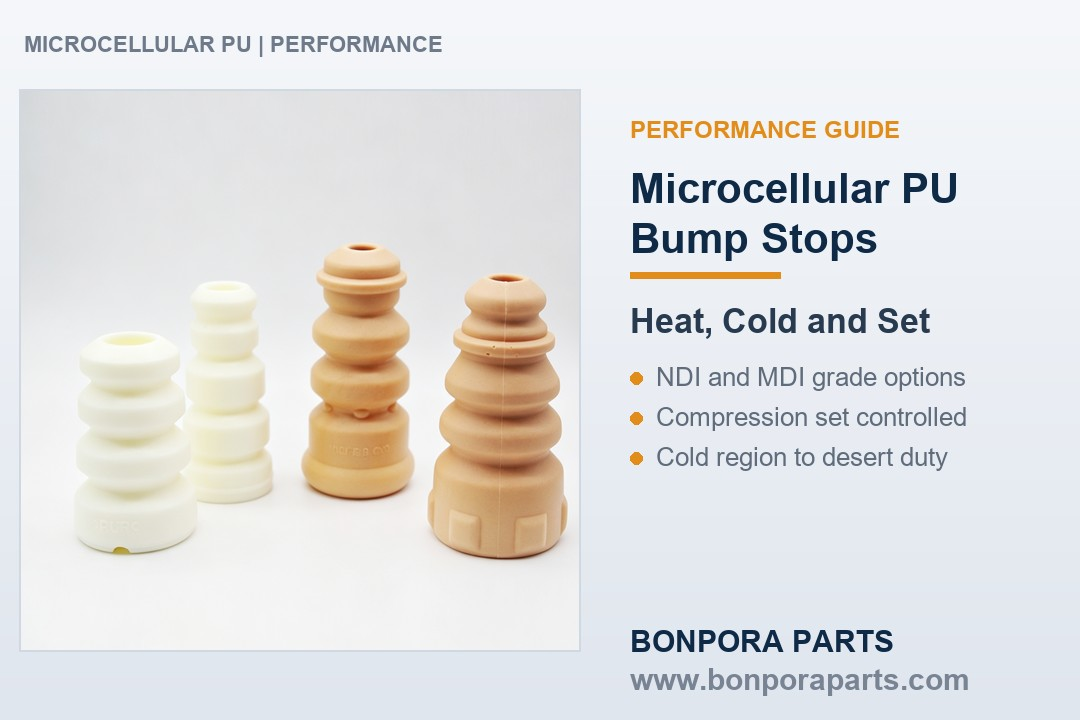
Microcellular PU Bump Stop Performance Guide
Two microcellular polyurethane bump stops with identical dimensions can behave like two different products once the seasons change. The grade that feels perfect in a mild climate may stiffen in Nordic winter or take a permanent set in Gulf summer heat, and the difference rarely shows on a calliper - it shows in the polymer chemistry. This guide explains how a microcellular PU bump stop performs across temperature extremes, what compression set means for service life, and which figures a professional buyer should request before committing to a programme.
Bonpora Parts and Components Co., Ltd. (邦博润(北京)汽车零部件有限公司) supplies microcellular polyurethane bump stops (聚氨酯缓冲块) in NDI and MDI grades, together with shock absorber parts (减震器配件), chassis and suspension parts (底盘悬挂件) and precision metal parts, covering European, American, Korean and Japanese mainstream platforms, with custom development from drawings or samples (来图、来样定制).
What a Microcellular PU Bump Stop Does
The bump stop (缓冲限位块) is the last line of defence in the suspension. When the strut reaches the end of its travel, the bump stop compresses between the strut body and the impact element and converts the remaining kinetic energy into a controlled, progressive resistance. Without it, the suspension bottoms out metal to metal: the piston rod (活塞杆) and internal valve plate (阀片) take the full shock, mounts crack, and cabin noise follows within weeks.
Microcellular polyurethane is chosen for this duty because its structure is a lattice of millions of tiny gas-filled cells. Under load the cells collapse progressively, so the part behaves like a tuneable gas spring rather than a solid block: soft at first contact, steeply progressive near full compression. The same behaviour must survive heat, cold and years of repeated impacts, which is where grade selection matters.
Temperature: the Hidden Variable in Bump Stop Selection
Polyurethane is a thermoset elastomer, but its dynamic behaviour still shifts with temperature. The polymer segments move more freely as heat rises and stiffen as the material approaches its glass transition region. The gas inside the microcells also changes pressure with temperature. In practical terms, one bump stop is never one stiffness value - it is a curve that moves with the climate it operates in.
Cold climate behaviour
As temperatures fall below freezing, every elastomer gains stiffness and loses rebound. A grade selected for a temperate market can become uncomfortably hard at minus 30 degrees Celsius, transmitting a sharper impact instead of absorbing it. In severe cases a low-quality foam can stiffen so much that it no longer compresses progressively and starts to act like a hard spacer. NDI-based microcellular grades keep a wider useful window and retain elasticity well below zero, which is why they are the usual recommendation for Nordic, Canadian and high-altitude applications where the part must work right after a cold start.
High temperature and heat build-up
Heat is the more damaging direction. Every compression cycle converts a fraction of the impact energy into heat inside the foam; this hysteresis warms the part during consecutive impacts, for example on corrugated gravel roads. Continuous exposure above roughly 100 degrees Celsius accelerates polymer ageing, softens the cell walls and permanently changes the load curve. Grades differ here: NDI systems tolerate sustained thermal load and repeated heat build-up better, while standard MDI grades are suited to moderate continuous temperatures and lighter duty cycles. Desert markets, mining fleets and heavy commercial vehicles therefore need the grade to be specified, not assumed.
Compression Set: the Figure That Predicts Service Life
Compression set (压缩永久变形) measures how much of a deformation the material never recovers. A bump stop spends much of its life partially compressed - on loaded vehicles, lowered suspensions or trucks with constant payload - and every full-bottoming event adds another episode of deep compression. If the foam takes a set, the part loses free height. The consequences arrive in sequence:
The strut travel range that the bump stop was designed to cover is no longer protected.
Contact is lost at rest, and the first sign the driver notices is a clunk over sharp bumps - the noise the bump stop was fitted to prevent.
Metal-to-metal contact returns at full compression, passing the load into the damper mount and the spring seat (弹簧座).
Replacement intervals shorten, and the workshop replaces a far more expensive strut assembly instead of a low-cost wear part.
A quality microcellular PU grade keeps compression set in the single-digit percentage range under standard laboratory conditions, and premium NDI grades hold it even under elevated temperature. Buyers should treat the set value, not only hardness and density, as the pass-or-fail figure for programmes aimed at hot climates or high payload duty.
NDI and MDI Grades Under Thermal Load
Bonpora produces both isocyanate systems and selects between them by application. The table below summarises the practical differences a buyer works with:
| Property | NDI-based grade | MDI-based grade |
|---|---|---|
| Useful temperature window | Wider, stays elastic well below freezing and tolerates sustained heat | Moderate window, best in temperate to warm service |
| Dynamic heat build-up | Low hysteresis, suited to consecutive impacts | Higher hysteresis, suited to occasional events |
| Compression set under heat | Holds single-digit set at elevated temperature | Set rises with sustained heat exposure |
| Rebound and resilience | Very good | Good |
| Typical applications | Heavy trucks, off-road, mining, cold regions | Passenger cars, light commercial, temperate markets |
| Programme cost level | Higher material cost, lower warranty risk in severe duty | Economical for mainstream volume |
Neither system is universally better; the correct answer is the one matched to the climate, payload and impact frequency of the target fleet. A distributor serving several regions often carries both systems in parallel, indexed by application rather than by price alone.
How Density and Hardness Shape the Load Curve
Within one chemistry, two parameters tune performance. Density, typically in the range of about 0.35 to 0.65 grams per cubic centimetre for suspension grades, raises load capacity and lowers compression set as it increases - the cell walls become thicker and more resistant to permanent collapse. Hardness, adjusted through the formulation, sets where the progressive curve begins to steepen. A well-matched bump stop is not simply the hardest one: it is the density and hardness combination that covers the specific stroke and impact energy of the vehicle platform. This is why copying a dimension without copying the specification rarely reproduces the original driving behaviour, and why the rebound bump stop family used in heavy applications is engineered as its own programme rather than a variation of a passenger car part (see the rebound bumpers range for reference).
Laboratory Tests That Separate Good From Average
A credible microcellular PU programme is backed by a small set of standard tests. Buyers should ask which of these are run in-house and on which batch frequency:
Compression set: conditioned compression at defined temperature and duration, then recovery measurement - the core durability figure described above.
Dynamic fatigue: thousands of impact cycles at defined stroke and frequency, with load loss and height loss recorded at intervals.
Heat ageing: prolonged exposure at elevated temperature, followed by re-test of hardness, density and set, to simulate years of hot-climate service.
Cold flexibility: compression behaviour after conditioning well below freezing, to confirm the grade still absorbs rather than transmits.
Temperature cycling: repeated swings between cold and hot chambers, which reveal cell structure weakness faster than either extreme alone.
Density and hardness per batch: fast statistical checks that confirm the moulded compound matches the approved specification.
Specifying the Right Grade for Your Market
The fastest way to a correct specification is to describe the operating reality, not the part alone. The table below maps common markets to the emphasis that matters most:
| Target market | Dominant stress | Specification emphasis |
|---|---|---|
| Middle East, Australian outback | Sustained heat, corrugated roads | NDI grade, compression set at temperature, heat ageing data |
| Nordics, Canada, high mountains | Deep cold, salted roads | Low-temperature elasticity, NDI grade, cold flexibility test |
| Southeast Asia, tropical coastal | Heat with humidity | Hydrolysis-resistant system, set and ageing data |
| General European aftermarket | Mixed moderate climate | MDI grade with documented set value, batch control |
| Mining and heavy haulage | Extreme impact frequency | NDI grade, dynamic fatigue endurance, matched rebound bumpers |
Sharing the target fleet, typical payload and road profile with the manufacturer lets the engineering team propose a grade with test evidence instead of a generic catalogue item.
Warning Signs of an Underspecified Bump Stop
Field returns tell the story of a grade chosen on price alone. Inspect returned parts for these signals:
Height loss: the part is visibly shorter than nominal even unloaded - compression set has done its work.
Hardening: the surface resists fingernail pressure that a fresh part would allow, indicating heat ageing or the wrong chemistry.
Surface cracking or crumbling: cell walls breaking at the skin point to over-hard application or degraded polymer.
Noise returns shortly after fitting: the classic clunk reappears because the set part no longer contacts at rest.
Uneven wear at one end: often a mounting or alignment issue, but also seen when a foam grade is used beyond its duty window.
Custom Development From Drawing or Sample
Many replacement programmes start from an OE number, a used sample or a used drawing rather than a complete specification. A manufacturer with in-house polyurethane systems can reverse-engineer the density, hardness and chemistry from the sample, propose NDI or MDI by duty cycle, and validate with the laboratory tests above before tooling. Bonpora supports this route for distributors and fleet programmes, including matched supply with dust covers and spring seats so the whole strut protection set arrives as one validated assembly - see custom parts development for the process and the shock absorber parts range for related components.
Frequently Asked Questions
What compression set value should a quality microcellular PU bump stop achieve?
For passenger car applications, a single-digit percentage set under standard laboratory conditions is the level to expect from a controlled microcellular grade, and premium NDI grades hold comparable figures at elevated temperature. The exact limit should be agreed per programme, because the test temperature, duration and deflection all influence the number. The practical rule is simple: demand the set data together with the test conditions, and treat any supplier who offers hardness only as a risk.
Can PU bump stops work in winter temperatures below minus 30 degrees Celsius?
Yes, when the chemistry is selected for it. NDI-based microcellular grades retain useful elasticity far below freezing and are routinely specified for Nordic, Canadian and high-altitude fleets. The failure mode seen in the field is not general polyurethane weakness but a temperate-market grade fitted into a cold region, so the buyer should state the coldest expected service temperature in the enquiry.
Is an MDI grade acceptable for commercial vehicles in hot climates?
MDI grades serve light commercial and passenger applications well in temperate conditions. For heavy commercial vehicles operating in sustained heat - desert transport, mining, high-frequency impact duty - the higher hysteresis and faster set growth of standard MDI systems make them a match risk, and NDI grades are the usual recommendation. Where cost pressure is significant, a middle path is MDI for the mainstream catalogue and NDI for the export or heavy-duty line of the same programme.
How do I source the correct bump stop when I only have an OE number?
Send the OE number together with the vehicle platform, model year range and target market. The manufacturer cross-references the reference, confirms free height, diameter, density band and mounting interface, and supplies a sample for validation before batch production. Where only a used part is available, a physical sample with the origin market noted is enough to rebuild the full specification, including the chemistry choice between NDI and MDI.