sales@bonporaparts.com
0086-10-64988621
English
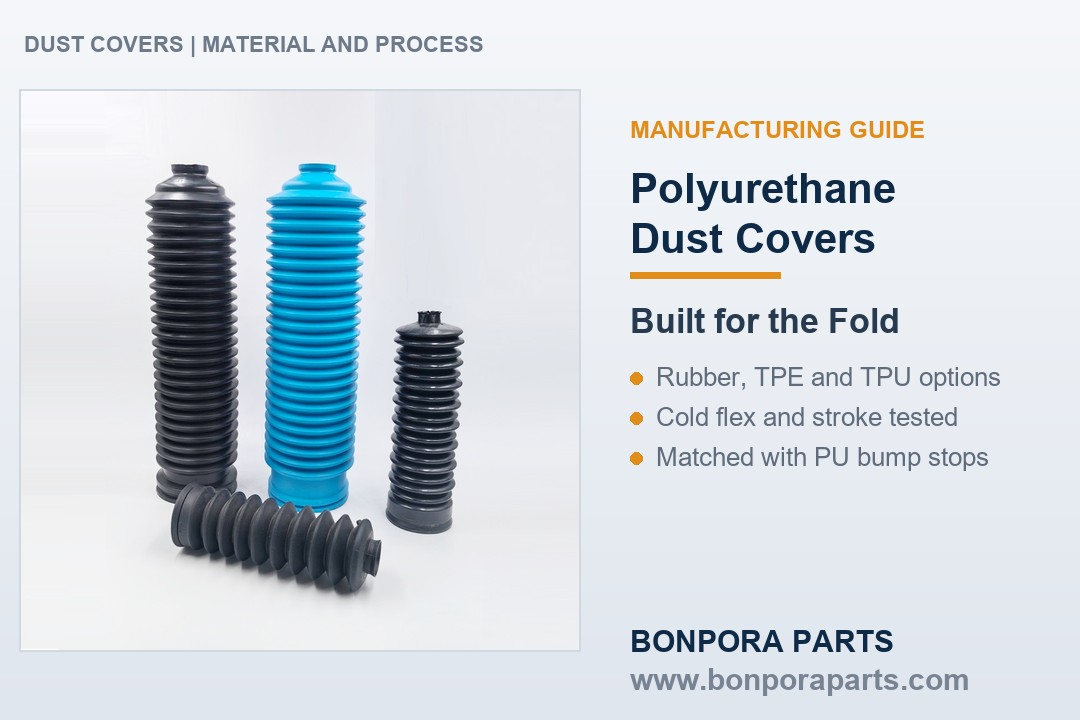
The dust cover is the cheapest part on a strut and, paradoxically, one of the most decisive for how long the strut lives. Distributors who source from a polyurethane dust cover and bellows supplier quickly learn that two covers with identical dimensions can behave completely differently after one winter on a salted road. This guide explains how dust covers and shock guards are engineered and manufactured, which material families are available, what separates a good bellows from a short-lived one, and which quality checks a professional buyer should require before committing to a programme.
Bonpora Parts and Components Co., Ltd. (邦博润(北京)汽车零部件有限公司) supplies polyurethane bump stops in NDI and MDI grades, damper components, chassis and suspension parts and precision metal parts, covering European, American, Korean and Japanese mainstream platforms. Dust covers and shock guards sit inside the damper component family, and they are engineered to work as a set with the bump stop and spring seat around them.
A dust cover (防尘罩) is the folding bellows that surrounds the piston rod (活塞杆) and protects the rod seal from everything the road throws at the suspension. Its working environment is remarkably hostile for a polymer part:
Mechanical abuse: stone chips thrown at the lower mount, repeated folding and unfolding over every millimetre of suspension stroke, and vibration at high frequency.
Chemical attack: road salt, brine, oils, grease and cleaning agents that swell or embrittle the wrong compounds.
Weathering: ozone and UV that crack unsuitable rubber, plus temperature swings from well below freezing to near engine-bay heat in some positions.
Contamination: fine grit that embeds in the seal lip if the cover is torn, scoring the hard-chrome rod and starting the classic chain failure that ends in a full strut renewal.
The related shock guard (减震护罩) performs the same protective duty in other chassis positions. Because a failed cover destroys expensive components around it, replacement demand is constant, and the part has become a catalogue staple for every distributor serving European, American, Korean and Japanese vehicles.
There is no single correct material for a dust cover; there is a correct material for a given climate, stroke and price point. The three families below cover most of the aftermarket.
Traditional covers are moulded from natural, styrene-butadiene, neoprene or EPDM-based compounds. Rubber offers excellent elongation and fold fatigue behaviour at moderate cost, which is why it still dominates high-volume applications. Its weak points are ozone and weathering resistance, which depend heavily on the compound, and weight, since walls must be relatively thick to reach the same durability.
Thermoplastic elastomers (TPE) and thermoplastic polyurethane (TPU) covers are injection moulded in a fully automated cycle. Polyurethane grades stand out for abrasion resistance, tear strength and resistance to oils and ozone, and they keep their flexibility in cold climates when the grade is selected correctly. TPE compounds offer a wide hardness range and easy colour matching, which matters for brands that want a distinctive appearance on suspension kits.
The practical selection logic is climatic. A cover destined for Nordic or Canadian service must pass low-temperature flexibility testing that would already be excessive for a Mediterranean application; a cover for mining regions needs maximum abrasion and tear resistance; a cover for coastal markets needs proven salt resistance. Sharing the target market and duty cycle with the manufacturer is the reliable way to arrive at the right compound instead of guessing from a datasheet.
| Property | Vulcanised rubber | TPE | TPU (polyurethane) |
|---|---|---|---|
| Fold fatigue life | Very good | Good | Very good |
| Abrasion and tear resistance | Moderate | Good | Excellent |
| Ozone and UV resistance | Compound dependent | Good | Excellent |
| Cold flexibility | Good to very good | Grade dependent | Grade dependent |
| Oil and salt resistance | Moderate | Good | Very good |
| Typical process | Compression or transfer moulding | Injection moulding | Injection moulding |
The manufacturing route differs between thermoplastic and rubber compounds, but the engineering logic is the same: a folded geometry that must survive millions of stroke cycles without cracking at the folds.
Cover development starts with the application data: free length, compressed length, stroke, rod and seal diameters, and the mounting interfaces at both ends. From this the engineer defines the number of folds, fold radius and wall thickness. More folds with generous radii spread the bending strain across the part, while fewer folds concentrate strain and crack earlier. Wall thickness is a compromise - thick enough to resist stone impact, thin enough to fold without excessive force on the strut. Tooling for TPU and TPE covers is usually a two-plate injection mould with a collapsible or threaded core that forms the internal bellows profile.
Thermoplastic covers run on standard injection moulding machines in a short, highly repeatable cycle. The critical control points are material drying before moulding, since moisture in polyurethane causes bubbles and weak folds; accurate melt and mould temperature, which govern fold definition; and controlled cooling so the part keeps its shape on demoulding. Because the cycle is automated, dimension consistency from the first shot to the ten-thousandth is far better than in manual rubber moulding, which simplifies incoming inspection for the buyer.
Rubber bellows are produced by loading preformed compound into a heated mould and curing it under pressure, either directly (compression) or through a transfer pot that feeds the cavity. Cure time and temperature are set per compound, and post-curing may follow for demanding grades. Skilled operators and disciplined mould maintenance matter more here than in thermoplastic production, which is why a rubber cover supplier should be audited on process control rather than only on sample quality.
After moulding, flash is removed from the parting lines without damaging fold edges - a nicked fold becomes a crack initiator. Covers are then checked for dimensions and visual defects, and sampled batches go through the laboratory tests described below. For matched kits, the cover is assembled check-fit with the corresponding bump stop before packing, so the inner diameter, free height and mounting plate are confirmed as an assembly rather than as two independent dimensions.
A credible dust cover programme is backed by a small set of standard tests. Ask potential suppliers which of these they run in-house and how often:
Dimensional report: free length, compressed length, inner and outer diameters at both mounts, and fold count against the approved drawing.
Low-temperature flexibility: the cover is conditioned cold and flexed through its stroke; cracking or whitening at the folds is an automatic rejection.
Stroke cycle endurance: repeated compression cycles on a bench that simulate far more folding than the cover will see in service.
Ozone and weathering exposure: especially for rubber compounds, to confirm the compound includes effective protection.
Abrasion and tear strength: the parameters that decide survival in gravel-road and mining environments.
Hardness and density: per batch, as a fast statistical check that the correct compound was moulded.
A supplier who can produce these reports per batch, and who measures the finished cover rather than only the raw material, is the one whose parts behave like the originals in the field.
On most struts the bump stop rides inside the dust cover, so the two parts share every interface dimension. Sourcing them from one manufacturer removes the most common cause of returns in this category: a cover whose inner geometry interferes with the bump stop, or a stop whose mounting plate does not locate in the cover. Bonpora produces the polyurethane bump stops (聚氨酯缓冲块, NDI and MDI microcellular grades) alongside dust covers, spring seats and shock guards, so kits are confirmed as assemblies. The same logic extends to the surrounding chassis hardware, since worn steering tie rods (转向拉杆) and links change suspension travel and loading, which then accelerates wear on the very covers and stops the kit protects.
For material selection on the stop side, the same duty-cycle conversation pays off twice: NDI-based grades hold their progressive curve under sustained heavy loads and high temperatures, which suits commercial vehicles and loaded applications, while MDI-based microcellular grades offer a finely tuned compression curve for passenger cars. One conversation with the material engineer covers both parts of the kit.
Many replacement applications - especially for markets where original documentation is scarce - are ordered with nothing more than a used part and a vehicle identity. Manufacturers that support custom development from drawings or samples can measure the used cover, reverse the bellows profile, confirm a dimension sheet, and tool prototypes before series production. Providing photographs from two angles, the mating rod and mount dimensions, and the target market is normally enough to start; most custom programmes reach a confirmed first article within a few weeks when the interfaces are supplied up front.
In practice yes. The cover is inaccessible while the strut is assembled, and a cover that looks intact may already have hardened or slightly torn fold edges. Since the labour cost of a later second teardown far exceeds the part price, workshops replace the cover, bump stop and spring seat as a kit whenever the strut is opened.
Not universally better - they are differently strong. Polyurethane (TPU) covers offer superior abrasion, tear and ozone resistance and excellent oil and salt behaviour, which makes them attractive for harsh climates and heavy-duty applications. Rubber compounds remain a proven, economical choice for standard service. The right answer depends on the market climate, stroke and budget of the application, which is why the material should be chosen with the manufacturer rather than assumed.
The usual culprits are a compound without adequate ozone or cold-weather protection, fold radii that are too sharp for the stroke, mechanical damage at installation, and tears from stone impact that were never repaired. Once grit passes a damaged lip, it scores the piston rod and destroys every seal fitted afterwards, so early cover failure should always be investigated rather than only replaced.
Yes. Because both parts are produced in-house, they are check-fit as an assembly before packing, and private-label packaging can be arranged for distributors and suspension brands. Sending the vehicle applications and market focus of your range lets the manufacturer propose kit combinations that match your fast-moving numbers.
A dust cover is a small polymer part with a large influence on strut life. Evaluate it by material family and climate fit, insist on the six standard tests above, and prefer suppliers who produce covers together with the bump stops and spring seats they interface with, so the kit is confirmed as an assembly. Review the dust covers range, compare it against your best-selling strut applications, and request samples of the material grade that matches your market before committing to a programme.
