sales@bonporaparts.com
0086-10-64988621
English
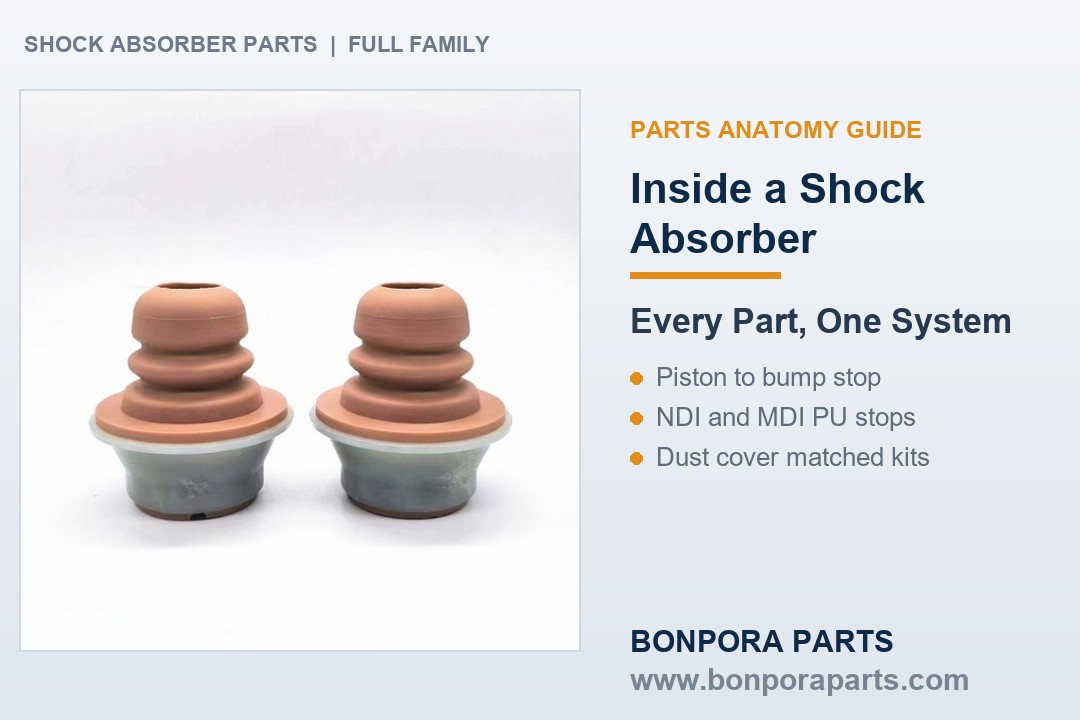
A complete damper assembly contains more than a dozen precision components, and each one has a measurable effect on how the vehicle rides, steers and wears. Distributors and rebuilders who buy from a shock absorber parts manufacturer eventually learn the same lesson: a damper is not one part with a part number, it is a system of interacting parts, and replacing only the obvious one often leaves the complaint unresolved. This guide walks through the assembly from the piston rod cap down to the polyurethane bump stop, explains what each component does, and shows how a professional buyer evaluates the whole family rather than a single item.
Bonpora Parts and Components Co., Ltd. (邦博润(北京)汽车零部件有限公司) produces components across four families: polyurethane bump stops in NDI and MDI grades, damper internals, chassis and suspension parts, and precision metal parts, covering European, American, Korean and Japanese mainstream platforms. The anatomy below reflects how these families fit together on a real strut.
Before individual parts make sense, the working principle has to be clear. A twin-tube or mono-tube damper is a sealed oil column with a moving piston. When the wheel meets a bump, the suspension compresses; when the spring pushes back, it rebounds. The damper exists to convert this kinetic energy into heat through a controlled flow of oil, so that the spring alone never decides how the car moves.
During compression, the piston moves down and oil is forced through calibrated ports in the piston. Thin spring steel valve plates (阀片) flex to open those ports at defined pressures, and the base valve at the bottom of the tube meters the remaining flow while the nitrogen gas bladder (氮气气囊) or gas chamber absorbs the volume displaced by the entering rod. Compression damping controls how quickly the wheel is pushed up into the body - too little and the vehicle bottoms out, too much and impacts transmit straight into the cabin.
On rebound, the direction of flow reverses. A different set of valve plates on the piston opens, and the spring seats themselves stay passive while the extension force is built almost entirely at the piston. Rebound damping is what stops the wheel from dropping into potholes and what keeps the tyre contact patch loaded on corrugated roads. Because rebound forces are typically higher than compression forces, the piston assembly, the piston rod (活塞杆) and the rod guide carry the highest structural loads in the whole unit.
With the principle established, here is each component in the order a workshop would meet it during a teardown, with the terminology used in international trade.
The piston rides on the rod and carries the piston ring (活塞环) that seals against the tube wall, plus the stacked valve plates and ported discs above and below it. Machining tolerances on the piston diameter and seat faces are tight because any leakage path between the ring and the bore reduces damping force at low speeds, exactly where ride comfort is decided. The valve plates themselves are typically hardened spring steel in the 0.10 to 0.30 mm range, and their thickness selection defines the opening pressures of the force curve.
The piston rod is the visible, chrome-plated shaft. It must stay straight under side loads, resist corrosion and carry a surface finish that does not wipe the rod seal on every stroke. Above it sits the rod guide bushing, which centres the rod and works with the seal to keep oil in and contamination out. Rods are induction hardened and hard-chrome plated; a rod with pitting or bent geometry destroys seals quickly, which is why rebuilders inspect the rod before anything else.
The dust cover (防尘罩) is the folding rubber or thermoplastic boot that shields the rod and seal from stone chips, dust, salt and water. The related shock guard (减震护罩) serves the same protective function in other chassis positions. A torn boot is deceptively minor: grit that passes the damaged lip embeds in the seal and scores the rod, and a scored rod then destroys every new seal fitted to it. This is the classic chain failure that turns a cheap boot replacement into a full strut renewal.
The spring seat (弹簧座) locates the coil spring on the strut and spreads its load across the housing. Seats are stamped from steel or moulded as steel-and-polyurethane hybrids, and their contact face geometry must match the spring end coil closely or the spring will sit off-axis and generate noise and uneven wear. Polyurethane spring seats add a damping layer between coil and housing and resist the corrosion and collapse that affect plain stamped seats in salt-belt markets.
Around the rod, above or below the dust cover, sits the polyurethane bump stop (聚氨酯缓冲块, NDI/MDI grades), the jounce bumper or buffer stop (缓冲限位块) that engages only near full compression. Microcellular polyurethane compresses progressively, absorbing the last energy that the damper cannot, and protects the strut internals from metal-to-metal bottoming. Material selection here is a genuine engineering decision: NDI-based grades handle sustained heavy loads and high temperatures with low compression set, which suits commercial vehicles and loaded applications, while MDI-based microcellular grades offer a finely tuned progressive curve for passenger cars. A collapsed or crumbled bump stop announces itself as a harsh clunk over sharp bumps, long before the damper itself fails. The full range can be reviewed on the polyurethane bump stops page.
A damper never works alone. The steering tie rod (转向拉杆) and its ball joints translate steering input into wheel angle, the stabilizer links connect the anti-roll bar to the suspension, and control arm bushings define the kinematics. Worn chassis joints change suspension geometry and loading, which then accelerates wear on dampers, bump stops and spring seats. That interaction is the practical reason chassis and suspension parts and damper internals are best sourced within one quality system: the parts are used together and wear together.
The table below summarises the assembly for buyers preparing catalogues or quotation requests.
| Component | Function | Typical materials | Early wear signs |
|---|---|---|---|
| Valve plate stack | Meters oil flow, defines force curve | Hardened alloy or high-carbon spring steel | Inconsistent damping, noise |
| Piston and piston ring | Seals and directs flow on the rod | Aluminium or cast iron, filled PTFE ring | Reduced low-speed damping |
| Piston rod | Transmits suspension loads | Induction hardened steel, hard chrome | Pitting, scoring, oil weep |
| Nitrogen gas bladder | Compensates rod volume, separates gas and oil | Elastomer bladder in steel can | Foaming, fading force when hot |
| Rod guide and seal | Centres rod, retains oil | Engineering polymer, NBR or FKM seal | Oil leak at the top mount |
| Dust cover / shock guard | Shields rod and seal from contamination | Rubber or TPE bellows | Tears, cracks, hardened lips |
| Spring seat | Locates and carries the coil spring | Stamped steel, PU hybrid | Corrosion, collapse, coil noise |
| Polyurethane bump stop | Final energy absorption at full compression | Microcellular PU, NDI or MDI base | Crumbles, permanent set, clunk |
Keep the table beside the price list when comparing offers. A quotation that is cheaper because the bump stop is conventional rubber instead of NDI microcellular PU, or because the spring seat is thin plain steel, is not a discount - it is a different part with a shorter service interval.
Because the families above are produced by different processes, evaluate a supplier family by family rather than on one showcase item.
Precision metal parts: confirm thickness, flatness and hardness reporting for valve plates, and per-batch traceability with retained samples.
Polyurethane parts: ask which base chemistry is used where, NDI or MDI, and request density, hardness and compression set data rather than a generic datasheet.
Bellows and covers: check cold flexibility and crack resistance, since a boot that stiffens in cold climates fails at the folds first.
Chassis parts: review ball joint articulation torque, boot sealing and plating thickness - the parameters that determine service life in corrosive markets.
A manufacturer who can show per-family process data, and who measures finished assemblies rather than only individual dimensions, is the one whose replacement parts behave like the originals.
Replacement demand arrives as symptoms, not as parts. A customer complaining of a clunk over sharp bumps may need a bump stop, a dust cover and a spring seat in the same visit. Distributors who stock the surrounding wear parts together convert that symptom into a complete repair in one order, while those who stock only the damper send the workshop elsewhere for the rest. Programme buyers also gain a practical benefit: when one factory supplies the piston-side hardware, the polyurethane bump stop and the spring seat, the interfaces are consistent and incoming inspection is reduced to a small number of confirmed checkpoints.
Not every platform has complete documentation, especially for markets where original data is scarce. Manufacturers that support custom development from drawings or samples can measure a used part, reverse its profile, confirm a dimension sheet, and then tool prototypes before series production. For polyurethane parts, sending the working condition - vehicle weight on the corner, ambient temperature range, expected stroke - lets the material engineer choose between NDI and MDI on evidence instead of habit. Most custom programmes move from sample review to confirmed first article within a few weeks when the mating dimensions are provided up front.
In most cases yes. The bump stop is a wear item made of microcellular polyurethane that permanently compresses over its life, and it is inaccessible while the strut is assembled. Replacing it during strut renewal costs little and prevents the harsh bottoming that customers report as a new-strut noise. Always check its height and elasticity against the specification before deciding to reuse it.
Both are microcellular polyurethane, but the chemistry changes behaviour under load and heat. NDI-based grades keep their progressive curve and recover better under sustained heavy loads and high temperatures, which suits trucks, commercial vehicles and heavily loaded SUVs. MDI-based grades offer a wide tuning range for the compression curve and perform well in passenger car applications. Sharing the vehicle and duty cycle with the manufacturer is the reliable way to choose.
Yes, and it is the practical way to buy them. The bump stop rides inside the dust cover on most struts, so the inner diameter, length and mounting plate must match. Suppliers who produce both parts confirm the fit as an assembly rather than as two independent dimensions, which removes the most common cause of returns in this category.
Provide the vehicle application with model year and market, the part type, and any dimensions that can be measured: outer and inner diameters, free height, mounting details, and photographs of the original from two angles. For PU parts, the working condition matters as much as the shape. With this input, an experienced manufacturer can normally identify or reverse the part and return a confirmed quotation.
A damper assembly is a chain of components that wear as a system: valve plates and piston internals set the force curve, the rod and seals keep the oil where it belongs, the dust cover and shock guard protect the interface, the spring seat carries the coil, and the NDI or MDI polyurethane bump stop takes the final hit. Buyers who evaluate and source the full family - rather than a single discounted number - deliver complete repairs, fewer comebacks and simpler incoming inspection. Review the shock absorber parts range, compare it against your fast-moving applications, and request samples of the families that matter most before committing to a programme.
