
Suspension Types & Shim Selection Guidelines
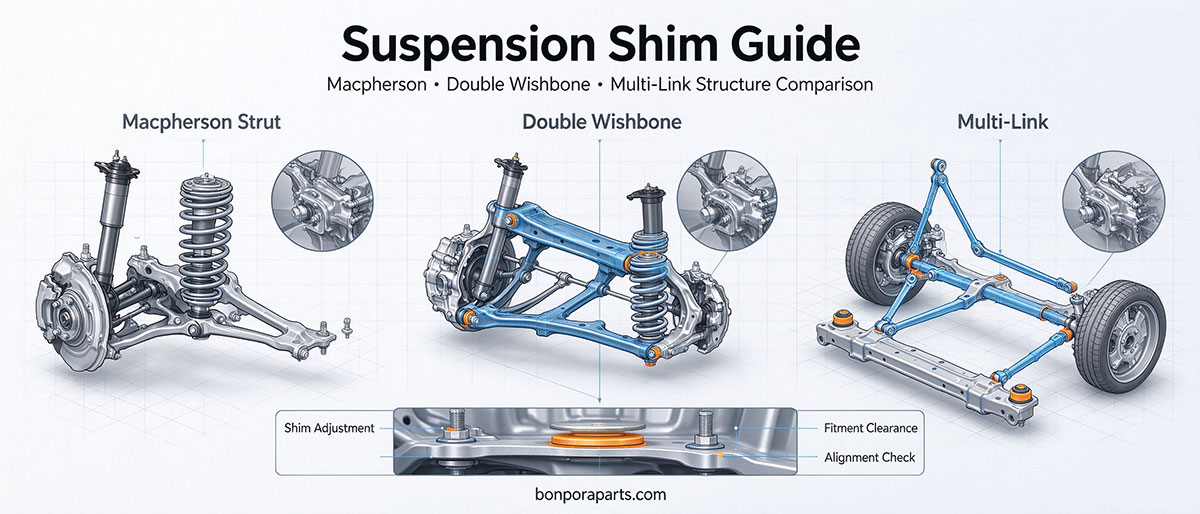
Different suspension layouts deliver distinct handling, comfort and geometry performance. Alignment shims are used to correct wheel angles including camber, caster and toe. Improper shim selection or installation will cause uneven tire wear, pulling, steering wander and accelerated component failure.
MacPherson Strut Suspension
MacPherson suspension combines a strut assembly and a single lower control arm. The strut works as both shock absorber and steering kingpin. It features compact structure, low weight and low cost, widely adopted on front axles of mass-market passenger cars and SUVs. It offers direct steering response for daily road use. Its main limitation is weaker lateral stiffness. Wheel camber changes significantly during compression and extension. The strut bears side bending load, which speeds up oil seal and bearing wear under aggressive driving. Most factory MacPherson setups have limited built-in camber adjustment.
Shim Notes for MacPherson: Curved wedge shims are the common solution fitted between knuckle and strut. High strength tempered steel shims are preferred. Aluminum shims are only acceptable for minor fine tuning. Avoid stacking thick plain washers for angle correction. Keep total camber adjustment within ±1.5 degree. Excessive shim thickness creates severe side load on strut bearings and leads to oil leakage and abnormal tire wear. Clean mounting surfaces thoroughly before installation. Verify kingpin caster, steering return, axle shaft angle and strut bearing movement after shim fitting.
Double Wishbone Suspension
Double wishbone suspension uses upper and lower A-shaped control arms. The shock absorber only handles damping without carrying wheel locating loads. The kingpin axis is defined by the upper and lower ball joints. It delivers high lateral rigidity and stable camber curve throughout wheel travel. Tires maintain better contact with road surface during cornering. It provides excellent control over brake dive and body roll. Shock service life is longer. The downside is larger packaging space, higher component cost and complex tuning. Multiple ball joints and bushings may cause alignment drift once worn loose.
Shim Notes for Double Wishbone: U-shaped open shims are the standard factory adjustment part installed between control arm shaft and bracket. Graded thin spring steel shims in 0.5 mm, 1 mm and 2 mm sizes are recommended. Equal addition or removal of front and rear shims mainly changes camber. Uneven adjustment of front and rear shims modifies caster angle. Do not stack more than 3 shims at one bolt position. Excessive total thickness tilts bushings and reduces bolt clamping security. Never place shims between bushing inner and outer sleeves. Check left-right caster difference strictly after adjustment. Replace worn ball joints and bushings before shim tuning. Shims cannot fix loose chassis components.
Multi-link Suspension
Multi-link suspension uses 3 to 5 separate links to constrain wheel movement in different directions. Damping and wheel guiding functions are decoupled. It achieves balanced ride comfort and handling performance. Independent tuning of camber and toe is possible. Flexible layout makes it popular for rear axles of premium sedans, SUVs and new energy vehicles. Weakly engineered low-cost multi-link designs still have limited performance ceiling. Factory adjustability varies widely across models.
Shim Notes for Multi-link: Wedge or angular flange shims adjust camber and toe together. Adjustable length control rods are the preferred solution for most modern multi-link systems. Shims are only for auxiliary correction. One single shim change alters camber, toe and track width simultaneously. All adjustments must be tracked on alignment racks. After installing flange shims, inspect clearance for brake calipers, rotors and wheel speed sensors. Aged bushings will make alignment data shift quickly after shim correction. Keep left-right toe difference within factory tolerance range to maintain straight line stability.
General Shim Material Selection
Tempered steel / spring steel shim: First choice for alignment correction. High rigidity, stable thickness and resistant to compression deformation. Apply galvanized or electrophoretic coating for rust protection.
Aluminum shim: Light weight and anti-rust. Suitable for mild tuning only. Not recommended for heavy load or off-road service due to creep risk under sustained clamping pressure.
PU shim: Used for spring spacer or lift block only. Do NOT use PU shims for camber and caster alignment. Permanent deformation will make alignment angles unstable.
Plain flat washer: Only for gap compensation. Not designed for wheel angle correction.
Universal Safety Rules
Shims are alignment correction parts, not repair parts. Bent arms, deformed knuckles and worn bushings must be replaced or repaired before shim adjustment. Complete four wheel alignment and road test after installation to check pull, steering return and alignment thermal drift. Tighten bolts strictly according to manufacturer torque values. Heavy stacked thin shims increase risk of loose clamping. Avoid oversize angle adjustment beyond the reasonable kinematic range of original suspension design. Extreme geometry change accelerates bushing and ball joint failure and creates safety hazards.