
- 1. Why Suspension Stability Matters More on Wet Pavement
- 2. What Happens During Emergency Braking on a Wet Road
- 3. Suspension Components That Keep Tyres Planted
- 4. Progressive PU Bump Stops for Controlled Compression
- 5. Precision Suspension Shims for Consistent Geometry
- 6. Durable Rubber and Polyurethane Bushings for Wet Climate Use
- 7. Suspension Does Not Create Grip, It Protects Available Grip
- 8. Bonpora Suspension Components for Rainy Market Programmes
- 9. Frequently Asked Questions
Suspension Stability for Wet Road Traction and Emergency Braking
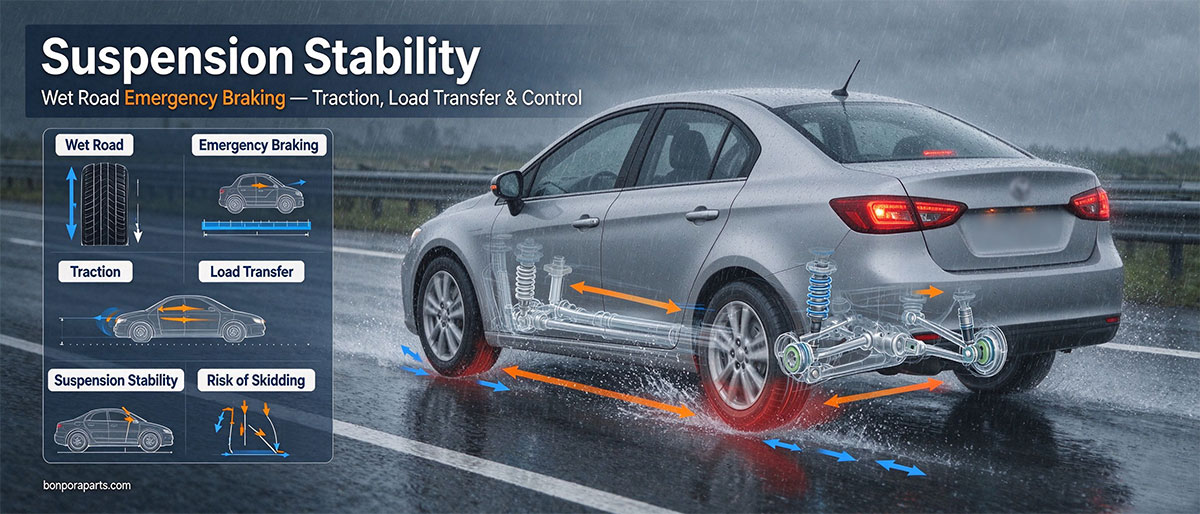
Rain soaked roads reduce tyre to road friction dramatically. While tyres define the traction limit, suspension stability decides whether that available grip can be maintained during emergency braking, sudden lane avoidance and travel over uneven water covered surfaces. A well controlled suspension keeps tyres planted, balances load transfer and prevents abrupt geometry shifts that trigger skid, understeer or oversteer.
Why Suspension Stability Matters More on Wet Pavement
On dry asphalt, tyres keep a wide safety margin between current demand and the adhesion limit. On wet pavement, a water film lowers friction and small disturbances grow quickly into visible slip. Body pitch, wheel bounce and side roll change the vertical load on each tyre within fractions of a second. When the suspension cannot follow these movements in a stable way, the contact patch of one or more tyres fluctuates, and the remaining grip becomes hard to predict.
Electronic systems such as ABS, ESP and TCS regulate slip by comparing wheel speed signals and adjusting brake force or drive force. These systems rely on stable wheel behaviour. Excessive suspension movement creates noisy wheel speed readings and reduces the accuracy of slip detection, which weakens intervention during the critical first seconds of an emergency manoeuvre.
What Happens During Emergency Braking on a Wet Road
When a driver applies firm emergency braking on wet asphalt, weight shifts rapidly toward the front axle. The nose of the car dives, the rear axle lightens and tyre loads change across all four corners. Uncontrolled suspension travel creates excessive dive, uneven vertical load across the wheels and a fluctuating tyre contact area.
Even with fully working ABS, unstable suspension motion can extend the stopping distance and raise the risk of loss of control. The rear axle, already light under braking, may lose lateral grip first, while the front tyres work close to the adhesion limit. In this state, a small steering input or a patch of standing water can push the vehicle toward understeer or oversteer before the driver can react.
Suspension Components That Keep Tyres Planted
Several parts of the chassis work together to stabilise the vehicle in these critical moments. Understanding their role helps explain where component quality directly affects wet road safety.
Shock Absorbers and Damping Control
Shock absorbers manage rebound and compression so wheels follow the road contour instead of bouncing away from the surface. Damping that has faded allows repeated wheel oscillation after a bump or puddle entry, which interrupts tyre contact and shortens the window for stable braking.
Control Arms, Ball Joints and Suspension Bushings
Control arms, ball joints and suspension bushings preserve the designed wheel alignment, keeping camber and toe consistent under dynamic load. When these connecting parts develop play, ageing or permanent deformation, the tyre contact angle drifts during braking, and wet grip performance drops sharply.
Bump Stops and Travel Limiters
Bump stops define the final stage of suspension compression. They absorb energy near the travel limit and prevent hard contact between metal parts. Their stiffness curve shapes how the chassis behaves when the suspension moves close to full compression during heavy braking or rough wet road travel.
Progressive PU Bump Stops for Controlled Compression
Bonpora PU bump stops serve as the final travel limiter in the suspension system. During heavy emergency braking, crossing puddles or hitting wet road bumps, these polyurethane buffers deliver progressive cushioning before metal to metal bottoming occurs. The progressive resistance restrains excessive compression, moderates pitch motion and protects suspension geometry from sudden destructive impact.
The result is more predictable tyre loading and more reliable traction on slippery surfaces. Compared with generic soft rubber buffers that compress unevenly over time, formulated polyurethane keeps its load curve stable through repeated cycles and seasonal temperature change, which matters in markets with frequent rainfall and wide temperature variation.
Precision Suspension Shims for Consistent Geometry
Bonpora precision suspension shims support fine calibration of ride height, camber and bump stop engagement point. Consistent shim thickness ensures repeatable suspension behaviour across production batches, a key requirement for passenger vehicles, EV suspension systems and light commercial fleets operating in rainy climates.
Small geometry corrections spread braking load more evenly across the tyres. When alignment and engagement timing stay within tolerance, the chassis reacts in a predictable way during hard braking, and the chance that one tyre loses grip ahead of the others is reduced.
Durable Rubber and Polyurethane Bushings for Wet Climate Use
Bonpora suspension rubber and polyurethane components are formulated to resist water, ozone, thermal ageing and exposure to road chemicals such as road salt and winter de icing agents. Durable bushings and buffer blocks maintain their designed stiffness after long service, avoiding the soft, delayed response common with worn generic rubber parts.
For EV suspension, where lightweight construction and predictable NVH performance carry equal weight, these validated parts help keep the chassis stable during combined regenerative and hydraulic braking on wet roads. Stable bushing behaviour also supports consistent steering feel, which gives drivers clearer feedback when grip margin becomes narrow.
Suspension Does Not Create Grip, It Protects Available Grip
It is important to state the boundary clearly: suspension parts do not raise the static friction coefficient of wet pavement. Their safety contribution lies in stability control. A stable suspension keeps each tyre inside its traction window long enough for electronic safety systems to intervene effectively. When suspension geometry collapses or bounces out of control, even premium tyres and advanced ESC cannot deliver their full safety potential.
This is why wet weather safety must be viewed as a system result: tyres provide the grip ceiling, electronics regulate slip trend, and a stable suspension platform holds the whole system together under emergency load.
Bonpora Suspension Components for Rainy Market Programmes
For vehicle manufacturers, suspension engineering teams and aftermarket distributors targeting markets with frequent rainfall, consistent component quality is non negotiable. Bonpora provides OE grade bump stops, suspension shims, rubber buffers and chassis rubber components with material traceability, sample validation and custom compound tuning. Every part is tested for load capacity, fatigue life and environmental stability to support safe, repeatable chassis performance in emergency wet road scenarios.
Frequently Asked Questions
How does suspension stability affect braking distance on wet roads?
A stable suspension controls pitch, body roll and vertical load transfer so each tyre keeps a consistent contact patch. Worn or uncontrolled suspension causes wheel bounce and uneven loading, which can lengthen stopping distance even when ABS works correctly.
What role does a bump stop play during emergency braking?
A bump stop limits maximum suspension compression in a progressive way, prevents hard metal to metal bottoming, moderates nose dive and preserves wheel geometry so tyre contact remains steady under heavy dynamic load.
Why are suspension shims important for wet road handling?
Precision shims maintain calibrated ride height, camber and bump stop engagement timing. Consistent shim thickness supports predictable load distribution and helps prevent one tyre from losing grip ahead of the others during wet braking or sudden lane change.
Which Bonpora components support suspension stability on wet pavement?
Bonpora supplies PU bump stops, suspension shims and suspension rubber or polyurethane bushings, validated for passenger cars, electric vehicles and light commercial chassis programmes operating in rainy climates.