
- 1. What Counts as a Load Case for an Off-Road Bump Stop
- 2. Load Case 1: Jump Landings and Full-Compression Bottom-Out
- 3. Load Case 2: Roll and Articulation Limit Loading
- 4. Load Case 3: Towing, Overloading and Sustained Contact
- 5. Load Case 4: Gravel, Washout and High-Frequency Impact
- 6. Turning Off-Road Bump Stop Load Cases into Specification Lines
- 7. Worked Example: Two Ways to Buy for a Lifted Pickup
- 8. Frequently Asked Questions
- 8.1. Do air bumps make polyurethane bump stops obsolete for off-road builds?
- 8.2. Should the bump stop touch at static ride height on a lifted truck?
- 8.3. Can a workshop specify force at deflection without a test rig?
- 8.4. Does a harder off-road bump stop protect the shock absorber better?
- 8.5. How long should an off-road bump stop last?
Off-Road Bump Stops: Load Cases Buyers Forget
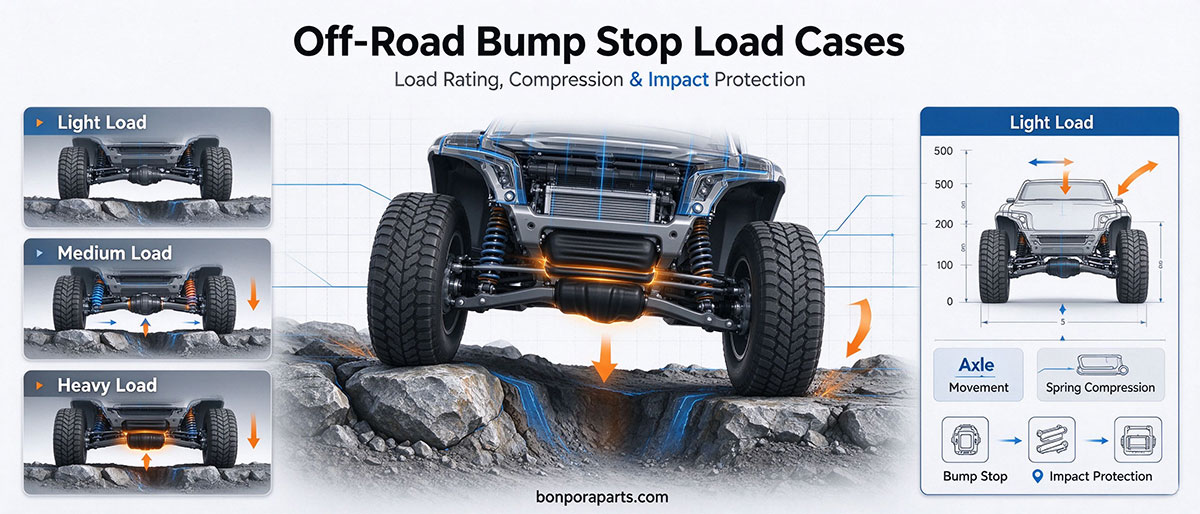
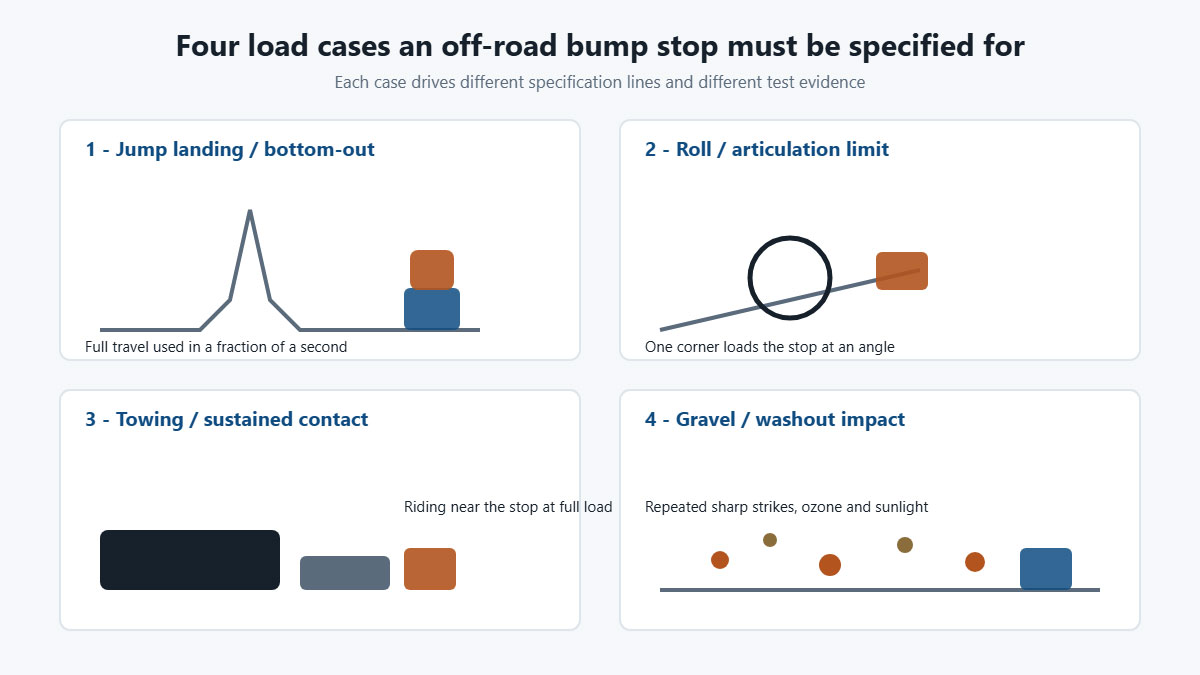
An off-road bump stop that is chosen from a catalogue number will eventually be asked to do a job nobody specified. Four load cases decide whether the part survives: jump landings and full bottom-out, roll and articulation limits, towing and sustained contact, and gravel or washout impact. Write each one into the specification before you order.
What Counts as a Load Case for an Off-Road Bump Stop
A load case is a repeatable combination of event, travel used, load state and temperature. A catalogue fitment answers the question "does it fit". A load case answers the question "does it survive the way this vehicle is actually driven". For a road car the difference rarely matters, because the part is touched only on a severe compression event. On an off-road vehicle it matters a great deal: a jump landing, a rock step or a washout can drive the suspension through its remaining travel in a fraction of a second, and the bumper is what stops the damper from reaching metal-to-metal contact.
That is why the part is a tuning element rather than a wear item. Changing its height, its hardness or the shape of its contact face changes how the vehicle behaves at the limit. The four tuning variables are the free length, the hardness, the geometry of the contact face and the gap left at static ride height. Two vehicles of the same model can need different parts once one of them carries a suspension upgrade, because the travel that remains after the change is a different number.
The compound choice follows the same logic. The product family uses high-elasticity polyurethane built on MDI or NDI chemistry: MDI systems cover a wide span of general off-road and OEM-style applications, while NDI systems are often chosen where high dynamic load and rebound behaviour matter most, at the cost of more demanding processing. Neither family is automatically better, which is why a supplier should be given the application data first and asked to propose the compound afterwards.
The four sections below describe the load cases that buyers most often leave out of the specification, and what each one demands from the part.
Load Case 1: Jump Landings and Full-Compression Bottom-Out
This is the case buyers do think about, but usually in the wrong units. What matters is not the height of the jump; it is the amount of travel left after the springs and dampers have taken their share, and how quickly the remaining travel is consumed. A landing that uses the last eighty millimetres of travel in a fraction of a second asks the bumper to absorb high-impact energy while staying progressive enough not to spike the load into the frame.
Three consequences follow for the specification.
First, the available space must be measured, not assumed. If the space between the bumper seat and its contact face at full bump is smaller than the section of the part being ordered, the bumper will extrude outwards rather than compress cleanly. Extrusion is the failure mode to watch for on this type of part, and it is almost always a gap problem rather than a compound problem. Measure the full-bump dimension on the vehicle.
Second, the performance requirement should be written as a force at a stated deflection. A race team can usually state this directly; a workshop customer may only be able to say whether the current setup feels too soft or too hard at the limit. Either answer is usable if it is written down, and it is exactly the input a supplier needs before proposing a hardness and a stiffness curve.
Third, the evidence to request changes. For this load case, ask for the stiffness curve report, which confirms the part reaches the designed force at the designed deflection, and the fatigue life report, which predicts behaviour on long-travel use. Tear strength matters here too, because it describes how fast a defect grows once an impact has started one.
Load Case 2: Roll and Articulation Limit Loading
On an off-camber trail section, one corner of the vehicle can run out of travel while the opposite corner hangs into droop. The stop on the loaded corner is then compressed at an angle, and the contact face loads unevenly: one edge takes a disproportionate share of the force. That is a slow tear scenario rather than an impact scenario, and it starts where the elastomer meets the edge of the strike pad or the rim of the seat.
The specification lines this case drives are geometric rather than chemical. State the contact pad size, so the pressure on the face can be judged. For an externally mounted stop, the bolt pattern and the angle of the mounting face matter as much as the section, because a stop that sits crooked will edge-load every time the suspension articulates. Where the part rides on the damper shaft inside the body, confirm the seat diameter and any washer or sleeve interface with tolerances instead.
Externally mounted stops carry a second exposure in this load case. Because they sit in the open, ozone and sunlight attack the surface over time, and a surface that has started to check will crack earlier under edge loading. Ozone ageing resistance is one of the tests named for this product family, and it is the report to insist on when the stop is mounted outside the damper.
Hardness deserves a note here as well. A harder part resists edge deformation, but it also raises the force the vehicle feels at the limit, and ride quality at the limit is what the customer judges. Hardness should be chosen against the load path, not against the assumption that harder means stronger.
Load Case 3: Towing, Overloading and Sustained Contact
The third case is not an event at all. A pickup that tows at its limit, or a vehicle that runs at or near its load limit for long periods, can sit close to or on its bump stop for whole sections of road. The site guidance for this product family makes the same point from the vehicle side: where a vehicle runs at or near its load limit for long periods, the bumper should be checked at full load rather than at kerb weight, because the gap at ride height changes with the load.
Sustained contact changes the physics. Under continuous cycling the internal temperature of the elastomer rises, and long periods of high ambient temperature combined with that cycling accelerate ageing. This is where the compound families separate: MDI-based systems are described as acceptable at moderate cycle rates, while NDI-based systems generally show lower hysteresis in demanding cycles. A part that is correct for occasional bottom-out can be the wrong part for a tow rig that lives near its stops.
Two specification lines cover this case. State the duty: kerb weight or full load, towed or not, the typical surface, and how often the vehicle reaches the stop. Then ask the supplier to propose the compound against that duty rather than against the vehicle name. Where the duty is severe, fatigue life evidence is the report that answers the question.
There is also a warranty boundary to draw early. A stop that is worn because a setup drives the suspension onto it is a design issue on the vehicle, not a defect in the part, and suppliers treat the two differently. The standard terms quoted for this family cover material and manufacturing defects for one year or 30,000 km, with the explicit note that the period may be adjusted for modified or racing applications. Recording the intended duty on the order is what keeps that conversation factual if a claim arrives.
Load Case 4: Gravel, Washout and High-Frequency Impact
The fourth case is the least dramatic and the most common. Gravel roads and washouts deliver repeated sharp strikes rather than one big landing: the suspension consumes a large share of its travel again and again, at a rate the damper's heat capacity struggles to follow. On a motorcycle the same case dominates, because the rear stop works as the end-stop for small travel at high frequency, and its geometry matters more than its bulk.
For the part, this case is a surface and compound question. Repeated strikes favour a compound with high tear strength and stable behaviour as it heats. An exposed external stop also faces ozone and sunlight for its whole service life, which is why surface durability belongs in the specification even for a mid-market build. The product family is quoted for minus 40 to plus 100 degrees Celsius, a range chosen to cover high-temperature desert conditions and low-temperature snow environments, and the compound can be adjusted where the application demands it.
The practical translation is a duty statement in the RFQ: the climate, the typical surface, and whether the vehicle is used competitively. A supplier who receives "daily use on corrugated gravel at 35 degrees Celsius ambient, external mount" can make three decisions at once - compound family, whether ozone ageing evidence is the priority report, and what inspection interval to suggest. A supplier who receives only a reference number has to guess all three.
Turning Off-Road Bump Stop Load Cases into Specification Lines
The table below condenses the four cases into the lines that belong in a purchase specification, together with the evidence each line justifies. It is deliberately short: a one-page specification that covers the four cases will outperform a ten-page document that does not.
| Load case | What it does to the part | Specification line to write | Evidence to request |
|---|---|---|---|
| Jump landing / bottom-out | Full travel consumed in a fraction of a second; extrusion if the gap is smaller than the section | Space available at full bump, measured on the vehicle, plus the force wanted at a stated deflection | Stiffness curve report; fatigue life report |
| Roll / articulation limit | Uneven, edge-biased loading of the contact face; slow tear start at the edge | Contact pad size; for external stops, bolt pattern and mounting face angle | Tear strength report; ozone ageing resistance for exposed stops |
| Towing / sustained contact | Long periods at or near the stop at full load; heat build-up under cycling | Duty statement: load state, cycle rate, typical surface | Fatigue life report; compound proposal (MDI vs NDI) from the duty data |
| Gravel / washout impact | Repeated sharp strikes on an exposed surface; ozone and sunlight attack | Climate and duty statement, including the -40 to +100 degrees Celsius operating range | Ozone ageing resistance; tear strength |
Before any purchase order for an off-road programme, run the twelve checks below. The first four are measurements, the middle four are specification decisions, and the last four are process guards.
Measure the space between the bumper seat and its contact face at full bump on the vehicle, not from the model.
Record the travel that remains after the lift kit or new spring rate has been fitted, and the gap at static ride height.
Convert the customer's judgement - too soft or too hard at the limit - into a force at a stated deflection, in writing.
State the load case: kerb weight or full load, towing or not, competition or fleet duty.
Choose the compound family against the duty: MDI for a wide span of general off-road use, NDI where high dynamic load and rebound matter most, and ask the supplier to confirm from the data.
Confirm the temperature range the part will see; the product family is quoted at minus 40 to plus 100 degrees Celsius.
Quote the mounting interface with tolerances: shaft diameter, seat diameter, contact pad size, any washer or sleeve, and for external stops the bolt pattern and face angle.
If the stop is externally mounted, ask for the ozone ageing resistance report.
Order one to three samples per candidate reference and set the acceptance criteria before the samples arrive.
Fit the first article over the full travel with the wheels off the ground so contact is made slowly, then inspect the contact pattern on the strike pad before the vehicle is driven in earnest.
Agree the carton size and loading pattern so parts are not held compressed in transit or storage; polyurethane held compressed for months may not recover fully, and direct sunlight should be kept off stored parts.
Write the warranty terms for modified or racing use into the order; the standard one year or 30,000 km can be adjusted for those applications, and that should be settled before the order, not after a failure.
Worked Example: Two Ways to Buy for a Lifted Pickup
Consider a distributor who sells about four hundred bump stops a year for one popular lifted pickup. The specification route chosen before the first order decides the cost of the next twelve months. All figures below are illustrative and are meant to show the shape of the calculation, not a quoted price.
Route A orders by reference number from a catalogue listing. The listing fits, but nothing in it states the force at full compression for a vehicle carrying a load. Over the year, part of the range proves too soft at full load: customers report the suspension reaching a hard stop, twenty-eight units come back or turn into claims. Assume an average claim cost of 26.50 per unit for replacement, credit and administration, half an hour of fitting labour per return at 55.00 per hour, and 240.00 of repeat freight across the year.
Route B spends one afternoon before the order: two hours measuring the full-bump gap on six customer vehicles at the same 55.00 per hour, a three-piece sample order at 45.00 plus 80.00 of courier cost, and a specification premium of 0.08 per unit - the price of stating the duty and buying against a stiffness curve instead of a shape.
| Cost line | Route A: order by reference | Route B: specify by load case |
|---|---|---|
| Gap and ride-height measurement | 0.00 | 110.00 |
| Samples and courier | 0.00 | 125.00 |
| Specification premium (400 units) | 0.00 | 32.00 |
| Claims: 28 units at 26.50 | 742.00 | 0.00 |
| Refit labour: 28 units, 0.5 h at 55.00/h | 770.00 | 0.00 |
| Repeat freight | 240.00 | 0.00 |
| Total for the year | 1,752.00 | 267.00 |
The difference is 1,485.00 for the year, and it excludes the harder-to-price items: the customer who does not come back after a second failed part, and the technician time spent diagnosing a vehicle instead of fitting a part. The same structure applies at any volume; only the claim lines scale with units sold.
The second route costs one working afternoon because the data it collects is short. If the programme covers several vehicles, the wholesale and sourcing guide for the off-road jounce bumper range shows how the same inputs are turned into an RFQ that several factories can quote on equal terms.
Frequently Asked Questions
Do air bumps make polyurethane bump stops obsolete for off-road builds?
No. Some off-road builds use a pressure-driven air bump in place of a solid elastomer, but an external polyurethane stop remains simpler to service and easier to change while a setup is being tuned, because it does not require the damper to be rebuilt. The choice follows the build, the budget and how often the setup changes, not a rule.
Should the bump stop touch at static ride height on a lifted truck?
No. The gap left at static ride height is a tuning variable, and the number that matters is the travel remaining after the suspension change. The stop should be reached as designed, not ridden continuously. If a vehicle sits on its stops at ride height, the springs, the load state or the stop selection is wrong, and sustained contact becomes a heat and ageing problem rather than a cushioning function.
Can a workshop specify force at deflection without a test rig?
Yes, indirectly. Record what the customer feels at the limit - too soft or too hard, on which surface, at what load - together with the measured gap at full bump. A supplier can convert that written description into a proposed hardness and stiffness curve. A race team can state the force directly; a workshop description is usable as long as it is written down rather than remembered.
Does a harder off-road bump stop protect the shock absorber better?
Not automatically. Hardness is one of four tuning variables, alongside free length, contact face geometry and the gap at ride height. A harder part raises the force for the same deflection, which can push more load into the frame and change how the vehicle feels at the limit. What protects the damper is a part that reaches the right force at the right deflection, which is what the stiffness curve report confirms.
How long should an off-road bump stop last?
For this product family the stated design life under standard off-road operating conditions is no less than five years or 80,000 km, and no less than three years or 30,000 km for motorcycles, with no cracking, no extrusion and no significant permanent deformation. The warranty is one year or 30,000 km for material and manufacturing defects, with the period adjustable for modified or racing applications. At inspection, look for cracking, check whether the part recovers its free height after full compression, and examine the strike pad for polish or deformation.
If you are building the range rather than buying for one vehicle, the Bonpora off-road jounce bumper range lists the product family and its specification guide, and the off-road bump stop category groups the application families in one place.
- Prev.:Genuine OE, OES, Aftermarket & Budget Parts Guide for Old Ford F‑150 | Bonpora Parts
- Next.:...