sales@bonporaparts.com
0086-10-64988621
English
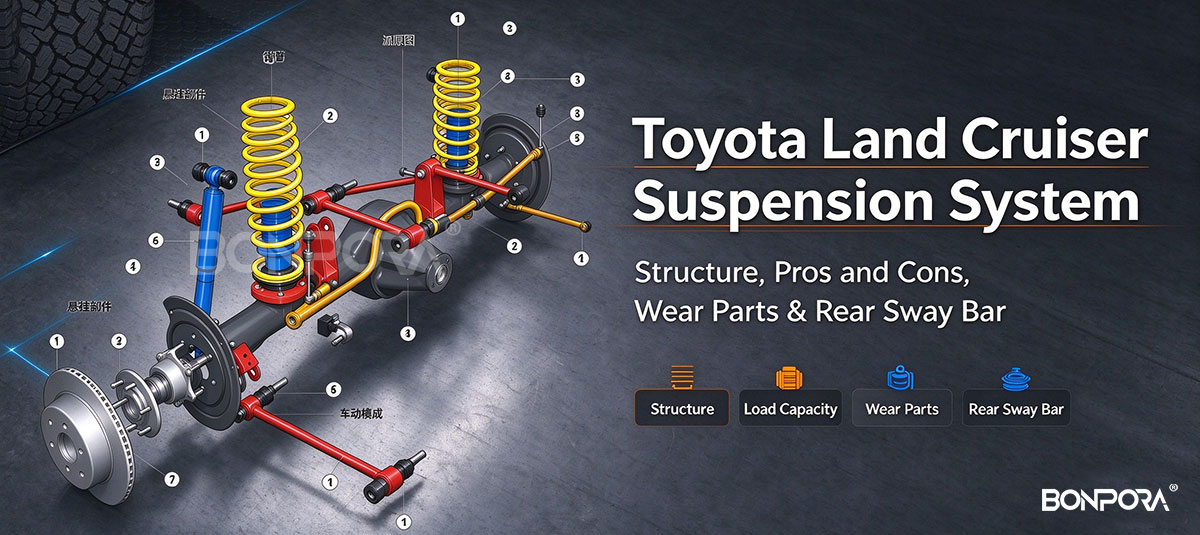
The Toyota Land Cruiser has built a global reputation for durability, off-road capability and long service life. For vehicle operators, repair suppliers and aftermarket part buyers, understanding the Toyota Land Cruiser suspension system structure, its practical advantages and disadvantages, common wear parts, and rear sway bar role is essential for maintenance planning and parts sourcing.
This guide explains the Land Cruiser suspension system in practical terms, without unsupported claims. It also helps buyers identify common replacement parts and evaluate compatible suspension components for service and repair needs.
Land Cruiser models have used different suspension configurations across generations and markets. Common setups include:
Front solid axle or independent suspension, depending on generation and model
Rear solid axle with coil springs or leaf springs in certain applications
Control arms, link arms, rods and bushings
Shock absorbers and coil springs
Stabilizer bars / sway bars, including rear sway bars in some versions
Because model codes, production years and market variants differ, exact suspension structure should always be confirmed by chassis number, model code or original equipment information.
Where the Land Cruiser suspension system is widely regarded as strong:
Good load-carrying ability for utility and heavy-use conditions
Proven durability in harsh off-road and long-distance service
Strong parts availability in many global markets
Clear service and maintenance culture among operators and technicians
Flexibility for different replacement and upgrade options
The same structural characteristics can also create trade-offs:
Complex suspension geometry may require careful alignment after repair
Multiple linkages and bushings can create more wear points
Heavy off-road use can accelerate bushing, joint and rod end wear
Some models are sensitive to worn stabilizer bar links and mountings
Replacement parts must match the exact model, year and application
Common replacement categories include:
Stabilizer bar links / sway bar links
Control arms and link arms
Tie rods and steering linkage parts
Bushings and mounts
Shock absorbers
Coil springs and related hardware
Rear sway bar components where applicable
A rear sway bar helps control body roll during cornering and sudden maneuvers. When links, bushings or mountings wear, the vehicle may experience noise, loose handling or reduced stability.
Buyers should confirm:
Whether the specific Land Cruiser variant is equipped with a rear sway bar
Original part number or OE reference
Arm length, mounting position and bushing compatibility
Hardware and fastener completeness
Bonpora supplies suspension components for heavy-use and SUV applications, including stabilizer bars, rear sway bar components, control arms, link arms, tie rods, bushings and related parts. These components are suitable for aftermarket service and replacement use where vehicle compatibility is confirmed.
Buyers evaluating Bonpora should focus on:
Product drawings and dimension verification
OE reference or vehicle application comparison
Material, surface treatment and corrosion resistance
Bushing, joint and fastener quality
Sample validation before volume ordering
View our product page here: https://www.bonporaparts.com/en/products/
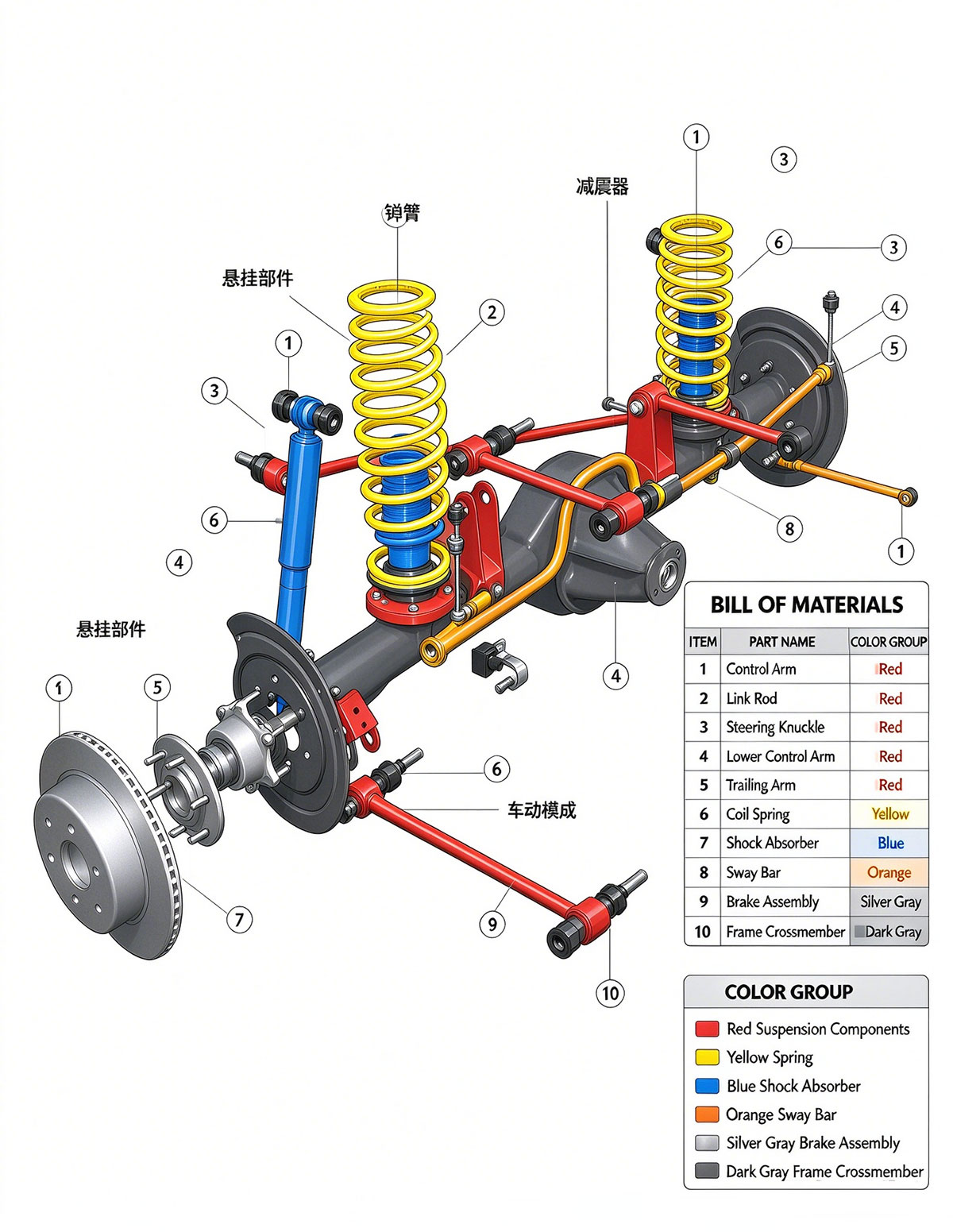
A: It varies by generation and model, but common elements include front suspension, rear axle, coil or leaf springs, control arms, link arms, rods, bushings, shock absorbers and stabilizer bars.
A: Typical strengths include good load capacity, proven durability in harsh conditions, strong global parts support and wide operator familiarity.
A: Common wear parts include stabilizer bar links, control arms, link arms, tie rods, bushings, mounts, shock absorbers and rear sway bar components where fitted.
A: Confirm the vehicle variant, model year, OE reference, arm length, mounting position, bushing type and hardware kit. Always validate compatibility before volume purchase.
For technical inquiry, sample request or volume production discussion, please contact our sales team: sales@bonporaparts.com.
