
Twenty Minutes, Eight Questions: How Buyers Qualify a Chassis Parts Supplier at Automechanika Dubai 2026
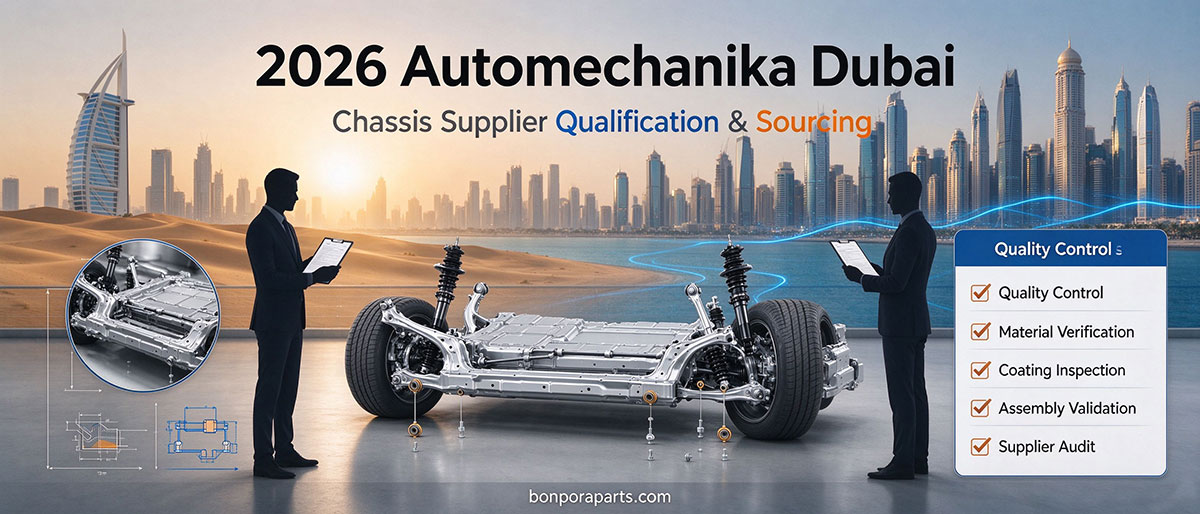
Automechanika Dubai is now in its first year at a new home. The 23rd edition runs from 10 to 12 November 2026 at Dubai Exhibition Centre in Expo City, after 22 editions at Dubai World Trade Centre. The organiser, Messe Frankfurt Middle East, expects more than 1,200 exhibitors from over 50 countries, across 11 product sections and at least 20 content features. In 2025 the show recorded visitors from 161 countries and exhibitors from 63 countries.
The move is not cosmetic. Glasgow Research and Consulting forecasts the Middle East and Africa aftermarket reaching USD 87 billion by 2034, growing at a compound annual rate of up to 7 percent. The region is also running a more complex vehicle mix: conventional vehicles still dominate volume, while hybrid, electric and connected vehicles keep adding requirements for parts availability, diagnostics and workshop skills.
1. What the Mixed Fleet Does to a Chassis Catalogue
A single chassis part number now has to serve more than one kind of buyer. A stabilizer link ordered for a conventional sedan may sit on the same shelf as one specified for a heavier hybrid or electric platform, where curb weight and load paths differ. That does not make the parts interchangeable, but it does change what a distributor needs from a supplier: coverage breadth, clear application data, and honest guidance about which platform each part actually fits.
This is the practical meaning of a more varied aftermarket. Distributors in Dubai, Riyadh, Jeddah, Doha and the wider region re-export into Africa and the CIS, so a single container often carries dozens of low-volume references rather than a few fast movers. Suppliers built only for high-volume single-reference orders struggle in that environment.
2. The First Twenty Minutes: Eight Questions
A show floor is a poor place to read a catalogue and a good place to test how a supplier answers. These eight questions, in this order, do most of the work.
| Question | What a credible answer sounds like |
|---|---|
| 1. Which platforms does this part number cover? | Named models, years and engine or drivetrain variants, with the source of that mapping. |
| 2. What is the coating, in salt spray hours? | A number for the finished part, and a separate statement for welds and threads. |
| 3. How is the dust boot sealed and tested? | A named test method and a pass criterion, not a claim that the boot is tight. |
| 4. What is the stud material and hardness? | A grade and a hardness range, plus the taper fit tolerance. |
| 5. Is the kit complete? | Castle nut, cotter pin, circlip and washer listed as included, not quoted separately. |
| 6. How do you pack for a mixed container? | Carton dimensions, unit pack printing, and how batches are kept separable. |
| 7. What ships with the documents? | HS code, country of origin declaration and material statement per shipment. |
| 8. What happens when a batch fails in the field? | A named process with a response time, not a general promise of support. |
Questions two, three and eight are the ones that separate suppliers most sharply. Everybody can show a photograph of a ball joint. Very few can put a number behind the coating, a method behind the seal, and a process behind a field failure.
3. Red Flags on the Floor
Photographs instead of data. A booth full of polished parts with no coating hours, no hardness range and no test method is a trading desk, not a manufacturer.
Kits assembled on request. If hardware has to be added later, it will be missing at the workshop.
Universal answers. A supplier who claims one part fits every platform has not tested any of them.
No origin documents. Buyers in this region re-export. A missing country of origin statement becomes a customs problem weeks later.
Price quoted before specification. The lowest number on the floor is usually the number that did not include the coating.
4. What to Bring Into the Hall
Three things make the twenty minutes productive:
Three fast-moving part numbers from your own shelf, with annual volume for each.
One failed part, ideally cut open. A supplier who can read a failure from the fracture face is a supplier who understands the joint.
A target landed cost band, so the conversation moves to specification trade-offs instead of list prices.
5. What BONPORA Supplies
BONPORA manufactures steering, suspension and chassis components in Hubei, China, and supplies importers, distributors, workshop chains and private label programmes across the Gulf, Asia, Europe and Africa. The range includes:
Ball Joints and Ball Joint Kits — castle nut, cotter pin, circlip and flat washer supplied in the box.
Tie Rod Ends and Rack Ends — inner and outer, hardened studs, controlled taper fit.
Stabilizer and Sway Bar Links — including adjustable and chrome-plated adjusting links with PU bushings.
Rubber Bushings and PU Buffer Blocks — OE-matching dimensions, compound options for hot climates.
Control Arm Components — OE-matching geometry with bushing and ball joint options.
Steel Shims, External Tooth Lock Washers and Flat Washers — the fastening layer that preserves clamp load.
Full specifications are listed on our Products page. We answer the eight questions above with numbers before a quotation is issued.
6. Why Importers Stay With BONPORA
The show floor rewards the supplier who can answer the third question before the buyer asks the fourth.
Specification data attached to the quote — coating hours, stud hardness and boot test criteria per part number.
Complete kits — hardware in the box, so the workshop does the job once.
OEM and ODM programmes — your brand, packaging and part numbering on our engineering.
Mixed-container loading — built for distributors who stock breadth rather than depth.
Export documents ready at shipment — HS code, origin and material statements included in the pack.
7. If You Are Not in Dubai This Week
The eight questions work by email as well as they work across a table. Send three part numbers, the annual volume behind each, and the platform list you need covered. You will get a coverage map, a specification sheet and a landed cost range — the same answers the booth is giving this week, without the flight.
Request a quote for ball joints, tie rod ends, stabilizer links, bushings or control arm components. Coverage maps, coating specifications, kit contents and OEM/ODM pricing available.
- Prev.:Built on Sound Welds: Chery Rear Axle Recall Exposes the Weakest Link in Chassis Sourcing
- Next.:...