
Awarded in 2026, Serviced in 2032
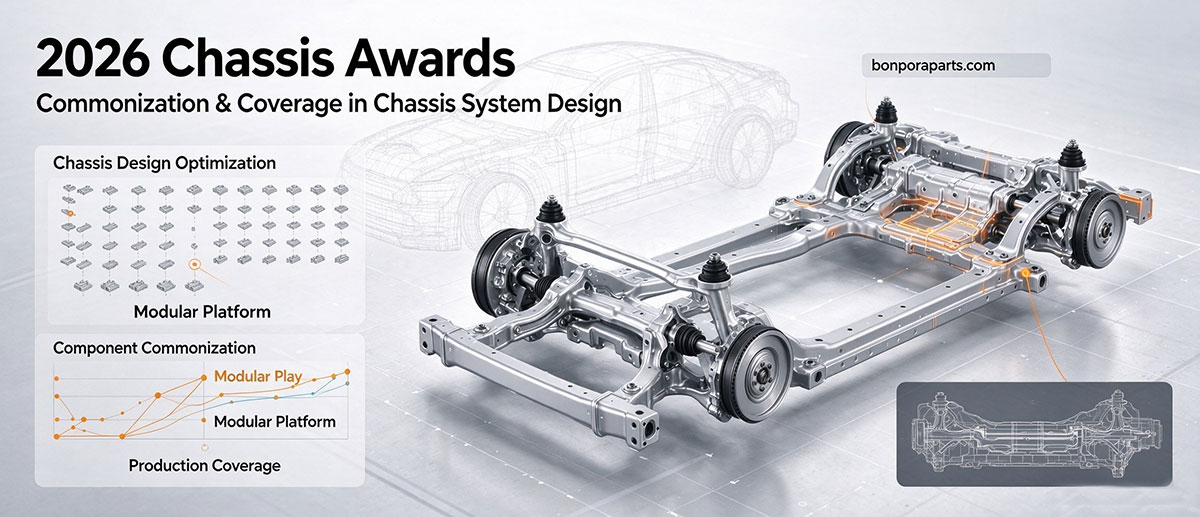
Two stories landed on the same page the same morning. The first concerned who makes the parts. The second concerned how many part numbers an OEM intends to keep. Read separately, they are procurement news. Read together, they describe the shape of the aftermarket catalogue that independent workshops in Europe, North America, the Gulf and Southeast Asia will be working from in the early 2030s.
What was actually ordered
The Nikkan Jidosha Shimbun report of 25 November summarised a supplier announcement dated 10 November from Musashi Seimitsu Industry, a Japanese chassis and driveline supplier based in Toyohashi. Three awards matter for anyone who sells linkage.
1. BYD: the parts are inside the steering gearbox
The Zhongshan plant of Musashi Seimitsu Automotive Parts took new orders from BYD for tie rod ends and rack end ball joints used on the steering gearbox of two battery-electric sport utility vehicles, the Da Tang and the Sealion 08. Production and delivery began in June 2026.
This is the least visible and most consequential of the three awards. A rack end ball joint sits inside the gearbox boot, at the inner end of the tie rod. It carries the steering load, it is greased once at assembly, and it is the first joint a workshop discovers after the boot has been torn for a year.
2. Mercedes-Benz: aluminum camber and tension links, machined in Mexico
Musashi Mexico took orders through Hirschvogel Components Mexico, the Mexican subsidiary of the German forging group, for a rear camber link and a rear tension link for a Mercedes-Benz sport utility vehicle. Both are aluminum suspension parts. Musashi Mexico performs machining and assembly, with mass production scheduled from April 2029.
The photograph released with the announcement shows exactly those two arms: a short curved camber link and a longer, kinked tension link, each with a bushing at one end and a bushing at the other. Different forgings, different jobs on the same axle.
3. Subaru: driveline, not linkage
Musashi and Kyushu Musashi expanded orders for front differential parts and transmission parts for hybrid vehicles and started mass production; a rear differential part was added as a new order. Relevant to a driveline buyer, less so to a linkage buyer, but it confirms the direction: Japanese Tier 1 capacity is being re-pointed at hybrid and battery-electric programmes, in the region where those programmes are assembled.
The Mexican operation is not a footnote. Musashi announced on 13 November that it would double capacity at the Mexico plant for hybrid vehicle parts, and the April 2029 camber link award sits on that same site. A part for a German badge, forged by a German supplier, machined in San Luis Potosi, shipping into a North American assembly chain: that is the normal shape of a 2029 suspension programme.
Same morning, the other announcement: fewer numbers
Mitsubishi Motors said it will accelerate cross-model parts commonization, beginning with the next Pajero series and extending afterward to global models. The reasoning given is blunt: in Japan, each model has tended to use its own individual parts, so the number of part types is too high relative to total production volume.
The Pajero is a useful test case because it is not a high-volume city car. The new generation was launched in Thailand on 19 October 2026, built at the Rayong plant, with sales in Japan and Australia from mid-December and a plan to reach roughly one hundred countries and regions from fiscal 2027 onward. It uses a ladder frame derived from the Triton pickup, with its own cabin and suspension development. A low-volume, hundred-country, body-on-frame flagship is precisely the programme where a shared control arm, a shared stabilizer link or a shared ball joint either pays for itself or does not.
The three clocks, now with dates
An award announcement is a start signal for a programme and a countdown for a catalogue. The intervals are not the same.
| Programme | Parts and place | Start of production | Typical first independent service demand |
|---|---|---|---|
| BYD Da Tang, Sealion 08 | Rack end ball joints, tie rod ends; Zhongshan, China | June 2026 | Around 2030 to 2031, once fleet mileage passes 60,000 to 80,000 km |
| Mercedes-Benz SUV | Aluminum rear camber link, rear tension link; machined and assembled in Mexico | April 2029 | Around 2032 to 2033, after the warranty period closes |
| Subaru hybrid | Front and rear differential parts, transmission parts; Japan | In production | Driveline service, not linkage; timing follows hybrid fleet age |
| Mitsubishi Pajero series | Commonized parts across models; Thailand production, global rollout | Japan and Australia from mid-December 2026 | Around 2030 onward, heaviest in markets with poor road surfaces |
The April 2029 date is the one to underline. A part that starts production in 2029 is a part that independent workshops will ask for in 2032 and 2033. A distributor who waits for the first request will be quoting from photographs at exactly the moment a competitor is quoting from a drawing.
What a shared part does not share
Commonization is usually sold as a cost reduction. For a buyer it is a change in the shape of the risk, and it shows up in five places.
| Item | Programme supply | Aftermarket supply |
|---|---|---|
| Number of numbers | Falls sharply across the model range | Falls only if the catalogue is rebuilt, not if it is inherited |
| Volume per number | Rises, which pays for tooling | Rises, which is good, but also concentrates a claim |
| Supersession chain | One number replaces several | Long, and often undocumented at the point of sale |
| Validation envelope | Must cover the heaviest application in the family | Unknown unless the supplier states it in writing |
| Tooling ownership | Usually amortised inside the OEM contract | Often left with the programme supplier and lost at end of production |
The validation envelope is where buyers get hurt. When one camber link serves a five-seat crossover and a seven-seat battery-electric variant with a heavier rear axle, the load case that matters is the heavy one. If the part was validated against the middle of the family, the first failures will appear on the heaviest variant, in the market with the worst roads, and they will appear inside the warranty period of the vehicle rather than inside the warranty period of the part.
Rack end ball joints deserve their own paragraph
Three dimensions decide whether a rack end fits: the thread on the inner shank, the ball diameter and the boot retention. On a battery-electric SUV with a variable-ratio gearbox, the rack end is frequently longer than the equivalent part on the combustion donor, and the boot clamp is a different style. None of this is visible in a product photograph. All of it is visible in a drawing.
Camber and tension links do different work
The camber link is short and sets the static camber of the rear wheel. The tension link is longer, runs fore and aft, and holds the wheel against braking and traction loads. They share a bushing style and they share a failure signature, which is a knock over small bumps and a visible polish mark on the bushing sleeve. They do not share a length, an arm angle, or a bushing durometer. A commonized family that looks identical at a glance is the exact case where measuring before quoting saves a container.
Six questions before you quote a commonized link
Which gearbox family does the rack end belong to?
Gearbox code, not model name. The thread and the ball diameter follow the gear, not the badge.What is the validation load case, and against which variant?
Ask for the heaviest application covered, in writing. A bench cycle count without the load case proves durability of nothing in particular.Is the arm forged or cast, and in which alloy?
Aluminum forging and aluminum casting do not share a section stiffness, and they do not share a repair procedure.Which bushing is pressed and which is bonded?
A bonded bushing cannot be replaced on its own, so the service part is the whole arm. That changes the stocking decision.What is the supersession list?
Old numbers, new numbers, and the date each changed. Without it, a distributor carries two numbers for one part and calls it coverage.Who holds the tooling after the programme closes?
If nobody does, the last-time-buy quantity is the only answer, and it should be agreed before the final release, not after.
What BONPORA can quote today
We manufacture and export chassis linkage and steering parts from Hubei, and we quote against drawings and application lists rather than photographs. The range covers ball joints and pre-assembled kits with castle nut, cotter pin, snap ring and plain washer; inner and outer tie rod ends; rack ends and rod ends with male or female thread; stabilizer links, fixed or adjustable, with bushings and eyelets; control arms with pressed or vulcanised bushings, including arms with an integrated ball joint; and steel shims, external tooth lock washers and plain washers for the same assemblies.
For a programme that is commonizing, the useful deliverable is not a price list. It is a coverage file: the part numbers we can support now, the platform and model year behind each one, the material and heat treatment declaration, the lot-level traceability unit, the supersession note where a number has changed, and the tooling status of every item. If a number exists only as a sample, we say so before quoting rather than after the first container.
Ask for the coverage file, not a price list
Send the platforms you intend to cover, the market, and the annual volume band. We will reply with the numbers we can support now, the ones that need tooling, and the lead time for each.
Email: sales@bonporaparts.com
Chassis and suspension: https://www.bonporaparts.com/en/chassis-and-suspension/
- Prev.:The Award Letter Names a Plant: Where Chassis Linkage Goes When Steering Programs Move
- Next.:...