
- 1. Two order books changed hands this week
- 2. What a steering award actually buys, and what it drags along
- 3. Three things that move, one thing that does not
- 4. Korea shows the second-order effect
- 5. Germany shows the first-order effect
- 6. What to ask before the bill of materials is frozen
- 7. Where BONPORA fits
- 8. Request a quotation or a documentation sample
The Award Letter Names a Plant: Where Chassis Linkage Goes When Steering Programs Move
A steering or chassis module contract is written for eight years, but it decides a bill of materials for fifteen. That is why chassis parts buyers read Tier-1 award news.
Two order books changed hands this week
On Sunday, Hyundai Mobis said it had secured orders worth about KRW 1 trillion, or USD 742.99 million, to supply braking and steering systems to two automakers in Europe and North America, with deliveries running for up to eight years. The braking side is an electronic integrated regenerative brake system, known as iMEB, for a European customer. The steering side is electric power steering for a North American customer. The customers were not named. Production will run at the existing plant in Slovakia and at a site near the North American customer, and deliveries start in three to four years.
The same announcement carried a second number. Hyundai Mobis expects overseas orders for modules and core components to reach USD 14.5 billion this year, against USD 9.2 billion a year earlier, roughly 58 percent higher and above its own USD 11.8 billion target. It also said a separate seven-year chassis module deal with another North American automaker is close to being finalized, potentially worth several trillion won depending on customer volume. Chassis modules for Jeep vehicles in North America have been supplied by this company since 2006, and chassis modules go to Mercedes-Benz from Hungary, with battery systems to Volkswagen from Spain.
In Germany, the movement runs the other way. ZF Friedrichshafen intends to sell its airbag and seat belt manufacturing division to ZF Lifetec for several billion euros, with Adient, American Industrial Partners and FountainVest among the interested parties, and is also considering a sale of its electric drive technology development division. ZF, Continental, Schaeffler and Bosch have each announced thousands of job cuts in recent months as car sales fall.
In Korea, the pressure shows up one level lower. KG Mobility is developing the SE10, a successor to the Rexton midsize SUV, on a platform from Chery, with a launch planned for early 2027 and a platform fee of USD 75 million financed through a foreign currency loan. Renault Korea builds the Grand Koleos and the Filante on Geely platforms in Busan. Sales at Renault Korea in the first ten months of 2026 reached 52,734 units, down 31.2 percent year on year. For a domestic supplier that does not win the successor model, the end of the outgoing vehicle is the last delivery date.
What a steering award actually buys, and what it drags along
A steering system award covers the rack, the motor, the controller and the software. It does not cover the parts that connect the rack to the wheel. Those are still ordered as chassis linkage, and they are still ordered by part number, per platform, per model year, for the whole service life of the vehicle.
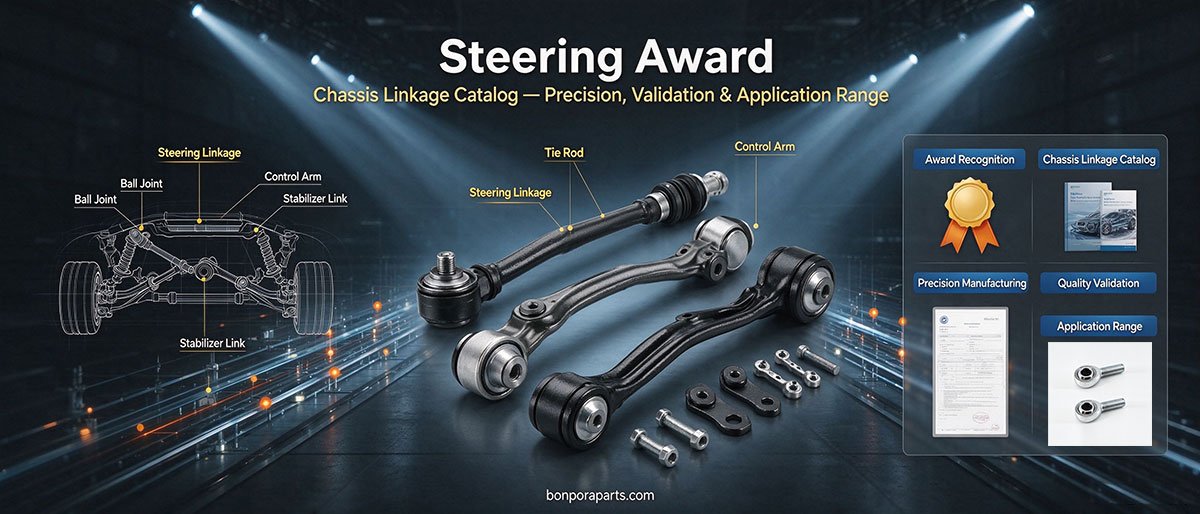
That list is small and stubborn. It repeats across platforms, and it never disappears when the architecture changes:
Ball joints, including the pre-assembled kits with castle nut, cotter pin, snap ring and plain washer
Inner and outer tie rod ends, plus rack ends with male or female thread
Stabilizer links, fixed or adjustable, with bushings and eyelets
Control arms with pressed or vulcanized bushings, and arms with an integrated ball joint
Steel shims, external tooth lock washers and plain washers used in the same assemblies
When electric power steering replaces hydraulic assistance, the driver feels a different rack. The knuckle still carries a ball joint. The tie rod still takes the same axial load. The stabilizer link still has to survive the same roll moment. What changes is how precisely those parts must be documented, because an EPS controller reacts to friction, backlash and preload that a hydraulic system used to absorb.
Three things that move, one thing that does not
| When a steering or chassis module program is re-awarded | What it means for chassis linkage supply |
|---|---|
| The plant moves, for example to Slovakia or to a site near the customer | The country of origin changes with it. Duty treatment, and for some programs regional content rules, now apply to a part number that did not change. |
| The bill of materials is rebuilt around the new module | Linkage part numbers may survive, but the approved supplier list is rewritten. Incumbents must re-qualify; newcomers get a window. |
| Volumes are set by the customer, not the supplier | A seven-year chassis module deal can be worth several trillion won or far less, depending on model volume. Tooling amortization becomes the real negotiation. |
| The physical function of the linkage does not move | The ball joint still centers the knuckle, the tie rod still sets toe, the link still resists roll. Engineering changes rarely touch the geometry; they touch the evidence. |
Korea shows the second-order effect
Platform transplants are quiet until they are not. When a midsize automaker adopts a Chinese platform, the assembly line in Korea can keep running at the same volume while the design authority and the sourcing authority for core parts move elsewhere. Body, electrical and drivetrain content can be replaced by imported parts. A supplier that used to win the door panel also pulled orders for the steel processor and the die maker behind it. Import the finished panel and the die work disappears, even though the same number of vehicles rolls off the line in Pyeongtaek or Busan.
The structural numbers explain the anxiety. Korea counts 4,142 businesses dedicated to parts for internal combustion vehicles, a base that shrinks first as electric models remove engines and transmissions. In a 2025 survey by the Korea Automotive Technology Institute, companies pursuing conversion or diversification named securing new customers and markets as their biggest difficulty, at 38.1 percent. One order that stops does not stop at one company.
For a buyer outside Korea, this is an opportunity and a warning. It is an opportunity because capable suppliers with idle capacity and trained staff are actively looking for new programs, including small and medium volumes that large Tier-1 plants no longer want to quote. It is a warning because capacity that leaves a region rarely comes back, and a supplier list that depends on one platform can be gone in a single model cycle.
Germany shows the first-order effect
The ZF move is not about chassis linkage. It is about portfolio discipline under a cost crisis. But the arithmetic is the same everywhere: when a large supplier sells a division or closes a plant, the parts that division used to make do not vanish from the roads. They move to whoever will quote them, often at lower volume and higher mix.
This is where independent chassis suppliers earn their place. A ball joint for a 2014 platform, a rack end for a low-volume commercial vehicle, a stabilizer link for a model that sold well in one market and poorly in another: these are not attractive programs for a Tier-1 with a five-year payback hurdle. They are routine work for a supplier built around flexible tooling and documented small lots.
What to ask before the bill of materials is frozen
If you buy chassis parts, or if you are preparing a quotation for a program that is about to be re-awarded, these six questions decide whether you can actually deliver:
Who owns the tooling, and where is it? If a module moves plant, the tooling may stay behind. Confirm ownership in writing, and confirm who pays for the transfer and the re-qualification run.
Can one part satisfy two acceptance procedures? A dual-source program often means two sets of test protocols. Ask which characteristics are drawing-controlled and which are process-controlled, then price the difference.
What is the traceability unit? Heat number, plating line, assembly station or shipment lot. A recall can only be narrowed to the batch you can name.
Which evidence travels with the part? Material certificate, case depth and hardness gradient, torque versus tension curve, salt spray hours, dimensional report, and a change log that survives a plant transfer.
How is the castle nut and cotter pin controlled? Fastener integrity is a process result, not a drawing note. Ask for the torque window and the clamp load behind it.
What happens at end of production? Service demand outlives the vehicle program by a decade. Ask for a last-time-buy window and a tooling retention commitment.
Where BONPORA fits
BONPORA manufactures and exports chassis and steering linkage from Hubei, China, for aftermarket distributors, rebuilders and OE/ODM programs: ball joints and complete kits with castle nut, cotter pin, snap ring and washer; inner and outer tie rod ends; rack ends with male or female thread; stabilizer links, fixed and adjustable; control arms in stamped steel or aluminum with pressed or vulcanized bushings; PU jounce bumpers; steel shims and lock washers.
Every shipment can be accompanied by the document pack a purchasing audit asks for: material and heat treatment records, hardness and case depth, dimensional inspection reports, salt spray results, assembly torque values and lot-level traceability. Tooling can be customer-owned, and low-volume part numbers are accepted when the drawing and the annual quantity are clear.
If a program you support is moving plant, changing module supplier or absorbing a new acceptance procedure, send the drawing and the current specification. We will tell you what can be quoted as is, what needs a new tool, and what documentation you will need to defend the part number at the next audit.
Request a quotation or a documentation sample
Send part numbers, drawings, annual volumes and the acceptance standard you work to. We reply with price, lead time and the document list, usually within two working days.
Email: sales@bonporaparts.com
Product catalog: https://www.bonporaparts.com/en/products/
Chassis and suspension index: https://www.bonporaparts.com/en/chassis-and-suspension/
- Prev.:810,000 Vehicles, One Fastener Gap: The Parts Behind the Largest Recalls of November 2026 | BONPORA
- Next.:...