
One Bolt Turns a Bracket Into a Cantilever
On 27 November 2026 the Vietnamese importer Thanh Cong Motor began campaign 48LS on 272 Skoda SUVs: 175 Kodiaq and 97 Karoq, all built at the Czech plant between 11 October 2022 and 11 April 2023. The repair is a single bolt, the right-hand bolt that attaches the steering rack to the body. It is replaced with a version that resists corrosion better, the work takes about one hour per car, and the owner pays nothing. Skoda states that no incident related to the defect has been recorded in Vietnam.
Two months earlier, the same bolt, the same remedy and a different scale. The German federal authority entered Skoda campaign 48LS in its database on 2 October 2026 under reference 17091R: 1,719,030 vehicles worldwide, 370,347 of them in Germany, covering Kodiaq, Karoq, Octavia and Superb built between November 2015 and August 2026. Skoda was the last of four group campaigns on the same part. Together they reach about 4.64 million cars.
This is not a story about a bad batch. It is a story about how much structure sits behind one fastener, and about what a recall leaves in the field after the fastener is changed.
One bolt, four brands, one design
The numbers are worth setting side by side, because they show a single design decision scaled across brands rather than four separate mistakes.
| Brand | Worldwide | Germany | Model lines named | Brand code | KBA reference |
|---|---|---|---|---|---|
| Volkswagen | 2,159,054 | 895,832 | Golf, Golf Variant, Tiguan, Touran, Caddy | 48VS | 17016R |
| Skoda | 1,719,030 | 370,347 | Kodiaq, Karoq, Octavia, Superb | 48LS | 17091R |
| Audi | 696,547 | 58,555 | Q3 | not stated | not stated |
| SEAT | 66,224 | not stated | Ateca, Tarraco | not stated | not stated |
| Group total | 4,640,855 | 1,368,308 | Four separate campaigns, one shared component and one shared platform family | ||
The North American file is separate and smaller: NHTSA campaign 26V590000 covers 208,724 vehicles, namely the 2018 Tiguan, the 2018 and 2019 Atlas and the 2019 to 2021 Audi Q3, with the same remedy wording, replacement of the right-side steering rack mounting bolt.
Four brands, four codes, four files, and one line in the bill of materials. That is the ordinary shape of a platform-level defect: the part is common, the campaigns are national, and the paperwork multiplies while the hardware does not.
Why a two-point bracket becomes a cantilever
A steering rack is not clamped along its length. It hangs on the subframe at two points, and the right-hand bolt is one of them. With both points intact the rack is a beam: load enters at the pinion, travels through the housing, and splits between two supports. Take one support away and the same beam becomes a cantilever, with the surviving bolt carrying not only the original share of the load but also a bending moment produced by the offset to the pinion axis.
The failure sequence in the official wording runs like this. Moisture enters the area of the right-hand bolt. Salt and water corrode it over years of service. The head breaks. The rack is then attached at one point only. When the driver turns the wheel with the car stationary, the force applied rises sharply, the housing is loaded in a way it was never designed to resist, and the housing can crack. Steering control is lost.
Two details in that sequence matter more than the corrosion itself.
First, the peak load is not at speed. Static steering, the moment of parking and of slow manoeuvring, is where tyre scrub torque and assist pressure are highest while the rack has almost no support from vehicle motion. A component that fails under parking load gives the driver very little warning at 100 km per hour, because at 100 km per hour it is not the governing case. That is why both Skoda and Volkswagen describe the first symptom as an unusual metallic noise from the front axle area, and why both instruct owners to stop driving when they hear it.
Second, the bolt is a structural element, not a fastener in the ordinary sense. Its torque specification, its coating system and its head geometry are design parameters. A purchaser who treats a rack bolt as a commodity item with a diameter and a length has removed the only variables that decide whether it survives a decade of road salt.
Practical reading for a workshop: a broken rack bolt does not always show as play in the steering wheel. The rack can still be held well enough at low load to feel normal on a lift. The check is visual and it is at the right-hand mounting point, not at the tie rod ends.
A recall is a parts list with a deadline
Here the story stops being about corrosion and becomes about supply. The remedy needs a corrosion-resistant bolt, and that bolt is scarce. German trade reporting on the campaign states plainly that where the new bolt is not available in volume, workshops fit a bolt of the previous type first, and the car returns for a second appointment when the improved version arrives.
That single operational detail changes the state of the field in three ways that a buyer should price in.
The repaired population is not homogeneous. Some cars carry the coated bolt, some carry the old bolt for another season, and some have not been touched at all. A part number that fits all three is not the same as a part that performs the same on all three.
The service channel absorbs the supply. For a period measured in quarters, the coated bolt goes to franchised dealers first. Independent workshops in importing markets see the surrounding parts before they see the bolt.
The campaign follows the VIN, not the car. A vehicle that changes hands, or crosses a border as a used import, can circulate for years without the owner ever receiving a letter. In markets where the parc is fed by imports rather than by a national distributor, that gap is the normal condition rather than the exception.
Three documents, three windows
The same defect is described with three different production windows. That is not a contradiction; it is how a global campaign is written down at national level. It does mean that a buyer cannot use one document to define coverage.
| Document | Models named | Production window stated | Count |
|---|---|---|---|
| KBA reference 17091R, Skoda, 2 October 2026 | Kodiaq, Karoq, Octavia, Superb | November 2015 to August 2026 | 1,719,030 worldwide, 370,347 in Germany |
| Vietnam campaign 48LS, from 27 November 2026 | Kodiaq, Karoq | 11 October 2022 to 11 April 2023 | 272, split 175 Kodiaq and 97 Karoq |
| French RappelConso sheet SR/03168/26, 13 November 2026 | Octavia III, Superb III, Karoq I, Kodiaq I | 9 March 2015 to 4 June 2024 | not stated |
Note what the third document adds: a generation boundary. Octavia III, Superb III, Karoq I and Kodiaq I are named as generations, not only as nameplates. When a catalogue is built by nameplate alone, Kodiaq becomes one heading with one arm, one ball joint and one tie rod end. When it is built by generation, the same nameplate becomes two headings with different geometry, different bushings and, in some cases, a different subframe.
This is the quiet cost of a long campaign window. A defect that runs from 2015 to 2026 does not sit inside one generation of any model. It sits across the facelift, across the platform update, and across the point where a supplier changed. The recall covers all of it because the fastener did not change. The aftermarket cannot assume the same, because everything around the fastener did.
What the bolt leaves behind
When the right-hand mounting point fails, or is suspected of failing, the parts on that corner have been working outside their design envelope. The rack has been moving relative to the subframe, the inner joint has been asked to absorb an angle it was not built for, and the outer joint and the arm have been carrying a geometry that changes as the rack shifts. Replacing the bolt restores the support. It does not certify the joints.
| Part | Why it is in this list | What to measure or look at |
|---|---|---|
| Rack end, the inner tie rod joint | It is the first joint downstream of a rack that has been moving on one mount, and it works at the largest articulation angle in the system | Axial play at the socket, boot condition, thread engagement at the rack, and whether the lock tab or staking is intact |
| Outer tie rod end | Static steering loads pass through it while the rack is at an angle it should not hold | Radial play at the stud, taper condition in the knuckle bore, and boot clamp tension |
| Ball joint at the affected corner | A shifted rack changes the steering angle at rest, which changes the load path into the joint | Axial pull-out condition, boot integrity, and the presence of the retention hardware that belongs to the joint |
| Control arm bushings | The arm locates the wheel while the rack moves; a geometry error is absorbed there before it is felt at the wheel | Bond separation between rubber and sleeve, void closure, and any witness mark from metal contact |
Then there is the alignment. A rack that has shifted on one mount, even by a fraction of a degree at the pinion, moves the toe on both sides. A four-wheel alignment after the repair is not a courtesy; it is the only way to know whether the geometry has returned to the design value, and it is the cheapest data point a workshop will collect on that car all year.
What BONPORA can quote today
We manufacture and export chassis and steering parts from Hubei, and we quote against drawings and application lists rather than photographs. The range covers ball joints and pre-assembled kits that ship with the castle nut, cotter pin, snap ring and plain washer; inner and outer tie rod ends; rack ends and rod ends with male or female thread; stabilizer links, fixed or adjustable, with bushings and eyelets; control arms with pressed or vulcanised bushings, including arms that carry an integrated ball joint; rubber bushings and PU buffers; and steel shims, external tooth lock washers and plain washers for the same assemblies.
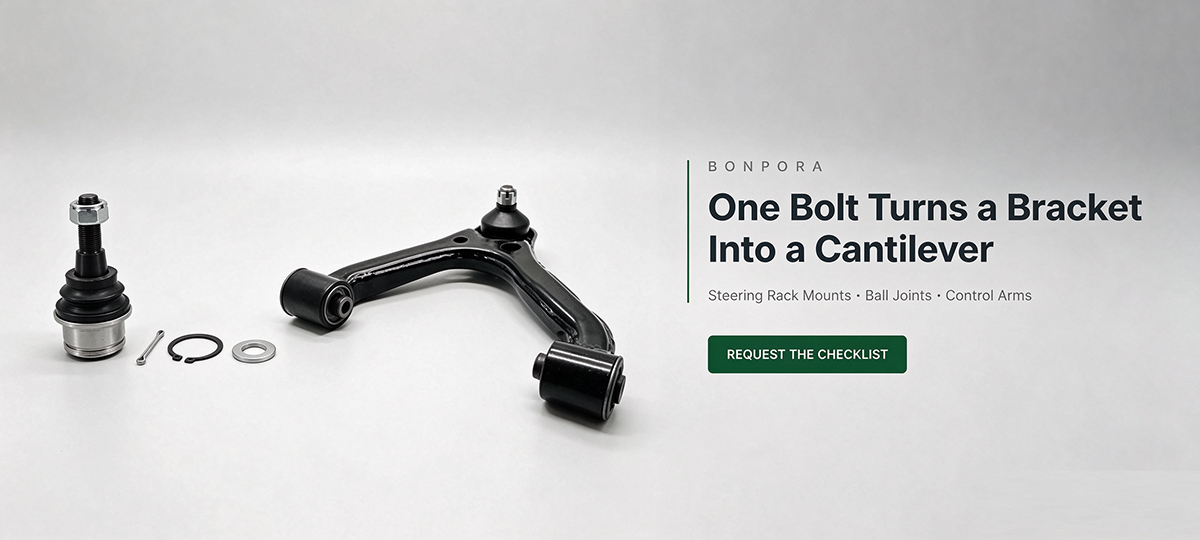
The kit is worth a sentence of its own. In the photograph at the top of this page the hardware is laid out beside the joint, and that is how it leaves the factory. A castle nut without a cotter pin, or a housing groove without a snap ring, is a joint that has been designed to be inspected rather than to stay put. The retention chain is part of the part.
Scope, stated plainly: we do not manufacture steering racks, we do not supply the rack mounting bolt discussed in this article, and we do not cast steering knuckles. We are not a supplier to any of the programs named here. What we control is the joint that goes into the bore, the link that connects it, and the arm that carries it.
Six questions to settle before an RFQ
Which generation, not only which nameplate?
A Kodiaq built in 2018 and one built in 2024 are different catalogue entries even where the name is the same.
Is the joint handed?
Left and right specific, or genuinely common, and does the drawing say so?
Which retention method applies?
Snap ring in a machined groove, rolled lip, or bolted flange, and is the groove dimension toleranced?
What pull-out value was tested, on how many samples, from which lot?
A batch record rather than a catalogue claim.
Does the coating system match the environment?
For anything that lives near a road salt line, the salt spray hours and the coating specification belong in the quotation, not in a brochure.
Which lot code will be on the carton?
And can it be traced to a heat number three years later, when a campaign is opened and every supplier in the chain is asked the same question?