sales@bonporaparts.com
0086-10-64988621
English
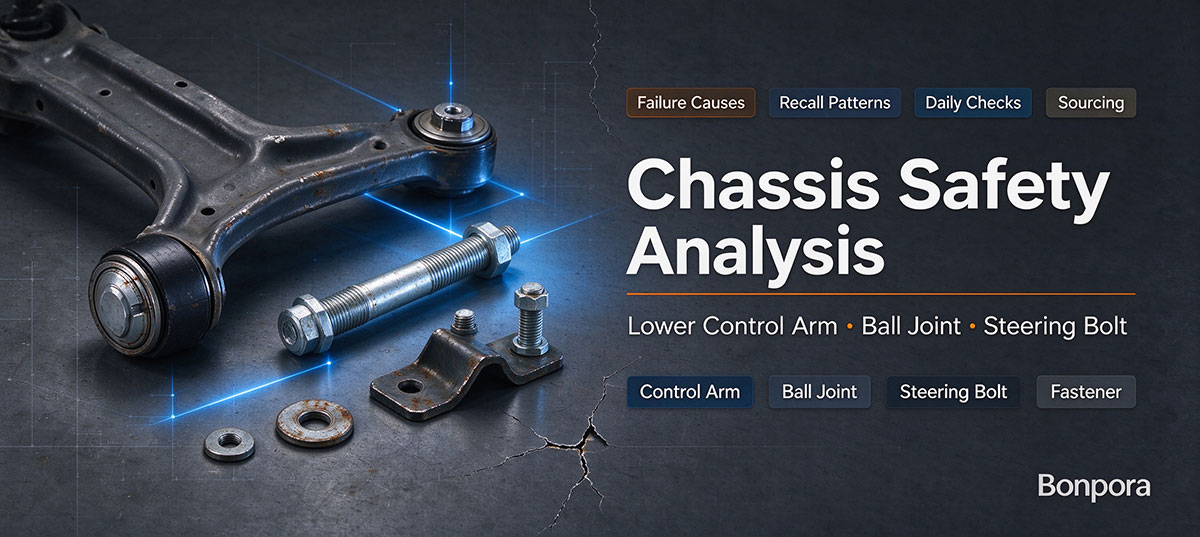
In recent months, several global vehicle recalls have drawn attention to chassis and suspension components that affect vehicle control and stability. Reports from different regions have cited issues including lower suspension arm bolts, ball joints, steering bolt corrosion, transverse link fasteners and control arm attachments. While each recall has its own root cause, the common theme is clear: chassis fasteners and load-bearing connections deserve careful attention during manufacturing, assembly and maintenance.
This article examines why lower control arms, ball joints and steering bolts are prone to failure, what drivers should check during daily use, and what buyers should look for when sourcing chassis components. It is intended for aftermarket distributors, repair shop networks, engineering teams and procurement managers.
Lower control arms, ball joints and steering bolts are part of the vehicle’s steering and suspension system. They connect the steering knuckle, wheel hub, subframe and chassis structure, while allowing controlled movement during steering, braking and road-induced loading.
Because these components carry or transmit dynamic loads, their failure can affect vehicle stability and control. Common safety-related concerns include:
Reduced steering precision
Unstable handling
Abnormal noise or vibration
Uneven tire wear
Potential loss of control in severe cases
The lower control arm connects the steering knuckle to the subframe or chassis. It is subject to bending, torsion, impact and repeated road loads. Failure may occur in the arm itself, in its mounting points, or in the fasteners that hold it in place.
Common failure modes include:
Material fatigue or cracking
Weld seam separation or insufficient weld strength
Bushing wear or displacement
Bolt loosening or fracture
Corrosion affecting mounting holes or fasteners
Lower control arm failures are often related to high local stress, repeated loading, corrosion, assembly variation or insufficient weld quality.
Ball joints allow the steering knuckle to move both vertically and horizontally while maintaining a structural connection. They are continuously loaded during steering, acceleration, braking and cornering.
Common failure modes include:
Bearing or seat wear
Boot damage and contamination
Lubrication loss
Stud taper wear or loosening
Housing deformation or fracture
Ball joints are particularly sensitive to sealing, lubrication, assembly torque and corrosion. Even small wear can increase play and change steering response over time.
Steering bolts and related fasteners hold critical connections between steering components, suspension parts and the chassis. Although they appear simple, they are among the most safety-critical elements in the system.
Common failure modes include:
Corrosion-induced strength loss
Hydrogen embrittlement
Insufficient preload or thread damage
Loosening under dynamic load
Fracture due to fatigue or impact
Steering bolts often fail not because of a single overload, but because of long-term degradation from corrosion, improper tightening, vibration or material issues.
Recent global recall reports have highlighted several patterns that are relevant to chassis component buyers:
Weld strength inconsistency in suspension arms
Fastener loosening or fracture in steering and suspension links
Corrosion affecting bolt integrity
Ball joint separation or loss of retention
Transverse link fastener issues affecting assembly stability
These cases show that chassis safety depends not only on individual component strength, but also on material quality, welding, fastening, sealing, coating and assembly control.
Vehicle owners may not detect internal wear before it becomes severe, but the following signs deserve inspection:
Abnormal clunking or knocking noise from the front suspension
Loose or imprecise steering feel
Uneven tire wear, especially on inner or outer shoulders
Vehicle pulling to one side during braking or driving
Vibration in the steering wheel
Visible corrosion, damage or play in suspension fasteners
Any sudden change in handling or steering should be checked by a qualified technician immediately.
Regular maintenance should focus on the following:
Inspect ball joint boots for tears, contamination or lubricant loss
Check lower control arm mounting points and fasteners
Look for corrosion around steering bolts and suspension brackets
Verify torque on service-critical fasteners according to vehicle specifications
Check alignment after suspension repair or part replacement
Replace damaged components before they affect vehicle control
Because chassis and suspension failures can have safety consequences, buyers should evaluate suppliers beyond price and delivery. A robust sourcing process should include:
Material specification and traceability
Welding process control and weld quality verification
Fatigue, load and corrosion resistance requirements
Fastener grade, coating and torque control
Ball joint sealing and lubrication design
Dimensional and assembly validation
Sample testing and production process capability
After-sales technical support and traceability
Bonpora supplies chassis components, suspension arms, mounting parts, fastener-related assemblies and structural components for passenger vehicle programs. Our focus is on helping buyers source application-specific parts with clear material, welding, fastening and dimensional control.
Buyers evaluating Bonpora may focus on the following capabilities:
Chassis and suspension component supply
Structural arm and mounting part evaluation
Material, welding and fastener discussion
Application-specific load and durability requirements
Sample validation and volume production support
Technical cooperation for replacement part programs
You can view our product page here: https://www.bonporaparts.com/en/products/
A: They fail due to bending, torsion, impact, repeated loading, corrosion, bushing wear, weld weakness or fastener failure. The lower control arm is a primary load path, so even small issues can affect stability.
A: Common causes include boot damage, lubrication loss, contamination, wear of the ball seat, taper wear, corrosion and housing damage. Ball joint failure can increase play and reduce steering precision.
A: Steering bolts maintain critical connections in the steering and suspension system. Corrosion, hydrogen embrittlement, insufficient preload, thread damage or fatigue can lead to sudden loss of retention.
A: Drivers should watch for abnormal noise, loose steering, uneven tire wear, pulling, vibration, visible corrosion or play in suspension fasteners. Any sudden change in handling should be inspected immediately.
A: Buyers should evaluate material traceability, welding control, fastener grade, corrosion resistance, sealing design, dimensional validation, sample testing and production capability. Safety-critical chassis parts require more than dimensional compliance.
For technical inquiry, sample request or volume production discussion, please contact our sales team: sales@bonporaparts.com.
