
How Dangerous Is a Ball Joint That Cracks at Speed? | OE-Grade Chassis Parts 2026
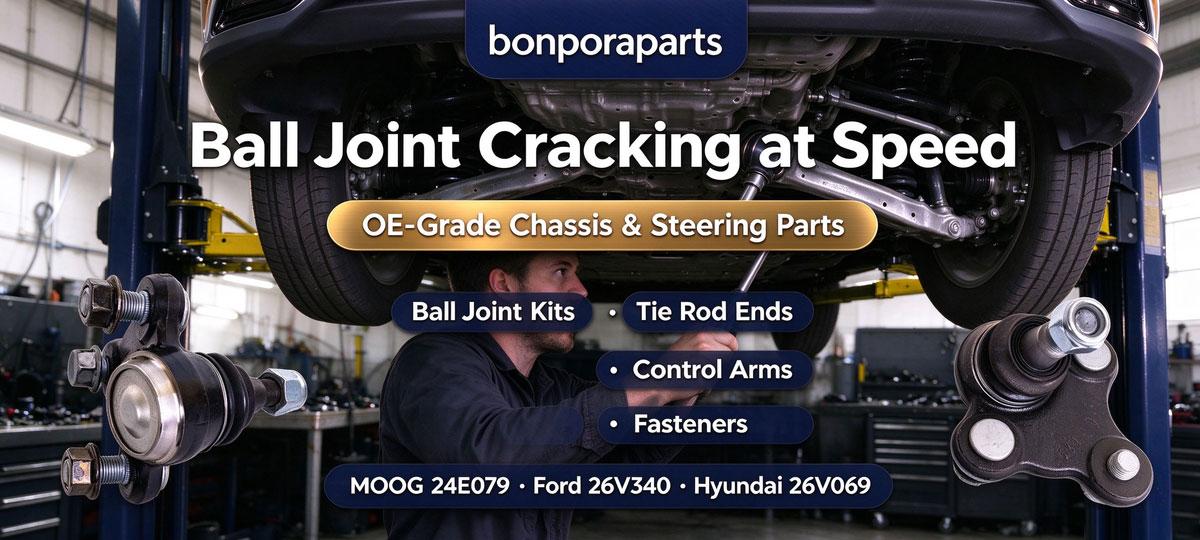
A ball joint looks like a small, quiet part. It is anything but. The ball joint is the spherical pivot that connects the steering knuckle to the control arm — and it carries the weight of the vehicle and transmits steering and road force on every mile you drive. When a ball joint cracks or separates at speed, it rarely fails quietly. In 2026, a wave of recalls — from MOOG's aftermarket ball joints (24E079) to Ford's lower control-arm ball joints (26V340) and Hyundai's steering knuckles (26V069) — is putting that exact risk back in the spotlight. For every importer and distributor, the question is no longer whether to carry OE-grade ball joints, but which supplier to trust.
1. What a Cracking Ball Joint Does at Speed
The danger is directly proportional to what the ball joint is doing. It is a load-bearing joint and a steering joint at the same time, so a failure changes both the wheel's geometry and the driver's control. And because the crack is usually hidden inside the rubber boot and metal socket, it gives almost no warning before it lets go:
Front lower control-arm ball joint separates — the control arm disconnects from the steering knuckle, the wheel loses support and alignment, and the vehicle suddenly loses directional control.
Tie rod end / outer tie rod ball stud fails — steering input stops reaching the wheel; the steering wheel can turn without the wheels following.
Ball-joint flange separates from the socket (as in MOOG 24E079) — the joint opens under load, causing an abrupt handling change and a collision risk.
The most dangerous cases happen at highway speed or in a corner, where there is almost no room to correct. That is why regulators treat ball-joint integrity as a safety floor, not a performance feature.
2. The 2026 Ball-Joint & Steering-Knuckle Recall Chain
The recall docket this year maps directly onto the failure modes above:
MOOG (NHTSA 24E079): certain aftermarket ball joints — the mounting flange may have cracked during heat-treating at a sub-supplier, allowing separation between flange and socket under load (October 2024 notice).
Ford (NHTSA 26V340000, 4,653 vehicles): 2021–2026 Bronco Sport and 2022–2026 Maverick front lower control-arm ball joints may have been incorrectly installed or repaired, allowing the control arm to disconnect from the front wheel knuckle; owners advised not to drive until repaired (letters mailed September 2, 2026).
Hyundai (NHTSA 26V069): 2026 Kona front steering knuckles may crack and break due to a manufacturing error, causing a loss of steering control.
Ford Explorer (NHTSA 26V101, 412,774 vehicles): rear suspension toe links, paired with cross-axis ball joints (CABJ) manufactured by SAF, may fracture under certain loading conditions.
Ford (NHTSA 25V310): the nut on the ball joint securing the front upper control arm may not have been installed or torqued to specification.
Volkswagen (NHTSA 25V434): chassis, brake and suspension bolts (including control arm, subframe and rear brake carrier bolts) may not have been correctly tightened.
The pattern is unmistakable: heat-treatment cracks, manufacturing errors, improper assembly and missed torque. None of these are visible to the driver — until they are felt as a sudden loss of control.
3. The Ball-Joint & Chassis Categories Buyers Need to Stock
For distributors, workshop chains and e-commerce buyers, the recall signal maps directly onto the product categories in the Bonpora catalog (www.bonporaparts.com/en/products):
Ball joints and complete ball-joint kits (with cotter pins, castle nuts, washers) — the component class at the center of the MOOG 24E079 and Ford 26V340 campaigns.
Tie rod ends and inner tie rods — the steering class where a fractured ball stud means loss of steering input.
Front lower control arms and control-arm assemblies — the bracket connecting the knuckle to the subframe.
Stabilizer links, including adjustable links with rod ends — fast-turnover suspension parts.
Rubber bushings and mounts — NVH and alignment parts that share the service interval with ball joints and control arms.
Steel shims, external-tooth lock washers, flat washers and fastener hardware — the fastening class that prevents loose-joint and lost-torque failures.
4. Why OE-Grade Ball Joints Are the Only Safe Stock
When a ball-joint recall is about heat treatment, flange integrity and bolt torque, the supplier's process becomes part of the product. Bonpora supplies chassis and steering components matched to OE geometry, with controlled heat treatment and surface finishing, complete pack-on kits (shims, nuts, washers, cotter pins) and documented QC — so import buyers who source direct from the factory get consistent batch-to-batch quality, clear cross-references, samples and shipping documentation, in English end to end.
5. Conclusion: Stock the Ball-Joint Parts That Hold Up
From MOOG's aftermarket ball-joint recall to Ford's lower control-arm ball joints and Hyundai's steering knuckles, 2026 keeps proving the same point: a ball joint is judged on material, heat treatment, fit and correct fastening — and when it fails, it fails at speed, with no warning. That is exactly where aftermarket demand sits this year, and exactly what a factory-direct, OE-grade source delivers.
Contact: sales@bonporaparts.com | Product page: www.bonporaparts.com/en/products
- Prev.:Why Lower Control Arms, Ball Joints and Steering Bolts Are Common Failure Points: A Technical Analysis of Recent Recalls
- Next.:China EV Export Tax Rebate Cut 13% to 9% (2027) | Factory-Direct Chassis, Suspension & Steering Parts | Bonpora