
China's EV Export Tax-Rebate Drops to 9% from April 2027 — Why Factory-Direct Chassis, Suspension & Steering Parts Become the Cost Lever
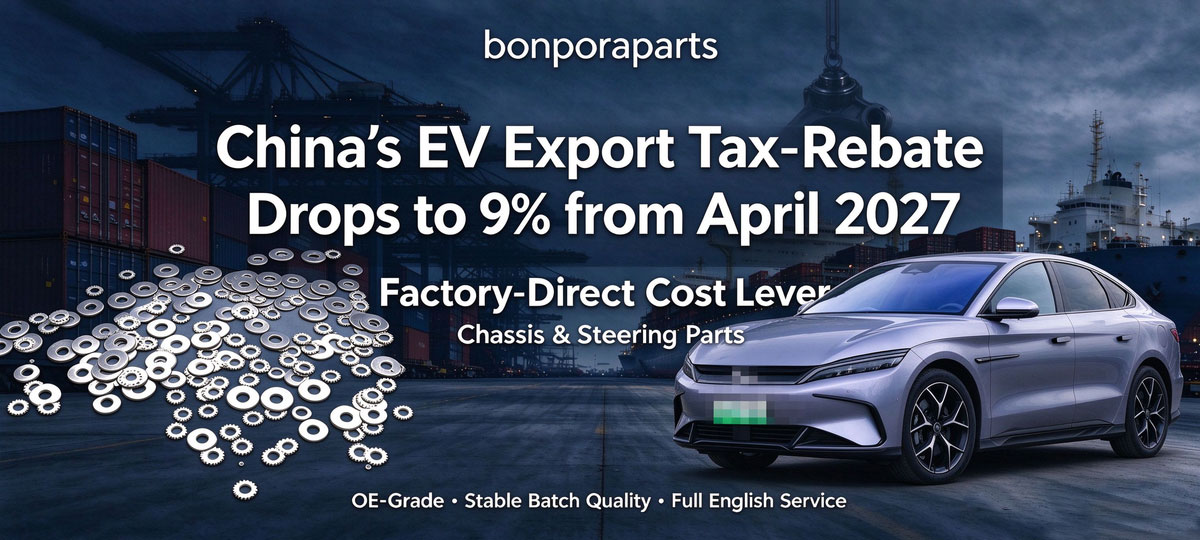
On 12 October 2026, China's Ministry of Finance and the State Taxation Administration published a notice that begins the countdown on an export incentive: from 1 April 2027, the value-added-tax (VAT) export rebate on new-energy vehicles (NEVs) will drop from 13% to 9%. The rebate is judged by the date on the customs declaration of the exported vehicle, so a vehicle that clears customs after that date falls under the new, lower rate — even if its sales contract was signed this year. For an export business that spans thousands of vehicles, that four-percentage-point change is a restructuring of the profit model. And it is precisely why, for overseas buyers sourcing chassis, suspension and steering parts, factory-direct supply is becoming the decisive cost lever.
What the Rebate Cut Actually Changes
Four percentage points sounds small; the arithmetic does not. Take an NEV with an export FOB price of about RMB 200,000: the cut reduces the rebate by roughly RMB 8,000 per vehicle. On a model above RMB 300,000, the reduction exceeds RMB 10,000 per unit. With automakers such as BYD, Chery, Geely and Great Wall each exporting more than 100,000 vehicles a year, the theoretical impact on export profit runs to hundreds of millions of yuan. Across the industry the message is the same: export competition is moving from policy support and pure cost advantage toward product strength, brand and localised operation.
Why This Shifts Attention to the Supply Chain and Aftermarket
When an export policy is trimmed, the whole cost chain gets re-examined. Automakers say they will re-calculate the full logistics and procurement cost during the window before the change takes effect, and many are looking beyond the vehicle itself — service networks, charging ecosystems and the aftermarket are increasingly treated as profit pools. For component buyers, the consequence is direct: the margin left for middlemen shrinks, and buyers who import chassis, suspension and steering parts now weight their sourcing on two things — delivered cost and consistent, verifiable quality. A factory-direct, OE-matched source removes layers of markup and keeps batch-to-batch quality stable, which is exactly the balance the market now demands.
The Chassis & Steering Categories That Carry the Demand
Whether the vehicle is a mainstream NEV or an older ICE fleet, the fast-turnover chassis and steering categories stay the same. For distributors, workshop chains and e-commerce buyers, these are the product classes in the Bonpora catalog (www.bonporaparts.com/en/products):
Ball joints and complete ball-joint kits (with cotter pins, castle nuts, washers) — the load-bearing, steering-critical class in every front-end inspection.
Tie rod ends and inner tie rods — regular steering wear parts that share the same service interval as ball joints.
Stabilizer links, including adjustable links with rod ends — fast-turnover suspension parts.
Rubber bushings and mounts — NVH and alignment parts that share the service interval with control arms and ball joints.
Steel shims, external-tooth lock washers, flat washers and fastener hardware — the fastening class that prevents loose-joint and lost-torque failures.
Why Factory-Direct OE-Grade Sourcing Wins When Cost Is Re-Examined
Bonpora supplies chassis and steering components matched to OE geometry, with controlled heat treatment and surface finishing, complete pack-on kits (shims, nuts, washers, cotter pins) and documented QC. Because the buyer sources direct from the factory, the price reflects the manufacturing cost rather than a stack of intermediaries, while quality stays consistent batch after batch. The full service runs in English end to end: part-number cross-referencing, samples, quotation, production scheduling, packaging and shipping documentation.
Sourcing Conclusion
As China's NEV export rebate steps down from 13% to 9% in April 2027, the entire export cost chain is being re-balanced — and that shift pushes aftermarket and component buyers toward leaner, factory-direct sourcing with OE-grade quality. For chassis, suspension and steering parts, the practical choice is the same one a disciplined buyer always makes: source the component class that holds up, from a supplier whose process and documentation protect you end to end.
Contact: sales@bonporaparts.com | Product page: www.bonporaparts.com/en/products
- Prev.:How Dangerous Is a Ball Joint That Cracks at Speed? — 2026 Recalls from MOOG 24E079 to Ford 26V340 Show Why OE-Grade Ball Joints & Steering Parts Are a Non-Negotiable Stock
- Next.:Strict Quality Control in Chassis & Suspension Parts: What Hyundai's Steering-Knuckle Manufacturing Error Teaches About Aftermarket Sourcing