
Strict Quality Control in Chassis & Suspension Parts: What Hyundai's Steering-Knuckle Manufacturing Error Teaches About Aftermarket Sourcing
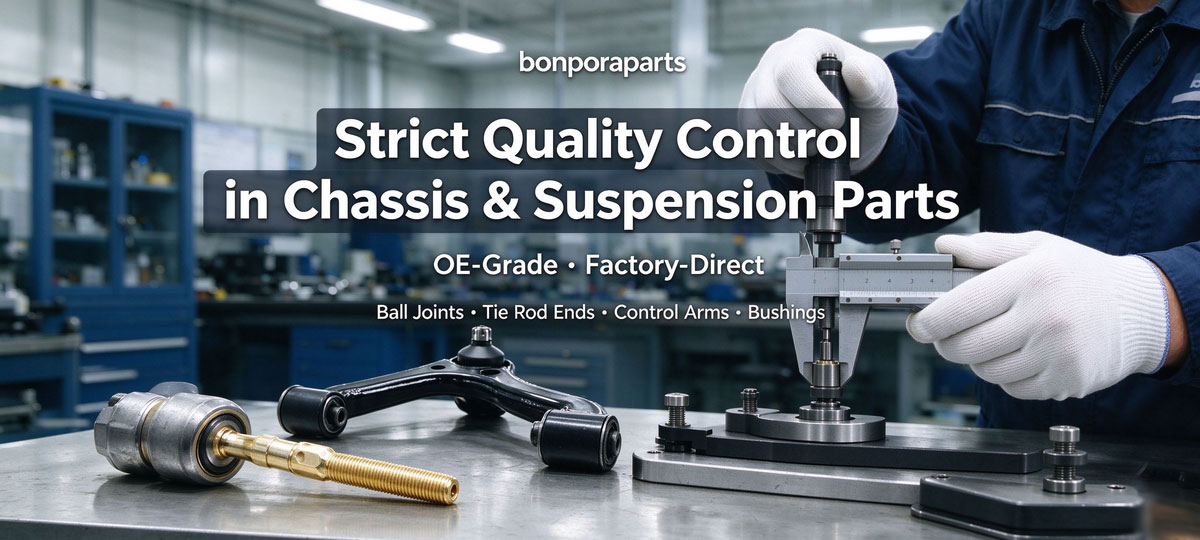
For any buyer of chassis and suspension parts, the difference between a dependable supplier and an unreliable one usually shows up long before the part is fitted — it shows up in the quality control behind the part. A recent safety recall in the United States illustrates exactly why. On NHTSA campaign 26V069, Hyundai Motor America recalled 4,555 units of the 2026 Kona because, due to a manufacturing error, the front steering knuckles may crack and break, resulting in a loss of steering control. The recall is a controlled, factual example of what happens when a load-bearing part leaves the factory without enough checks. This article looks at the three things that matter most to an aftermarket buyer: why strict quality control decides part reliability, how a manufacturing error like Hyundai's occurs, and what the consequences of an out-of-spec part can actually be.
1. Why Strict Quality Control Decides Part Reliability
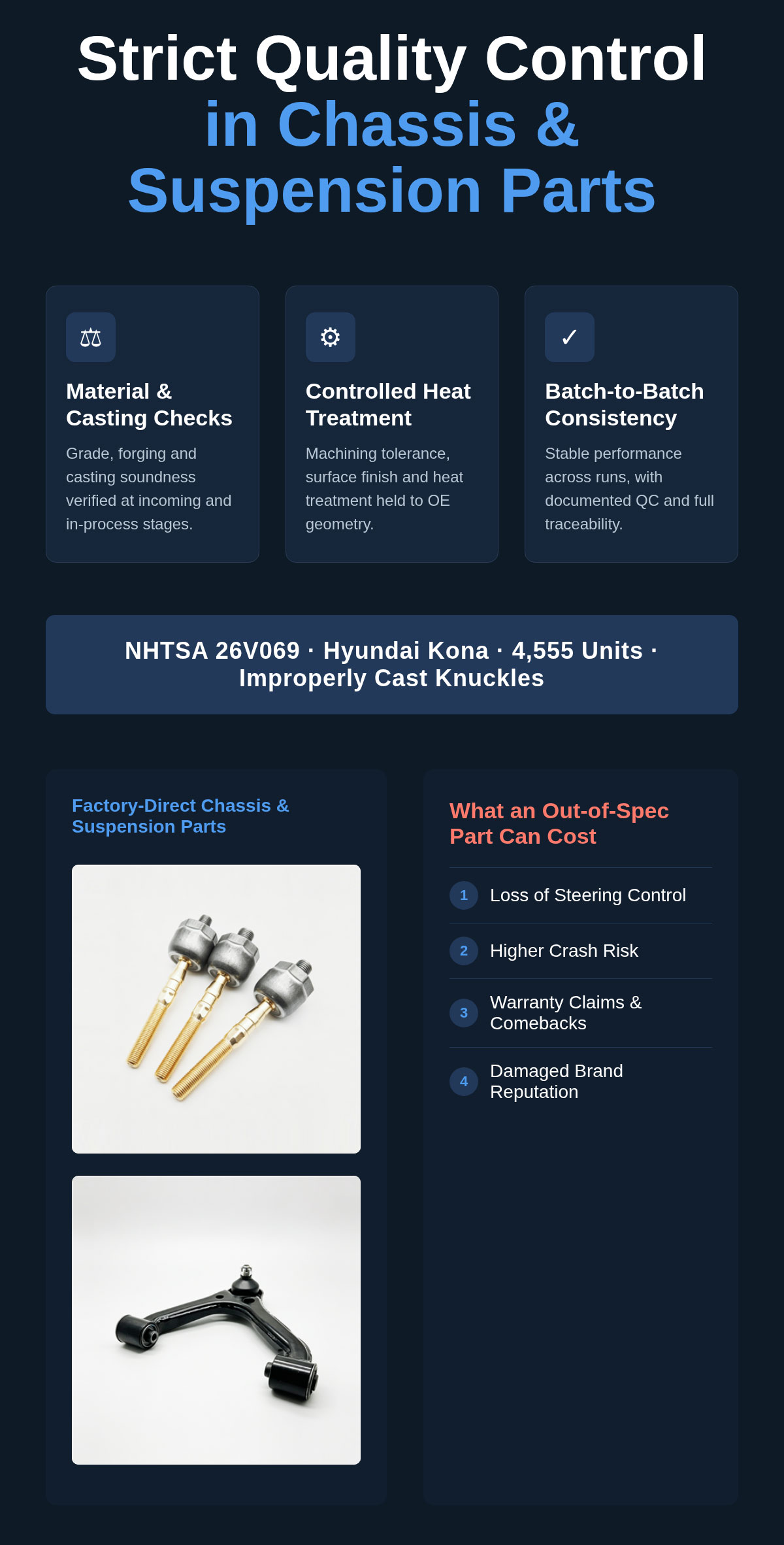
A chassis or suspension part is only as good as the checks that follow it through production. Material grade, forging or casting soundness, heat treatment, machining tolerance, surface finish and final inspection are the steps that turn a design into a part that will hold up over thousands of kilometres. When any of these steps is inconsistent, the failure does not appear at the factory — it appears months later, under load, on a customer's vehicle. That is why quality control is not a cost to be minimised but the first criterion a buyer should use to shortlist a supplier. In the aftermarket, the parts that see the most repeated stress are exactly the ones that deserve the strictest checks: ball joints and ball-joint kits, tie rod ends, stabilizer links, control arms and their bushings.
2. The Manufacturing Error Behind NHTSA 26V069
The Hyundai Kona recall is documented by NHTSA as a manufacturing defect. According to the Part 573 safety recall report, the front steering knuckles within a single production lot may have been improperly cast and installed, which could result in a crack developing in the knuckle assembly under high load inputs. The affected population is 4,555 vehicles of the 2026 Kona, and the remedy is inspection and free replacement of the front steering knuckles. The language of the report is precise and worth reading carefully: this was not a design shortcoming that appeared in every vehicle, but a batch that slipped through production with an improper cast. It is, in short, a quality-control failure at the manufacturing stage.
3. What an Out-of-Spec Load-Bearing Part Can Cost
The consequences of an out-of-spec steering knuckle are not theoretical. NHTSA states that a cracked or broken steering knuckle can result in a loss of vehicle steering control, and that a loss of steering control increases the risk of a crash. For the vehicle owner that is a safety issue; for an aftermarket buyer it is a commercial one. A part that fails early damages the reputation of the workshop or distributor that fitted it, triggers warranty claims and comebacks, and erodes the trust that a brand spends years building. When a load-bearing chassis part fails, the cost of the replacement is trivial compared with the cost of the failure. This is why the sourcing decision matters: a slightly cheaper part bought from an unchecked source can undo the value of an entire service relationship.
4. Where OE-Grade, Factory-Direct Sourcing Fits
The practical answer for an aftermarket buyer is to source the load-bearing classes from a supplier whose quality control is documented and whose factory you can qualify directly. Bonpora supplies chassis and suspension components on that basis — ball joints and kits, tie rod ends, stabilizer links, control arms and bushings — designed to OE geometry, with controlled processing, documented QC and stable batch-to-batch performance. Because the buyer works with the factory directly, the price reflects manufacturing cost rather than a stack of intermediaries, and quality and traceability are protected end to end. The full service runs in English: part-number cross-referencing, samples, quotation, production scheduling, packaging and shipping documentation.
5. Frequently Asked Questions
Q1. Which chassis and suspension parts does Bonpora supply?
Bonpora supplies ball joints and ball-joint kits, tie rod ends, stabilizer links, control arms and rubber bushings, plus related fasteners. The full catalog is at www.bonporaparts.com/en/chassis-and-suspension.
Q2. Can I request samples before a bulk order?
Yes. Bonpora offers a sampling step so a buyer can verify fit and quality before committing to a production run. Send your part numbers or OE references to sales@bonporaparts.com.
Q3. Do you supply to OE geometry with documented QC?
Yes. Parts are designed to OE geometry with controlled processing and documented quality control, and batch-to-batch performance is kept stable across production runs.
Q4. What is the minimum order quantity and lead time?
MOQ and lead time depend on the part and packaging. Standard stocked items can ship quickly, while custom or bulk orders follow a confirmed production schedule. Ask the sales team for current timing on your part list.
Q5. How do I get a quotation?
Send your part list, OE numbers or catalog references to sales@bonporaparts.com. The sales team replies in English with pricing, MOQ, packaging and delivery terms.
Contact: sales@bonporaparts.com | Product page: www.bonporaparts.com/en/chassis-and-suspension
- Prev.:China's EV Export Tax-Rebate Drops to 9% from April 2027 — Why Factory-Direct Chassis, Suspension & Steering Parts Become the Cost Lever
- Next.:Road Salt Can Kill a Toe-Link Ball Joint: A Seasonal Lesson from the Ford Explorer Recall