
Road Salt Can Kill a Toe-Link Ball Joint: A Seasonal Lesson from the Ford Explorer Recall
Every winter, road-deicing salt turns a suspension joint into a potential failure point. That is the lesson behind a recent Ford recall in China covering 7,133 imported Explorer SUVs, in which the rear-suspension toe-link ball joint could be corroded and seized by road salt, eventually fracture, and reduce steering control. Announced in May 2026 as a supplement to an earlier recall of the same model, the campaign has been highlighted again this season as a warning for drivers in high-corrosion regions. For buyers who stock ball joints and suspension links for the aftermarket, the recall is a practical reminder that corrosion resistance is not a cosmetic feature — it is a safety property. This article explains how road salt attacks ball joints and how to source joints that survive salt-belt winters.
A Seasonal Recall: Road Salt Can Corrode a Toe-Link Ball Joint
Ford China announced the recall of 7,133 imported Explorer vehicles built between October 2017 and October 2018. In these vehicles, the rear-suspension toe-link ball joint may, when the vehicle is exposed to the highly corrosive environment of heavy road-deicing salt use in winter, become corroded and seized, and in severe cases fracture. A fractured toe-link connection reduces steering control and increases the risk of a crash. The remedy is a free replacement of the improved toe-link assembly plus an alignment check of the rear toe. The campaign extends an earlier 2022 recall of the same model and is again drawing attention this season as a seasonal safety reminder.
Why Road Salt Attacks Suspension Joints
Road-deicing chemicals — primarily sodium and calcium chlorides — are aggressively corrosive. A ball joint survives because its working surfaces are protected by a sealed boot, corrosion-resistant plating and grease. Over time, moisture and salt find their way past a cracked or worn boot, attack the plating, and corrode the ball stud and socket surfaces. The result is a joint that feels fine for years and then seizes or degrades rapidly: steering grows heavy, small creaks appear, and in the worst case the connection fractures. Salt-belt drivers in northern regions and parts of Europe and North America face this every winter, which is why corrosion resistance directly controls a ball joint's service life.
What This Means for the Aftermarket in Salt-Belt Regions
For distributors and workshops serving high-corrosion regions, the practical takeaway is that replacement ball joints and suspension links must be specified for the environment they will work in, not just for the vehicle they fit. A joint with a thin plating and a cheap boot may install correctly yet fail early under salt exposure, damaging the workshop's reputation and putting drivers at risk. That is why OE-grade parts with properly sealed boots, corrosion-resistant plating and the correct grease specification matter more in salt-belt markets than anywhere else.
How Buyers Should Evaluate Corrosion Resistance
Check the boot — a fully sealed, correctly fitted boot keeps salt and moisture out of the working surfaces.
Check the plating — the stud and housing should carry corrosion-resistant surface treatment, not bare metal.
Check the seal and grease — the joint should be pre-packed with grease appropriate to low-temperature, wet conditions.
Buy complete — matching fasteners and locking hardware included in the kit reduce the chance of a sub-standard substitute.
OE-Grade, Corrosion-Resistant Ball-Joint Kits from Bonpora
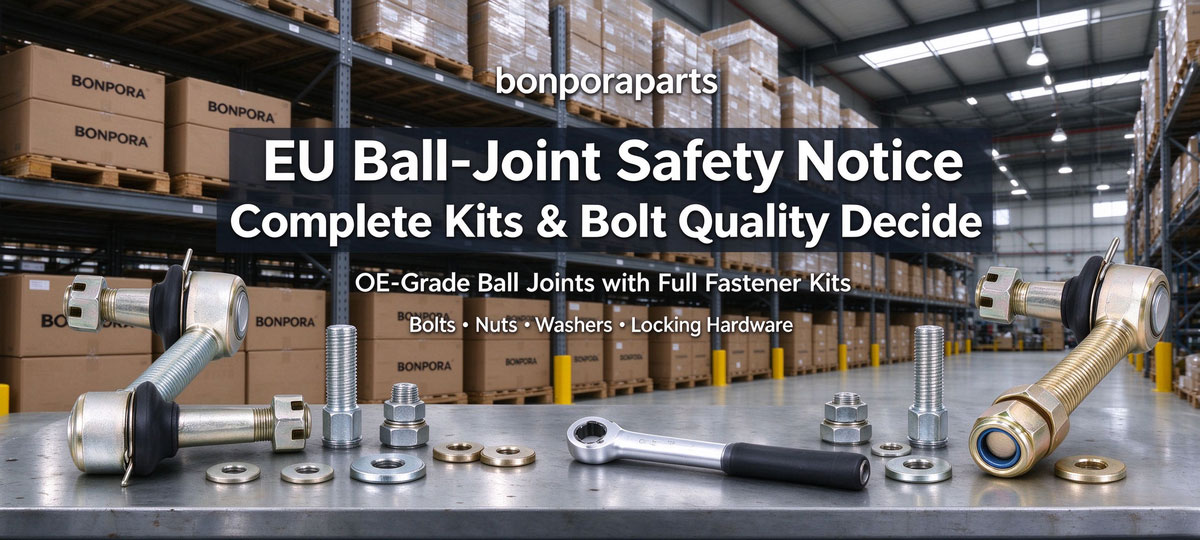
Bonpora supplies ball joints, tie rod ends and suspension links designed to OE geometry with sealed boots, corrosion-resistant surface treatment and controlled grease specification, supplied as complete kits with the correct fasteners and locking hardware. Because the buyer works directly with the factory, surface treatment and sealing can be specified and verified for the markets the parts will serve. For a distributor or workshop in a salt-belt region, factory-direct sourcing of corrosion-resistant, OE-grade suspension joints is the practical way to keep cars on the road through the winter — and keep the toe-link ball joint exactly where it belongs.
Contact: sales@bonporaparts.com | Product page: www.bonporaparts.com/en/products
- Prev.:Strict Quality Control in Chassis & Suspension Parts: What Hyundai's Steering-Knuckle Manufacturing Error Teaches About Aftermarket Sourcing
- Next.:When a Rear Control-Arm Pin Slides Out: Arm, Bushing & Fastener Quality Decide