sales@bonporaparts.com
0086-10-64988621
English
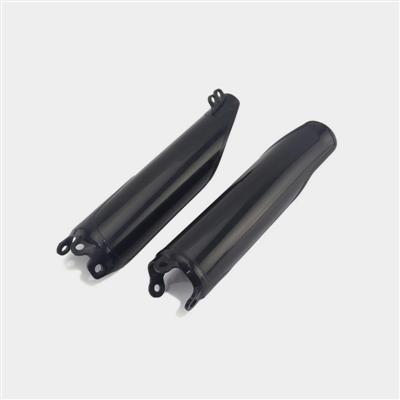
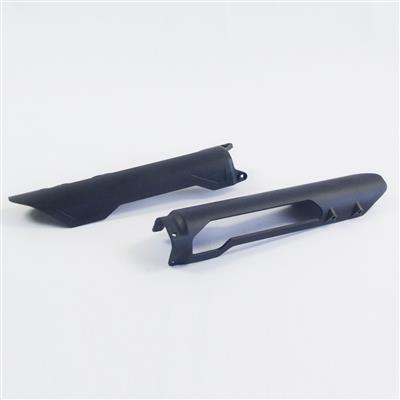
The shock absorber guard exists mainly to protect the shock absorber and to prevent dirt, mud, fine sand, flying stones and similar debris from entering the shock absorber, damaging the piston rod and causing oil leakage. The Bonpora specification describes the part as protecting the piston rod from rocks and debris, clearing the shock absorber during compression, being made from durable, wear resistant, impact resistant and UV resistant materials such as HDPE or nylon, and being cost effective and easy to install.
Those sentences describe two jobs rather than one. The first is shielding: an impact barrier that absorbs or deflects stone strikes before they reach the piston rod, the dust boot or the seal. The second is sweeping: the guard has to clear the shock absorber body through the compression stroke, which turns the part into a moving clearance problem rather than a static cover. A guard that shields well but fouls the spring or the body on full compression will generate a noise complaint and a warranty return even though the material is sound.
The failure path is worth stating clearly, because it explains the material and geometry decisions. A stone that strikes an unprotected rod can raise a burr or a nick. That damage then drags through the rod seal on every stroke, the seal lip wears or tears, oil escapes and the shock absorber loses damping. Fine sand and mud do the same job more slowly by embedding in the seal. A guard interrupts this path at the cheapest point in the assembly, which is why the part is judged on cost effectiveness rather than on absolute performance.
Shielding is a coverage question: the guard must sit between the likely impact direction and the rod over the working stroke. Clearing is a clearance question: at full compression there must be enough gap to the spring, the body and any surrounding component to prevent contact, rubbing or trapping of debris. In production the clearance side is usually the harder one to hold, because it is driven by the mounting geometry and by the natural variation in wall thickness and moulding shrink.
Both materials named in the specification are thermoplastics, and both are chosen for toughness rather than for stiffness. The choice between them is a balance of impact behaviour, stiffness at temperature, abrasion response and cost.
HDPE is the default material for a guard that must absorb repeated stone strikes without cracking. It stays ductile over a wide service temperature range, resists most road chemicals and is economical in thick sections, which suits blow moulding. Its limits are stiffness and heat resistance: a thin HDPE section can deflect and contact the rod or the spring when the part is hot or when airflow is low.
Nylon is stiffer, harder and more abrasion resistant, and it holds its shape better at temperature. It is commonly selected where the guard is a thin walled, self supporting shield or where its mounting points need to carry load. Its trade offs are moisture uptake, which changes dimensions slightly over time, and lower notched impact resistance in cold conditions compared with HDPE. A nylon guard therefore rewards a slightly more generous wall and radius design.
UV resistance is not a material property that appears by itself. It comes from a stabiliser package, usually a carbon black or a hindered amine system, dosed through a masterbatch. Because sunlight exposure is the dominant ageing mechanism on a part that sits in the wheel arch, the additive package deserves to be written into the purchase specification rather than assumed. Ask what stabiliser is used, at what loading, and whether the compound supplier provides a weathering statement.
| Property | HDPE guard | Nylon guard | Practical consequence |
|---|---|---|---|
| Impact behaviour | Ductile, absorbs strikes | Harder, less forgiving cold | HDPE suits exposed locations |
| Stiffness | Moderate | Higher | Nylon holds shape in thin sections |
| Abrasion resistance | Moderate | Higher | Nylon suits grit rich environments |
| Heat behaviour | Softens earlier | Holds shape better | Check clearance near hot components |
| Moisture effect | Minimal | Small dimensional change | Allow tolerance for nylon growth |
| Typical process | Blow moulding, extrusion | Injection moulding | Drives tooling cost and volume fit |
Blow moulding produces a hollow, double walled shell in one operation, which gives an HDPE guard its impact cushion and hides the inner surface from view. The advantages are low tooling cost against volume and generous wall thickness. The constraints are tolerance control on wall distribution, especially at the corners, and limited detail on the parting line. For a guard that must clear a moving component, corner wall variation is the parameter worth controlling.
Injection moulding holds dimensions more tightly, allows ribs, clips and mounting features in the same shot, and suits nylon. It costs more in tooling and rewards repeat volume. For a programme with several vehicle applications sharing one geometry family, injection tooling is often the route that keeps part to part clearance consistent.
Wall thickness is the cheapest way to buy impact resistance and the most expensive way to buy weight and cooling time. Ribs add stiffness without adding a thick section, but they must be designed not to create sink marks on the visible face or to trap road salt against the rod. Draft angle controls release and therefore surface finish. All three belong on the drawing, because a supplier that is free to choose them will choose for cost.
| Process | Typical material | Tooling cost | Best fit | Watch item |
|---|---|---|---|---|
| Blow moulding | HDPE | Lower | Hollow impact shell | Corner wall distribution |
| Injection moulding | Nylon, HDPE | Higher | Detailed clips and ribs | Warpage on long parts |
| Extrusion with forming | HDPE | Lowest | Simple sleeves and collars | Dimensional control of the profile |
A guard is a low unit price part, so the cost of a wrong first article is proportionally large. The approval step is where that risk is retired.
The drawing should fix the material and grade, the wall thickness with tolerance, the mounting feature dimensions, the overall envelope, the colour and the surface finish expectation. Colour matters commercially as well as visually, because a guard that fades differently from the last shipment is noticed by the distributor even when the part functions correctly.
| Item | Method | Why |
|---|---|---|
| Critical dimensions | Calliper and gauge against the drawing | Confirms tooling as built |
| Wall thickness | Section cut or ultrasonic gauge | Controls impact and clearance |
| Fit to mating part | Trial assembly on a real unit | Confirms clearance through the stroke |
| Impact check | Drop or strike test on the shield area | Confirms material and wall are adequate |
| Colour and finish | Visual against the approved sample | Protects brand consistency |
Most guard failures that are not geometry failures are material batch problems, and material problems are cheap to prevent at goods inwards.
Record the resin grade, the supplier and the batch for every delivery, and keep the certificate with the production record. Where the specification names a stabiliser system, the compound certificate should confirm the additive package, not only the base polymer.
Colour masterbatch and UV masterbatch are dosed by ratio, so a change in pellet size or a manual addition can change the dose. Regrind is the other quiet variable: a small controlled proportion is normal in moulding, but an uncontrolled proportion degrades impact strength and UV performance. Set a maximum regrind percentage in writing and audit it.
| Parameter | Risk if uncontrolled |
|---|---|
| Melt temperature | Degraded polymer, weak impact zones |
| Dosing of masterbatch | Colour shift, lower UV protection |
| Mould or blow pressure | Wall thickness variation, poor definition |
| Cooling time | Warpage, dimensional drift |
| Regrind percentage | Reduced impact strength |
| Cycle consistency | Part to part variation across a shipment |
An inspection plan turns the drawing into a routine. For a guard, visual and dimensional checks cover nearly all retained risk, with occasional destructive checks on wall thickness and impact behaviour.
| Stage | Check | Frequency |
|---|---|---|
| Incoming | Resin grade, certificate, masterbatch identity | Every delivery |
| First off | Full dimensional and visual check | Every production start |
| In process | Critical dimensions, wall thickness, appearance | Per defined interval |
| Final | Fit check on a mating unit, packaging check | Per batch |
| Periodic | Impact test and UV record review | Per agreed schedule |
| Defect | Likely cause | Correction |
|---|---|---|
| Thin wall at a corner | Parison or shot imbalance | Adjust process, add wall tolerance |
| Warpage on long parts | Cooling too fast, uneven ejection | Extend cooling, revise ejection |
| Colour drift between batches | Masterbatch dose variation | Dosing control, retained samples |
| Early cracking in service | Regrind level, degraded polymer, UV package | Set regrind limit, review compound |
| Contact marks on the spring | Clearance too small at full compression | Revise geometry, re check the envelope |
| Loose or noisy in service | Mounting feature tolerance | Tighten the feature, review the fixing |
For a distributor, the manufacturing detail shows up as return rate and as repeat order rate. A guard that keeps its shape and colour for several seasons stops generating replacement claims and keeps the part on the shelf list. A guard that cracks in the first winter produces a claim per unit and a lost workshop account, on a part whose unit price cannot absorb either. That is why buyers who audit the drawing, the material certificate and the inspection record usually pay slightly more per unit and considerably less per vehicle season.
It depends on the section and the location. HDPE suits hollow, thick sectioned guards that must absorb stone strikes in exposed positions, while nylon suits thin, self supporting shields that need stiffness and abrasion resistance. Where a programme covers several applications, confirm the choice per reference rather than assuming one material for the whole range.
Through the stabiliser package in the compound, dosed through a masterbatch at a controlled ratio, and verified by retaining a sample from each batch for comparison. Ask the compound supplier for a weathering statement and keep the certificate with the production record so that a later colour or cracking complaint can be traced.
Acceptable variation depends on the clearance available at full compression. Where the guard passes close to a spring or the shock body, the variation must stay well inside that gap, so the drawing should state a wall tolerance that the process can actually hold rather than a nominal figure. Confirm it on a sectioned first article.
Critical dimensions, wall thickness on a sectioned sample, appearance and colour against the approved sample, the mounting feature fit, and the packaging and labelling. A periodic impact check and a review of the UV record complete the plan for a part whose main risk is impact and ageing rather than dimensional accuracy alone.
Bonpora produces shock absorber guards in HDPE and nylon, selected for durability, wear resistance, impact resistance and UV resistance, with the geometry designed to shield the piston rod and clear the shock absorber through the compression stroke, and the part sized for cost effective fitment and simple installation. Start from the shock guard range, review the measurement method in the shock guard sizing guide, read the part overview in the shock guard overview, check related protection and damping components in shock absorber parts and piston rods, look at custom parts for a new geometry, and send your application data through the contact page.