
- 1. Why Auto Parts Product Data Decides Whether a Listing Gets Found
- 2. The 12 Auto Parts Product Data Fields Distributors Expect
- 3. What a Live Listing Looks Like: The Bonpora Catalog Applied
- 4. The OE Number Field: Where Cross-Referencing Starts
- 5. Fitment, Dimensions and Materials: The Fields Buyers Verify
- 6. What a Missing Field Costs: A Worked Example
- 7. Keeping Auto Parts Product Data Current After Launch
- 8. FAQ
- 8.1. Does one field set work for marketplaces, a webshop and a print catalogue?
- 8.2. Can I reuse a supplier's photos, dimensions and descriptions on my own webshop?
- 8.3. How should superseded OE numbers be handled in a listing?
- 8.4. Which fields matter most for a new distributor with no search traffic yet?
- 8.5. Should hardness and warranty values from a supplier page be copied into a listing exactly?
Auto Parts Product Data: Fields Distributors Expect
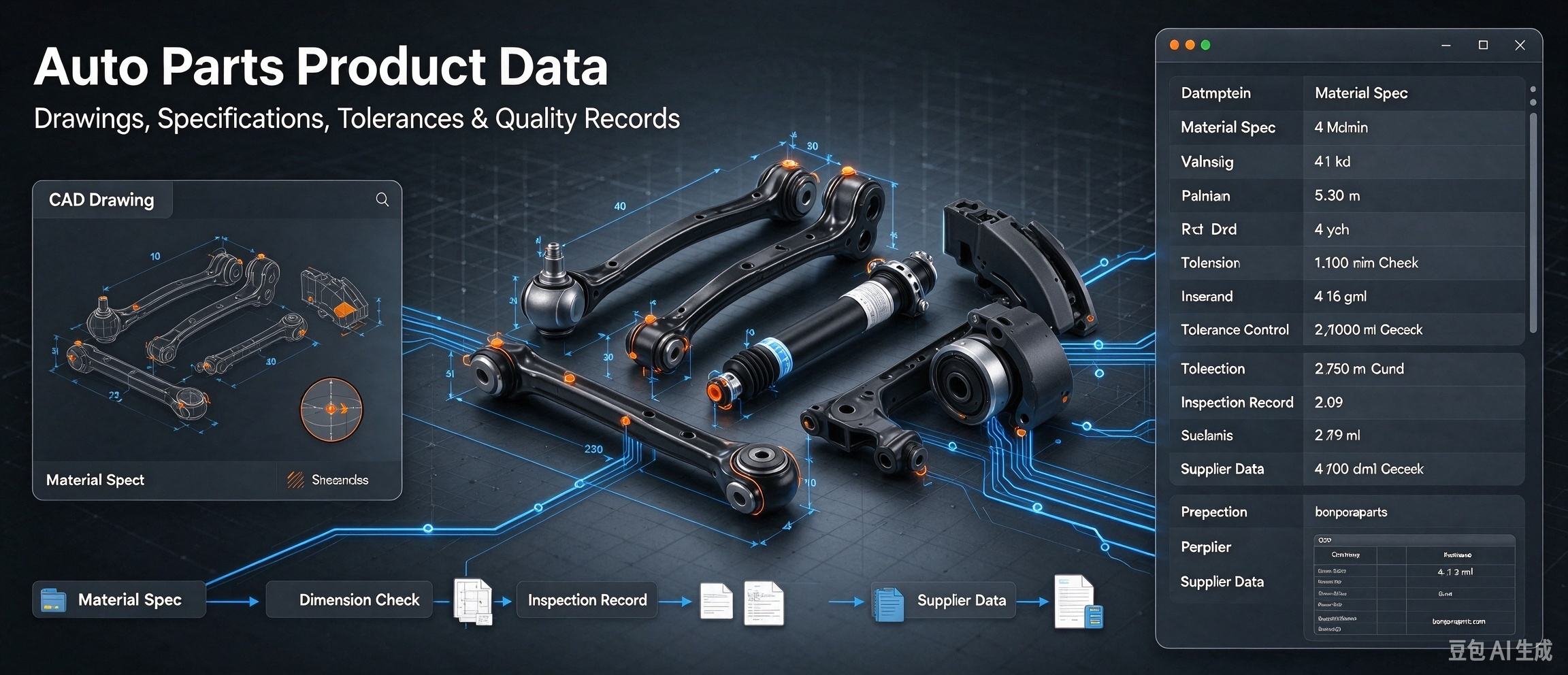
Auto parts product data is the field set that decides whether a distributor can list, find and reorder a part: OE number, fitment, dimensions, material, packaging, warranty and delivery. This guide defines the twelve auto parts product data fields buyers expect, shows how a live catalog applies them, and prices what one missing field costs.
Why Auto Parts Product Data Decides Whether a Listing Gets Found
A buyer who needs a replacement buffer block does not browse. The buyer searches, and the search almost always starts from one of three anchors: the OE number stamped on the old part, the vehicle it came off, or the part type combined with a material word. Every one of those anchors is a data field. If the listing does not carry the field, the listing does not answer the search, no matter how good the moulding behind it is.
This is visible in how a working catalog is organised. The Bonpora auto parts catalog groups its strut bump stop and jounce bumper range under a "search by car brand / OE number" panel and a by-vehicle-model panel covering marques such as Volkswagen, Audi, BMW, Mercedes-Benz, Honda and Toyota, with 238 references split across twelve index pages. The catalog structure is itself a statement about which auto parts listing fields matter: OE number first, vehicle second, everything else supporting.
The same hierarchy shows up in how the site describes buying behaviour on its product pages: ordering by OE number is presented as the most reliable route, because the number ties the part to the original specification regardless of how each brand names it. Part-type-plus-supplier searches ("polyurethane bump stop manufacturer") come second. A listing that lacks the OE field can still win the second kind of search, but it silently drops out of the first, which is where the buyers with a part in hand and a purchase order pending are working.
The 12 Auto Parts Product Data Fields Distributors Expect
The table below is the takeaway asset. Twelve fields, what each one does for the buyer, and a live example of how the field appears on a working listing. Distributors who upload listings with all twelve filled rarely get specification questions before the first order; the missing ones generate email rounds that stretch every quote.
| Field | What the buyer does with it | Live example | Failure when missing |
|---|---|---|---|
| 1. OE number and cross-references | Matches the part to the vehicle and to superseded references | OE 8D0412131E | Buyer cannot confirm fit; listing drops out of OE searches |
| 2. Supplier reference number | Orders, invoices and repeat purchases without naming ambiguity | Bonpora No. 4110000 | Two similar parts get confused on the PO |
| 3. Product name and part type | Filters catalogues and marketplace categories | Strut bump stop (jounce bumper) | Part lands in the wrong category; search misses it |
| 4. Fitment | Confirms the vehicle range before quoting | Audi / Volkswagen | Buyer asks "does it fit my car?" and waits |
| 5. Dimensions | Incoming inspection and packaging planning | Φ16.7 × Φ58.2 × 80.8 mm | Quote stalls until someone measures the old part |
| 6. Material | Signals compound family and duty level | Polyurethane | Rubber and PU variants get mixed up in the carton |
| 7. Hardness | Rough screening of ride and durability class | Shore A value, confirmed with the supplier | Buyers assume the wrong stiffness class |
| 8. Weight per piece | Freight calculation and volumetric billing | Listed per SKU | Landed-cost estimates are wrong for light, bulky parts |
| 9. Packaging | Shelf planning and private-label decisions | Neutral export packaging, carton quantity stated | Repacking costs appear after delivery |
| 10. Quality system | Risk screening before the first order | IATF 16949 site certificate | Buyer defaults to a local supplier "to be safe" |
| 11. Warranty | Sets the resale promise to workshops | 1 year, as listed on the product page | Claims disputes with no written basis |
| 12. Delivery time | Order timing against branch stock-outs | 15–30 days, as listed | Buyer orders elsewhere "because it ships faster" |
Fields 1 to 6 decide whether the listing is findable and verifiable. Fields 7 to 12 decide whether the buyer can build a landed cost, a resale price and a stock plan without sending an email. Both halves matter; the second half is simply less visible in search analytics and more visible in reply times.
What a Live Listing Looks Like: The Bonpora Catalog Applied
Theory is easier to trust against a concrete page. The Bonpora Audi/VW strut bump stop 8D0412131E listing carries a specification block with eleven fields in a fixed order: product name, country of origin, Bonpora No., OE, fitment, size, material, warranty, delivery time, packaging and custom service. That block is the same structure a distributor needs before the part can appear on a webshop, a marketplace feed or a printed catalogue.
The values on that page show why fixed fields beat prose. Size is written as three dimensions with the bore, diameter and free height separated, so an inspector can measure a sample against it line by line. Material is stated as polyurethane, which separates it from the rubber versions listed for the same platform. Delivery time is published as a 15–30 day band rather than a promise, and the page tells the reader that stock and quantity affect the final figure, which the supplier confirms before the order. Warranty is written as one year, plainly, with the wording a buyer can copy into terms.
Two further details on that listing deserve attention from anyone building auto parts product data of their own. First, the page offers OEM and custom design support as a field, not a sentence buried in the description, because for a distributor the ability to request a different hardness or compound is a purchasing decision, not marketing. Second, the fitment line names the platform family (the B5-generation front strut arrangement) rather than an endless model list, and then instructs the buyer to confirm the application against the OE number on the old part or the VIN. That is the honest way to publish fitment when model-year coverage varies.
The OE Number Field: Where Cross-Referencing Starts
The OE number is the one field a buyer cannot work around, so it deserves its own section. Three practices separate a usable OE field from a decorative one:
Publish the primary OE reference exactly as stamped, without catalog formatting. A buyer holding an old part types "8D0412131E" into a search box. Spaces and dashed groupings ("8D0 412 131 E") belong in the description, not in the indexed field.
List superseded and alternative references where they exist. As the same product page explains, different markets and model years may carry a superseded or alternative OE number, and a supplier with reference data can cross-reference the correct equivalent. A listing that carries only one number loses the buyers holding the other one.
Keep the supplier reference alongside the OE number. The 8D0412131E page pairs the OE number with Bonpora No. 4110000, so an order, a carton label and a warranty claim can all name the same part without ambiguity. That pairing is what batch traceability and claims handling depend on later.
For distributors, the operational habit is to treat the OE field as a small cross-reference table, not a single string. When a second reference is confirmed for the same moulding, it goes into the listing the same day, because every week it is absent is a week of OE searches landing on a competitor's page.
Fitment, Dimensions and Materials: The Fields Buyers Verify
Between the OE anchor and the commercial fields sits the verification block. These are the fields a technically minded buyer checks before the first order, and each has a common failure mode.
Fitment varies by year, engine and suspension option, which is why a vehicle list without a year range invites wrong orders. The defensible format is platform or model family plus generation, plus the instruction to confirm against the OE number. Where the supplier holds application data, the listing should say so and offer to verify against a VIN, as the 8D0412131E page does.
Dimensions should be published as measured values with the feature names attached, in the bore × diameter × height pattern used on the live listing. A drawing beats a number where an insert, flange or seating face matters; the listing should say whether a drawing is available on request. Tolerances do not belong on a public listing, but the drawing revision the dimensions come from does, because the revision number is what the buyer quotes back when samples arrive.
Material and hardness belong on the listing as family and class, not as laboratory claims. The example page states polyurethane, which is the decision-relevant fact; hardness in Shore A is commonly listed as a nominal value that should be verified with the supplier for the actual production batch, since compounds within the same family vary between manufacturers. The same rule applies to temperature ratings and oil resistance: publish the class, verify the batch.
Weight and packaging complete the commercial half. Weight per piece drives freight, and light moulded parts are billed by volume rather than weight, which makes carton dimensions as commercially relevant as part dimensions. Packaging on the example listing is neutral export packaging by default, with customised options for repeat orders; a distributor running private label needs to know that before the first order, not at the loading dock. The container-loading consequences of carton choices are covered separately in the buyer guides.
Before a listing goes live, walk it through this audit:
OE number present, unformatted, and equal to what is stamped on the part.
Superseded references added to the same listing.
Supplier reference number visible next to the OE number.
Part type named using the words buyers search, not internal jargon.
Fitment given as platform family plus generation, with a confirm-by-OE instruction.
Dimensions written as bore × diameter × height, with drawing availability stated.
Material family stated; hardness shown as a nominal value to verify with the supplier.
Weight per piece and carton quantity published.
Packaging type stated, including whether neutral or private label.
Quality system named at site level, with certificate scope available on request.
Warranty written as a number with a unit, matching the product page.
Delivery time published as a band, with the confirmation step explained.
What a Missing Field Costs: A Worked Example
The argument for completing auto parts product data is arithmetic, not aesthetics. The model below is illustrative, built from figures a mid-size distributor can recognise, and it prices a single missing field: the OE number.
| Input | Value | Basis |
|---|---|---|
| SKUs listed | 200 | Typical mid-size suspension programme |
| Catalog inquiries per SKU per year | 15 | Assumed, illustrative |
| Share of buyers who arrive with an OE number | 40% | Illustrative, consistent with the OE-first search pattern described on the catalog |
| Inquiries lost when the OE field is missing | 6 per SKU per year | 15 × 40% |
| Quote-to-order conversion | 8% | Assumed, illustrative |
| Average first order | 600 units × 1.90 USD = 1,140 USD | Assumed, illustrative |
| Lost orders per SKU per year | 0.48 | 6 × 8% |
| Lost revenue per SKU per year | 547.20 USD | 0.48 × 1,140 |
| Lost revenue across 200 SKUs | 109,440 USD per year | 547.20 × 200 |
| One-off cost to complete the field | 1,250 USD | 15 minutes per SKU at 25 USD/h internal admin |
| Payoff ratio | about 88 : 1 in year one | 109,440 ÷ 1,250 |
The same arithmetic runs in reverse for every other field. A missing dimensions field does not lose the inquiry; it loses days, because the quote stalls until someone measures the old part and sends the numbers back. On a part with a published 15–30 day delivery band, two email round trips inside the quoting stage are enough to push the realistic arrival date past the buyer's branch stock-out, and the buyer orders from whoever answered with a number attached. That is the quieter cost of incomplete auto parts product data: it does not show up as a lost lead, it shows up as a slower close on the leads that did arrive.
If you want the twelve-field table as a working spreadsheet, or sample data filled in against references you already sell, send the reference list through the Bonpora contact page, and the team will return the completed field set for review.
Keeping Auto Parts Product Data Current After Launch
Listings decay quietly. OE numbers get superseded, drawings get revised, warranty wording changes, and delivery bands move with the season. Three routines keep a catalogue honest:
Re-verify the OE field when a listing stops converting. A drop in OE search traffic usually means a newer reference now exists for the same moulding, and the listing is anchored to the old one.
Tie revision numbers to the listing. When a drawing revision changes a dimension, update the listing and note the revision the values come from, so incoming inspection and the catalogue never disagree.
Treat data quality as part of the quality system. The documentation a buyer can request from an IATF 16949 supplier — certificates, control plans, dimensional reports and batch records — is described in detail in the IATF 16949 quality documentation guide. Listings sit one layer above those documents: the listing is what the buyer sees first, and the documents are what make its claims checkable.
The practical test is simple. Pick five listings at random, open the five supplier pages behind them, and check whether every published value still matches. Where it does, the catalogue is earning inquiries. Where it does not, the fix costs minutes and the model above prices the delay in orders.
Data work does not need to be perfect before it starts paying. Complete the findable fields first — OE number, fitment, dimensions, material — publish the commercial fields as verifiable bands rather than promises, and let the first orders show which fields your buyers actually read. To have product data filled against your reference list, or to request a quotation with the complete field set attached, get a quote from the Bonpora team.
FAQ
Does one field set work for marketplaces, a webshop and a print catalogue?
The core twelve fields carry across all three channels; what changes is presentation. Marketplaces enforce their own mandatory fields and map yours into them, a webshop lets you publish the fields in any order but rewards the OE number being searchable, and a print catalogue usually compresses the set into a table where dimensions, OE reference and fitment do the work. Keep one master data record per SKU and cut the channel versions from it, so a superseded OE number only has to be fixed once.
Can I reuse a supplier's photos, dimensions and descriptions on my own webshop?
Ask, in writing, before publishing. Suppliers who support distribution generally allow reuse of specification data and imagery for the parts they ship, and neutral export packaging on the example listing exists precisely so the goods can be sold under the distributor's brand. The sensible arrangement is written permission for data and imagery, plus an agreement on who updates what when an OE number is superseded.
How should superseded OE numbers be handled in a listing?
Publish the current reference as the primary OE field and keep superseded numbers in a cross-reference line on the same listing, because buyers search both. If a customer's old part carries a number that no longer appears in current catalogues, the cross-reference line is what lets them confirm the replacement without contacting you first. Update the listing the day a new reference is confirmed rather than batching the changes.
Which fields matter most for a new distributor with no search traffic yet?
The findable four: OE number, fitment, dimensions and material. They are what a buyer arriving from an OE search or a vehicle search needs to confirm the part is credible, and they are the fields other websites can link to. Commercial fields such as warranty and delivery time build trust for the order, but they do not bring the visitor, so they come second in data-entry priority even though they belong on the same page.
Should hardness and warranty values from a supplier page be copied into a listing exactly?
Copy the structure, verify the values. Hardness is commonly listed as a nominal Shore A figure that should be confirmed with the supplier for the production batch behind your order, and the same caution applies to any performance value printed on a generic datasheet. Warranty is different: it is a published commercial term, so the listing should state it exactly as the supplier does, in this case one year, and keep the supplier's wording available for your own terms page. Where a figure is nominal, say so in the listing rather than presenting it as a tested result.