
- 1. The 30-Day Trade Show Follow Up Calendar in Five Gates
- 2. Gate 1 (D+1): The Recap Email That Becomes the Specification
- 3. Gate 2 (D+3): What the Factory Needs Before It Can Quote
- 4. Gate 3 (D+7): Tooling, Sample Route and Six Answers
- 5. Gate 4 (D+14): Normalising the Quote
- 6. Gate 5 (D+21): The Purchase Order File
- 7. After the Gates: Recovery Scripts and Trade Show Follow Up Metrics
- 8. FAQ
- 8.1. How soon should the first trade show follow up go out?
- 8.2. What if I have no drawing or part number after the show?
- 8.3. Should I ask for a price or a sample first?
- 8.4. How many follow ups are reasonable before I stop?
- 8.5. Can a first order be placed without a sample?
- 8.6. What does a quote that arrives after my decision date mean?
Trade Show Follow Up: 30 Days from Booth to Purchase Order
A trade show follow up runs on a calendar, not on enthusiasm: recap within 24 hours, a specification pack by D+3, tooling and sample answers by D+7, a confirmed quote by D+14, a purchase order file by D+21. Thirty days reaches a first order when every message adds information.
The booth is the cheap part. A stand at a fair such as GTFAIR in Guangzhou, which runs alongside the Canton Fair, produces a name, a part number and an intention in about eight minutes. Everything that decides whether the intention becomes an order happens afterwards, in an inbox, over five or six messages that most buyers write from memory.
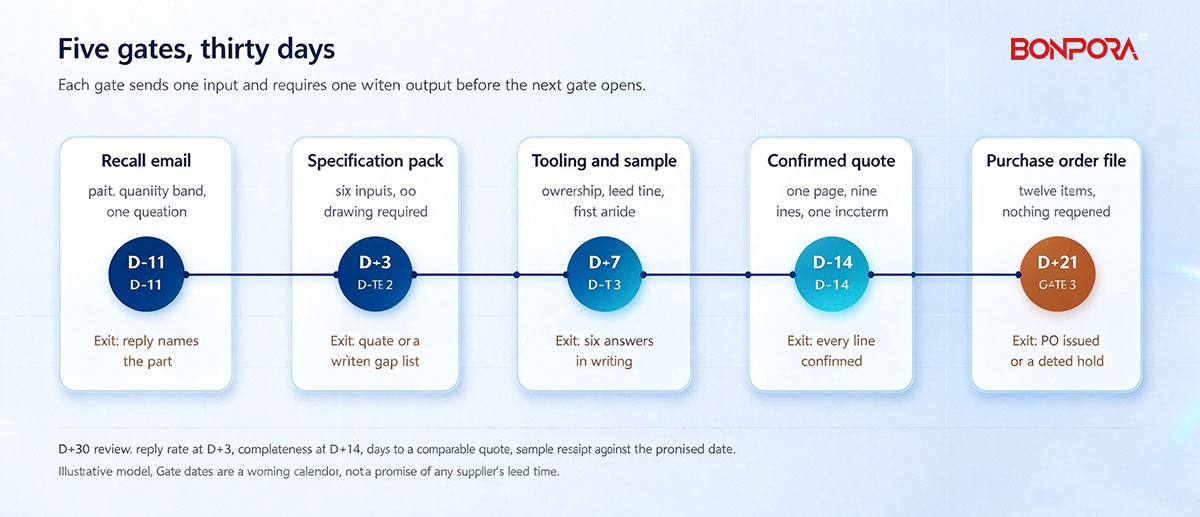
The 30-Day Trade Show Follow Up Calendar in Five Gates
The sequence below is built on gates rather than reminders. A gate is not a nudge with a different adjective. It has an input you send, an output the supplier has to put in writing, and an exit criterion that decides whether the conversation earns the next gate or moves to the alternative source you collected at the same show.
| Gate | Day | What you send | Subject line pattern | Exit criterion |
|---|---|---|---|---|
| 1 | D+1 | Recap of the booth conversation, quantities, target order date, one question | GTFAIR follow up — | The supplier replies naming the part and the quantity band |
| 2 | D+3 | Specification pack: six inputs, drawing optional | | A quote, or a written list of exactly what is missing |
| 3 | D+7 | Tooling questions and a sample request | Tooling and sample route for | Six answers in writing: ownership, lead time, first article, minimum first order, sample charge, packaging drawing |
| 4 | D+14 | Your comparison sheet, pre-filled, sent back for confirmation | Quote comparison — please confirm these nine lines | Every line confirmed, with incoterm, named place and validity date |
| 5 | D+21 | Purchase order file with packaging and warranty terms | PO file for | PO issued, or a documented reason to hold |
Two rules keep the calendar from collapsing into a chase. Each gate has a date before it has a topic, and the date is set at the booth rather than when you find time. And one gate carries one ask: an email with five questions receives one answer, usually the easiest, while the other four disappear into the thread.
Gate 1 (D+1): The Recap Email That Becomes the Specification
Send the recap within one working day, while the person who wrote the booth note can still read their own handwriting, and while your enquiry is still in the supplier's show queue rather than buried under next month's production.
Template 1 — the D+1 recap
Subject: GTFAIR follow up —
What you saw at the booth: the part, the material system if it was stated, the position on the vehicle.
The references you need to cover, or the OE numbers you are working from.
The quantity band you are planning, split into first order and twelve months.
The date you intend to place the order, even if provisional.
One question that can be answered in one line.
The last line matters more than the first four. A question answered in thirty seconds gets answered; a request for a price and a full catalogue in one message gets filed. Ask something that proves the note was read: whether the profile shown covers both front and rear positions, or whether the quoted tooling is existing or new.
The reply you want is not a price. It is confirmation that the part is understood, because that confirmation is what makes the D+3 pack worth preparing. If the answer carries a different part number from the one you wrote down, you have found a fitment risk on day one rather than on the loading dock. The first trade show follow up is also the only one a supplier reads twice.
Gate 2 (D+3): What the Factory Needs Before It Can Quote
Most silence after a fair is not disinterest. It is an enquiry that cannot be quoted. The Bonpora wholesale guide lists what a sample request should contain, and that list works unchanged as the D+3 pack, because a factory quoting from a photograph and a factory quoting from six inputs are doing two different jobs.
The part, or photographs of it beside a rule so that scale is unambiguous.
The references the profile must cover, not only the one you photographed.
The vehicle applications, since a reference list proves a number was catalogued, not that the part behaves identically.
Annual quantity and first order quantity, stated separately.
The dimensions that are critical, marked on a sketch if no drawing exists.
Free height measured from a new part rather than a used one, because a used part carries the set it took in service.
The measured height is the item buyers skip and later regret. It defines where the stop engages, and an old part that has collapsed by two millimetres will quietly move that point into the new tool.
State the acceptance fields as well, because a supplier who knows them quotes to them: material system (MDI or NDI polyurethane, which are not interchangeable), nominal hardness with tolerance, the static stiffness curve, maximum compression set after the agreed test, free height with tolerance at both ends, working temperature range, colour and marking, packaging, and the reference range the profile must serve. Nine fields are enough to stop two suppliers quoting different parts against the same line.
Template 2 — the D+3 pack
Subject:
One line stating what the pack contains and what decision it feeds.
The six items as a numbered list, one line each, so a missing item is visible rather than implied.
A closing line naming the date you need the quote, and offering the drawing in whatever format you have.
Gate 3 (D+7): Tooling, Sample Route and Six Answers
By the end of the first week the quote either exists or the reasons it does not are known. Gate 3 removes the two unknowns: who owns the tool, and what the sample proves.
Existing tooling or a new mould? The same part can be quoted twice at different prices for this reason alone, and the lower figure usually assumes a tool that already exists.
Who owns a new tool? Ownership decides what happens when you change supplier, and it belongs in writing before the first order rather than after the third.
How long does tooling take? This is the number that decides whether your container date is achievable, and it is separate from production lead time.
What is the first article process? A first article report is the only evidence that the tool produces the drawing rather than something close to it.
What is the minimum first order for a new profile? Existing profiles are usually quoted at carton or pallet quantities; a new profile is quoted with tooling and a first order that covers setup.
When will the packaging drawing be available? Artwork approval after production is how a private label programme loses three weeks it did not budget.
Where no reference exists, the sample route replaces the catalogue question. A custom profile can be produced from a drawing or a sample, and two inputs make it work: the geometry with critical dimensions marked, and the performance requirement described as the stiffness behaviour the application needs. A hardness number alone will not do, because two bumpers of the same hardness can produce very different force against deflection curves, and it is the curve the driver feels.
Template 3 — the D+7 tooling and sample request
Subject: Tooling and sample route for
The six questions, numbered, one per line.
What you will send for the sample: photographs, the measured height, the references, the applications.
The date you need the sample in hand, expressed as a date rather than as soon as possible.
Gate 4 (D+14): Normalising the Quote
Two weeks in, you hold two or three quotes that are not comparable: one ex-works, one FOB, one with tooling amortised into the unit price, one that quietly excludes packaging. Gate 4 is not the moment to re-derive landed cost. It is the moment to send your own sheet back, pre-filled, and ask for confirmation rather than a new quote. A supplier who will not confirm a line in writing has told you something useful about how the order will be handled.
Five lines must be confirmed before any comparison means anything:
The incoterm and the named place, spelled out rather than abbreviated into ambiguity.
The validity date of the price, since a quote without one is a number, not an offer.
Tooling: amount, ownership, and whether it is amortised or invoiced separately.
Payment terms, including what triggers the balance payment.
The warranty term and claim route, with the batch evidence the supplier expects to see.
Then convert to landed cost with the lines the wholesale guide uses: unit price, tooling, packaging, freight, duty and clearance, expected claim cost, and the cost of a lost sale when a repeat complaint takes the account. A bump stop is a light part, so freight is usually volume limited rather than weight limited, and the carton belongs in the comparison rather than in the packaging footnote.
Trading concessions at this stage is a separate exercise: the price negotiation levers guide sets out what to give in exchange for what, rather than what to ask for.
Ask for a specification sheet or a sample before the quote is finalised
Gate 5 (D+21): The Purchase Order File
A purchase order should never reopen a specification. If the PO is the first document that states the acceptance criteria, the drawing will be interpreted by whoever sets the tool, and the argument arrives with the first container. The file below survives an audit, a claim and a change of buyer.
Reference range, each reference confirmed against a removed part rather than a competitor list.
Drawing revision number and date, stated on the PO itself.
Material system named: polyurethane, MDI or NDI.
Nominal hardness with tolerance, and where on the part it is measured.
Static stiffness curve as an acceptance criterion, not a description.
Maximum compression set after the agreed test conditions.
Free height with tolerance at both ends of the part.
Working temperature range, or the special condition the compound must meet.
Packaging: unit pack, master carton, label content, and the approved packaging drawing.
Private label artwork approval status, if the carton carries your brand.
Batch code format and the records retained against it.
Warranty term, claim route, and the evidence the supplier will ask for.
Item eleven pays for itself. Keep the batch code from each carton and record fitment mileage, because a claim that can be matched to a production lot is settled on data, while a claim that cannot is negotiated on opinion.
After the Gates: Recovery Scripts and Trade Show Follow Up Metrics
Silence after a quote has four ordinary causes, and only one of them is a decision not to sell to you.
| What it looks like | Likely cause | What to do |
|---|---|---|
| Nothing at all after the D+3 pack | The enquiry landed in a shared inbox with no owner | Resend to a named person, with the pack attached rather than linked |
| A short reply that ignores the technical items | The sales contact cannot answer without the engineer | Ask for the technical contact, and copy the sales contact |
| We will revert, for ten days | The quote needs a tooling decision from someone senior | Ask for the tooling figure alone, which can be answered without approval |
| A price far above the others | The order is below the line's minimum, and the price is a refusal | Ask what quantity would change the price, then decide whether that quantity is real |
Three scripts cover most of the recovery, and each one lowers the cost of replying.
Script 1 — reduce the ask. Subject: One question on. Body: one sentence of context, one question, and a line saying everything else can wait for that answer. The common failure is not unwillingness but a five-part email that needs five answers from three people.
Script 2 — change the channel and the person. Subject: Technical contact for. Body: state that you are preparing the PO file, ask for the engineer who owns the profile, and attach the drawing so forwarding it costs nothing. A message that can be forwarded beats a message with more urgency in the subject line.
Script 3 — a dated close. Subject:
Five numbers then tell you whether the trade show follow up worked, and none of them is the number of emails sent: reply rate at D+3 measured against triaged leads, quote completeness at D+14 counted as confirmed lines out of nine, days from D+0 to a comparable quote, sample receipt against the date requested, and gate conversion, meaning how many triaged leads reached a PO file and where the rest stopped.
The economics are less obvious than they look, because the sequence spends more per message and still comes out ahead.
| Line | Unstructured chase | Five gates |
|---|---|---|
| Leads worked | 20 | 12 after triage |
| Messages per lead | 6 | 5 |
| Minutes per message | 4 | 6 |
| Triage time | 0 | 25 min |
| Re-quote loops | 3 × 40 min | 0 |
| Total admin time | 10.0 h | 6.4 h |
| Admin cost at 45 USD/h | 450 USD | 289 USD |
| Leads with a written quote at D+30 | 7 | 10 |
The structured path spends more per message and less in total, because triage removes eight leads before they consume five messages each. The 161 USD difference is not the argument. The last row is: three more quotes in hand at month end, and one avoided air-freight upgrade on a 6,000 piece order, worth 7,680 USD in this model at 1.62 USD per piece by air against 0.34 USD by sea, or roughly forty-seven times the admin saving.
All figures above are an illustrative model with assumed rates, not a quotation, a lead time or a cost commitment. The gate dates are a working calendar; tooling and production times have to be confirmed per project.
FAQ
How soon should the first trade show follow up go out?
Within one working day. The purpose is not politeness but accuracy: the booth note is still legible to the person who wrote it, and the enquiry reaches the supplier while it is still in the show queue. A recap sent in week three arrives as a new enquiry and is treated as one.
What if I have no drawing or part number after the show?
Send photographs of the part beside a rule, the vehicle applications, and a free height measured from a new part. A sample can also be sent for measurement. The specification pack does not require a drawing; it requires enough information for the factory to say what it still needs.
Should I ask for a price or a sample first?
Ask for a price when a released reference exists and the drawing revision is confirmed. Ask for a sample when no reference exists, when the profile differs from the catalogue, or when the application runs outside the standard temperature range, since the compound and the profile then have to be assessed together.
How many follow ups are reasonable before I stop?
Five, one per gate, each carrying new information. The stopping rule is not a count but a date: if the tooling questions are unanswered in writing by D+21, the conversation has failed the gate and the alternative source should be activated.
Can a first order be placed without a sample?
It can when a released reference exists, the drawing revision is confirmed and the acceptance criteria are on the PO. It should not be attempted for a new profile, because the first article is the only evidence that the tool produces the drawing rather than something near it.
What does a quote that arrives after my decision date mean?
It means the supplier is quoting to their own calendar. Keep the late quote as a second source and issue the order against the one that met the date. The D+1 email exists so that this comparison is a fact rather than a grievance later.
Request a quotation with your reference list and drawing
The Bonpora jounce bumper range is documented to the level this sequence assumes: MDI and NDI polyurethane systems, a stated working range of −40 °C to +90 °C, inspection of static stiffness curve, compression set, hardness and appearance under an IATF 16949 system, a design life of at least 80,000 km or 2 years, and a typical warranty of 1 to 2 years or 50,000 to 100,000 km. Custom profiles are quoted from a drawing or a sample.
The enquiry form on the product pages states that an enquiry is passed to a sales manager with a reply within one working day, which is Gate 1 seen from the supplier's side. The rest of the sequence, from the specification pack to the packaging drawing, is written up across the buyer guides section.