
- 1. Why Aftermarket Warranty Terms Cost More Than the Part
- 2. What the Supplier Already States, and What the Term Sheet Must Add
- 3. The Two Clocks: Start Date and Mileage Window
- 4. Remedy, Labour and Freight: The Three Cost Lines
- 5. Three Aftermarket Warranty Terms Packages Side by Side
- 6. The Reserve Model: What Each Package Costs Per Year
- 7. Twelve Lines to Agree Before the First Shipment
- 8. Frequently Asked Questions
- 8.1. Can a supplier refuse a claim because the part was fitted with worn dampers?
- 8.2. Should bushings and bump stops carry the same warranty term?
- 8.3. What happens to stock we hold past its shelf life?
- 8.4. How do we handle a claim on a part we cannot trace to a batch?
- 8.5. Do the terms belong on the purchase order or in a separate quality agreement?
Aftermarket Warranty Terms: Six Clauses to Negotiate
Aftermarket warranty terms for suspension parts are settled on six lines: when the clock starts, the mileage window, the remedy, who pays labour and freight, what evidence a claim needs, and the cap. Everything else is decoration. Get the six right and a two-year term covers two years of service. Get them wrong and it covers nine months.
Why Aftermarket Warranty Terms Cost More Than the Part
A suspension part is one of the lowest-cost items on the invoice and one of the most expensive things to replace in the field. The bumper may cost two dollars. The event around it — a lift, a technician's half hour, outbound freight, a credit to an unhappy customer, an hour of somebody's week in administration — is a different order of magnitude.
That asymmetry is why the clause deserves an afternoon rather than a line in the conditions. A supplier offering a longer term is not being generous: the term is priced into the unit cost somewhere, and the buyer's job is to check whether the price of the transfer is lower than the cost of carrying the risk. The bad outcome is buying it without knowing which risks moved.
The Bonpora jounce bumper range states a design life of at least 80,000 km or 2 years under normal use, with three named end-of-life conditions — cracking, excessive permanent deformation and loss of stiffness — and a typical warranty of 1 to 2 years or 50,000 to 100,000 km, with the exact term confirmed per order. Those two sentences separate what the part is engineered to do from what the supplier will contractually stand behind, and the gap between them is the space a term sheet fills.
The design life sentence also carries a qualifier that decides more claims than anything else in the document: under normal use. The same page is explicit that a bumper asked to carry the suspension continuously — on a vehicle with a sagged or overloaded spring, or a damper that has lost its gas charge — is outside its design envelope and will not reach the stated life. That is a correct engineering statement, not a loophole, and it is why a warranty clause cannot be read without the exclusion beside it.
What the Supplier Already States, and What the Term Sheet Must Add
Product literature is written to describe performance. Aftermarket warranty terms are written to allocate loss. The two documents overlap far less than buyers assume, and the missing middle is where disputes are born.
| What the supplier states | What it establishes | What the term sheet must add |
|---|---|---|
| Design life of at least 80,000 km or 2 years | An engineering target under normal use | Whether the contractual window matches, exceeds or falls short of it |
| Typical warranty of 1 to 2 years or 50,000 to 100,000 km, confirmed per order | A range, not a number | One named term, one named start date, one named mileage |
| Inspection of static stiffness curve, compression set, hardness and appearance under IATF 16949 | Records exist per lot | Which of those records travel with a claim, and in what form |
| MDI and NDI systems, −40 °C to +90 °C, adjustable for special conditions | Material capability | That a part used outside the released drawing or the stated range is excluded |
| Custom profiles from a drawing or a sample | The part can be made to order | That the approved drawing, not the catalogue image, is the reference for a claim |
Read the right-hand column downwards and the negotiation agenda writes itself: each row is a sentence somebody has to draft, and each is cheaper to draft now than to argue later. The companion piece on the seven buyer mistakes behind early bump stop failures covers the production side; this article stays commercial, because a claim that fails on paperwork fails whatever the part did.
The Two Clocks: Start Date and Mileage Window
Every warranty has two clocks and they rarely start together: the date the term counts from, and the date the part went onto a vehicle. The distance between them is inventory dwell time, and the buyer owns it.
| Start date defined as | Typical wording | What the buyer loses |
|---|---|---|
| Invoice or shipment date | "12 months from date of shipment" | The whole outbound pipeline: transit, customs, distributor stock, installer stock |
| Delivery to the buyer's warehouse | "12 months from delivery" | Distributor and installer dwell, typically 60 to 120 days |
| First fitment, evidenced by a dated retail invoice | "24 months from date of first retail sale" | Nothing, but the evidence must be defined precisely |
| First fitment, evidenced by registration or service record | "24 months from date of first registration" | Nothing, but claims administration gets heavier for both sides |
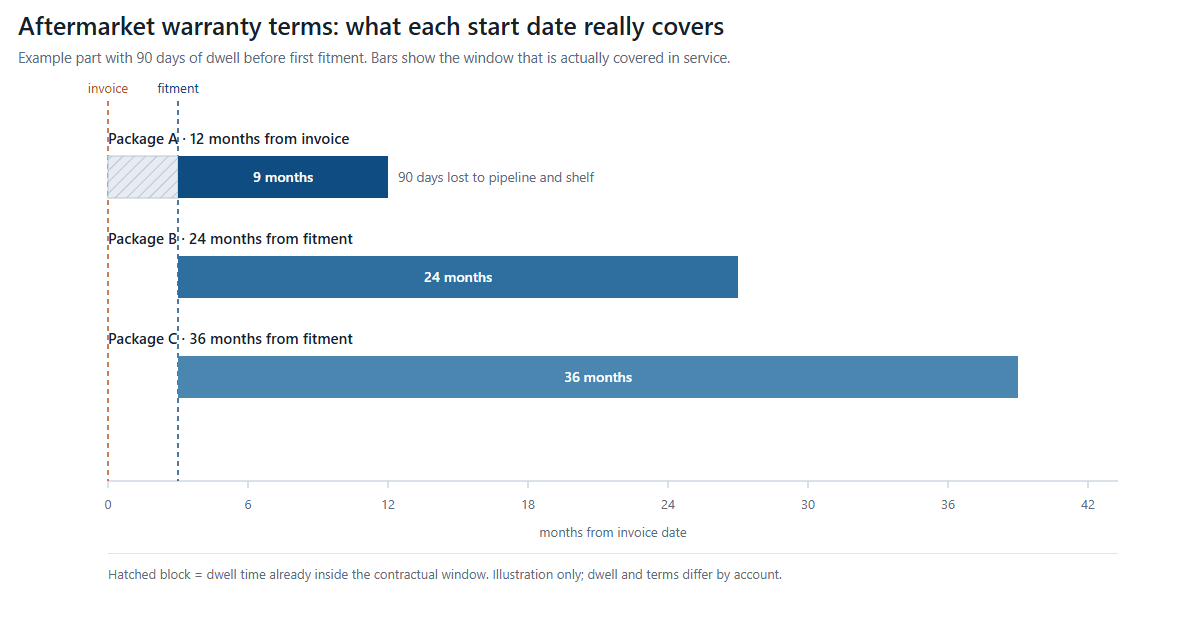
The arithmetic is blunt. A part that spends 60 days in a distributor's warehouse and 30 days on an installer's shelf has burned 90 days before it does any work. On a 12-month shipment-based term it is covered for nine months of service; on a 24-month fitment-based term, for 24. The headline numbers differ by a factor of two and the real coverage by nearly three. That is the largest single lever in aftermarket warranty terms, and it costs a supplier little to move if the buyer trades away part of the headline duration — a trade worth making deliberately rather than by accident.
The mileage clock is the other half of the clause and it should always read whichever occurs first. Kilometres bind fleet buyers, because a taxi can pass 60,000 km inside eighteen months. Months bind retail buyers, because a second car covering 8,000 km a year reaches the end of the calendar long before the mileage. A term written only in months over-covers the fleet and one written only in kilometres under-covers the retail account. Shelf life is the third clock nobody writes down: an invoice-based term can expire while the part is still in its carton.
Remedy, Labour and Freight: The Three Cost Lines
Once coverage in aftermarket warranty terms is agreed, the argument moves to what a covered claim actually pays.
The remedy comes first. Replacement, credit note and repair are three different financial events. A credit returns the part cost and leaves the buyer sourcing a replacement at today's price. A replacement restores the unit but adds a second freight movement. Repair is rarely viable for a moulded component and is better struck out than left ambiguous. Proration — a declining share of part cost as mileage accumulates — is common in the market for wear items and is legitimate, but write it as a table rather than a formula so both sides compute the same number.
Labour is second and usually largest. A bumper replacement bills around half an hour on many passenger cars; a bushing or control arm is a different job, and labour can exceed the part value several times. Three formulations appear: no cover, a fixed allowance per claim, or an hourly rate against a cap. The fixed allowance is easiest to administer and predict, which is why it usually wins. What matters is that the figure is written down, that it is per claim rather than per part, and that it says whether it applies when several parts fail in one repair.
Freight is third, and this is where otherwise reasonable clauses collapse. The question is not who pays freight; it is who pays it on a claim that is later rejected. A supplier who pays return freight on accepted claims is reasonable. One who requires the part back at the buyer's cost before any assessment turns every rejection into a loss, and shipping a hundred low-value parts back costs more than the parts are worth. For low-value items, photographic and dimensional evidence should replace the physical return, with the return reserved for claims above an agreed value.
Eight items make a claim file that adjudicates without a second exchange of emails, and assembling it takes ten minutes at the counter.
Part number, the batch or lot code from the part or carton, and the invoice that sold it.
The warranty start date claimed, with the document that establishes it.
Measured free height of the return against the released dimension, taken on a flat surface.
A hardness reading from the finished part, on a flat area rather than a rib or moulding line.
Photographs at fixed scale: overall, failure site, and the moulded identification.
Vehicle details — make, model, build year, mileage at failure, mileage at fitment if known.
Condition of adjacent parts: damper, spring, mount and bump stop on the same corner.
The symptom in the customer's words, not the technician's diagnosis.
Request a specification sheet or a reference sample with the four inspection items and the drawing band filled in. A claim argument is shorter when the acceptance criteria were agreed before the first shipment.
Three Aftermarket Warranty Terms Packages Side by Side
The table below is the working version of this article: what a buyer should put in front of a supplier instead of a sentence in an email. The packages are illustrative, not offers from a named supplier.
| Term line | A: supplier default | B: balanced | C: full transfer |
|---|---|---|---|
| Duration | 12 months from invoice | 24 months from first fitment | 36 months from first fitment |
| Mileage limit | None stated | 60,000 km, whichever occurs first | 60,000 km, whichever occurs first |
| Remedy | Replacement part only | Replacement or credit, buyer's choice | Replacement or credit, buyer's choice |
| Labour | Not covered | Fixed 15.00 per claim | Covered up to 18.00 per claim |
| Return freight, accepted claim | Buyer pays | Supplier pays | Supplier pays |
| Return freight, rejected claim | Buyer pays | Buyer pays | Buyer pays |
| Evidence | Part returned before assessment | Eight-item file, physical return above 40.00 | Eight-item file, physical return above 80.00 |
| Adjudication target | Not stated | 30 days from complete file | 15 days from complete file |
| Aggregate cap | None stated | 1.5% of annual invoice value | 2.5% of annual invoice value |
| Proration after 24 months | Not applicable | 50% of part cost | 70% of part cost |
| Price index | Base | +0.06 per unit | +0.11 per unit |
Two lines carry more weight than the rest. The start date decides how much service life the term buys, and the aggregate cap decides what happens in a bad year. A cap is not automatically a bad clause — a supplier needs one to price the risk at all — but 1.5% of invoice value on a family with a one percent failure rate leaves little headroom once labour is included. A buyer who accepts a cap should insist on a monthly claim report, so the limit is visible before it is reached.
The Reserve Model: What Each Package Costs Per Year
A term sheet cannot be priced from the premium alone, because a narrow term does not remove failures — it moves them onto the buyer's account. The model below makes that visible. It is a single-distributor example with illustrative inputs, and the only variable is the term; part, quality and failure rate are held constant.
Inputs: 18,000 units a year across a 40-reference range; selling price 6.40; part cost 2.15; 180 field failures presented as claims within 30 months, or 1.0% of units, split 30% in months 6 to 12, 40% in months 13 to 24 and 30% in months 25 to 30; 90 days average dwell.
| Line | Package A | Package B | Package C |
|---|---|---|---|
| Failures inside the covered window | 27 | 126 | 180 |
| Buyer's cost per settled claim | 39.35 | 19.60 | 14.50 |
| Cost of settled claims | 1,062.45 | 2,469.60 | 2,610.00 |
| Failures outside the window, absorbed at 36.75 each | 5,622.75 | 1,984.50 | 0.00 |
| Term premium at 18,000 units | 0.00 | 1,080.00 | 1,980.00 |
| Total annual warranty cost | 6,685.20 | 5,534.10 | 4,590.00 |
| Cost per unit sold | 0.371 | 0.307 | 0.255 |
The ranking is the opposite of what most buyers expect. The widest term is the lowest-cost option, because the failures happen either way and the buyer pays for them at full cost when they fall outside the window. Package A looks lowest on the price list and is the most expensive line in the year.
The same model gives the negotiating ceiling. Moving from B to C costs 900 in premium and adds about 140 in claim cost, so the upgrade is worth roughly 1,844 a year: a ceiling near 0.16 per unit against the 0.11 asked. Run the failure rate down and the answer changes. At about 0.49% the third package stops paying for itself, because the premium is fixed while the benefit scales with failures. That number is the one to argue with, not the price index. A buyer who believes the true rate is a quarter of a percent should buy the narrow term and spend the difference on incoming inspection. A buyer holding data that shows one percent should not be negotiating a twelve-month term at all.
Twelve Lines to Agree Before the First Shipment
The checklist is deliberately short, because eight pages of warranty text get read by neither side. Each line has a wrong version common enough to name.
| Line | What to write | The common wrong version |
|---|---|---|
| 1. Start date | First fitment, evidenced by retail invoice | "From date of shipment", which silently deletes the pipeline |
| 2. Duration and mileage | Both, with "whichever occurs first" | Months only, which over-covers fleets and under-covers retail |
| 3. Covered families | Each family named with its own term | One term for bump stops, bushings and dust covers alike |
| 4. Remedy | Replacement or credit, at the buyer's option | Replacement only, which adds a second freight movement |
| 5. Labour | Fixed allowance per claim, plus a multi-part rule | "Labour not included", which transfers the largest line |
| 6. Freight | Supplier pays return freight on accepted claims | Buyer pays all return freight, including accepted claims |
| 7. Evidence | Eight-item file, photographs accepted below a value | Physical return required before any assessment |
| 8. Adjudication | 30 days from a complete file, deemed accepted after 45 | No timeline, so a claim sits open across a quarter end |
| 9. Cap and reporting | Aggregate cap plus a monthly claim report | A cap with no visibility, discovered at the annual review |
| 10. Exclusions | Wrong application, outside the drawing or temperature range, continuous contact from a failed spring or damper | A general "misuse" exclusion usable against anything |
| 11. Root cause | Failure analysis report on request above an agreed value | No obligation, so the same failure returns next season |
| 12. Linked failures | Rule for a claim where damper, mount or spring was also worn | Silence, which is how most arguable claims are lost |
Lines 5 and 12 are the ones buyers leave blank most often, and they decide the size of the reserve. Line 10 matters for a different reason: an exclusion is only usable if it is specific. A clause saying misuse can be argued in either direction, while one naming continuous contact from a failed spring can be applied consistently — which is what makes a reserve predictable.
The wider commercial context for aftermarket warranty terms sits in the buyer guides library, which treats cost breakdowns, Incoterms and supplier scoring with the same terms-first logic.
Frequently Asked Questions
Can a supplier refuse a claim because the part was fitted with worn dampers?
Yes, and the refusal can be technically correct. A bumper in continuous contact because the spring has sagged or the damper lost its charge is doing a different job from the one it was designed for, and the design life statement is qualified accordingly. What a buyer should insist on is that a rejection carries evidence from the vehicle side — ride height, spring free length, damper condition — rather than an assertion.
Should bushings and bump stops carry the same warranty term?
Usually not. They fail by different mechanisms at different rates, and one term across a mixed range is set by the weakest family and paid for on all of them. Bushings are loaded continuously and fail through the bond or the rubber; bump stops are loaded occasionally and fail by set or cracking. Separate terms and claim rates by family give a buyer a scorecard that means something.
What happens to stock we hold past its shelf life?
It falls outside any sensible warranty and should be excluded explicitly rather than discovered at the first claim. The answer is procedural: date cartons on receipt, rotate first-in-first-out, and ask for a written storage condition and maximum storage period per material. Where a reference moves slowly, a fitment-based start removes the shelf period from the window instead of arguing about it later.
How do we handle a claim on a part we cannot trace to a batch?
Treat it as a systems finding, not a claim. A part with no readable batch code cannot be matched to a process record, so the supplier cannot investigate and the buyer cannot prove which shipment it came from — the claim is lost on evidence rather than merit. The fix belongs upstream: batch marking on the part, one lot per carton, and a receiving record that ties the code to the goods-in note. Where a reference is identified only by an OE number, a near-miss number is not a supersession.
Do the terms belong on the purchase order or in a separate quality agreement?
Either works if one document has priority and the other refers to it. The failure mode is common: warranty sentences pasted into PO conditions the supplier never read, contradicted by a quality agreement signed later. Put the twelve lines in one annex, reference it from both documents, and state which prevails in a conflict. A page both sides have read beats six neither has.
Request a quotation with the part family, the annual volume and the term you want to write, and the commercial answer can be built around the term rather than retrofitted to it.