
- 1. What a Bump Stop Warranty Failure Costs
- 2. The Three Conditions That Define a Failed Bump Stop
- 3. Seven Buyer Mistakes Behind Every Bump Stop Warranty Failure
- 4. How to Identify the Cause on a Returned Part
- 5. Five Contract Clauses to Agree Before the First PO
- 6. A Warranty Season Cost Model
- 7. FAQ
- 7.1. If the vehicle was overloaded, is the claim automatically rejected?
- 7.2. Do we need to return the physical part, or are photographs enough?
- 7.3. Is a 2-year warranty the same as a 2-year design life?
- 7.4. Should we specify NDI across the whole range to cut the claim rate?
- 7.5. Can we claim workshop labour time as well as the part?
- 8. Work With the Factory, Not Against the Claim
Why Cheap Bump Stops Fail in Warranty: Seven Buyer Mistakes
Most bump stop warranty failure starts in the purchase order, not in the mould. Seven recurring buyer mistakes — a downgraded compound, a skipped post-cure, unblasted inserts and four more — produce the majority of early returns, and every one of them leaves physical evidence on the part that a trained eye can read and a contract clause can prevent.
What a Bump Stop Warranty Failure Costs
A warranty claim on a bump stop never costs what the part cost. The component is one of the least expensive items on a suspension, but a claim drags freight, inspection time, administration and — the largest item of all — the customer relationship behind it. Priced properly, the saving on a cheap part is repaid several times over in return freight and paperwork.
The economics also set the time frame in which a claim is legitimate. Bonpora states a design life of at least 80,000 km or 2 years under normal use for its polyurethane bump stops, and the typical warranty quoted in the market runs from 1 to 2 years or 50,000 to 100,000 km. A part that cracks, takes a set or goes soft well inside that window is not a worn part; it is a claim — and deciding which of the two it is depends on knowing how the part fails and what each failure looks like on the bench.
The Three Conditions That Define a Failed Bump Stop
A bump stop is one of the few suspension parts whose failure is defined in material terms rather than by a noise or a leak. Three conditions mark the end of its life, each with a different symptom on the road.
Cracking is a structural failure of the material. Excessive permanent deformation — compression set — is a geometric failure, because the bumper has lost the free height that decides when it engages. Stiffness loss is a performance failure: the part is intact, but it no longer adds the progressive resistance the suspension was designed around. A bumper can fail one way and pass the other two checks, which is why assessing a return on appearance alone regularly misidentifies the cause.
These three conditions, and the line between a service crack and a moulding defect, are described in detail in the jounce bumper failure guide. The table below builds on that base and maps each of the seven recurring purchase-order mistakes onto what the failure looks like on a returned part.
Seven Buyer Mistakes Behind Every Bump Stop Warranty Failure
Each of the seven rows below was signed for before the first shipment: a mistake made before or during production, the evidence it leaves on the return, and the clause that closes it. Copy the table into the supplier agreement and tick the right-hand column before the first PO is signed.
| Buyer mistake | What goes wrong inside the part | How to identify it on the return | Clause to add |
|---|---|---|---|
| 1. Accepting a downgraded compound | The drawing named NDI, the quote priced MDI, or filler loading was raised to cut cost. Resilience and heat retention fall, so the bumper takes a set and goes soft early. | Compare hardness and the static stiffness curve of the return against the drawing. NDI and MDI parts are not interchangeable; the loss shows first in set and curve deviation. | "The material system named on the drawing is contractual. Any substitution requires written approval and a re-run of the approval tests." |
| 2. Post-cure shortened or skipped | Cast polyurethane continues to stabilise after moulding. Without a defined post-cure window, compression set grows in service even though the part left the factory looking correct. | Measure free height of the return against the released dimension. A part that is short and does not recover after unloading, with claim mileage rising week by week, points to incomplete cure. | "Post-cure is part of the control plan. The buyer may verify it during audit, and retained samples per lot are held for the warranty period." |
| 3. Inserts fitted without grit blasting | The rubber-to-metal bond starts on a mechanically toothed surface. A smooth or oily insert gives a weak interface that separates or cracks at the washer under repeated compression. | Peel the rubber back from the insert on a scrapped return. A bonding surface with no mechanical tooth, or a failure face that separates cleanly, indicates surface preparation was missed. | "Insert preparation is stated on the drawing notes. Bond integrity is checked destructively on a defined sampling plan." |
| 4. Hardness outside the drawing band | Too soft and the stop loses stiffness; too hard and it cracks at the rib roots. A common industry tolerance on durometer is in the region of ±5 Shore A, but the band should be verified with the supplier for the specific profile. | Durometer check at the mid-section on a flat area, against the drawing value. One lot consistently off-band while others pass points to a batching issue rather than a design issue. | "Hardness band, measuring location and instrument type are stated on the drawing. Out-of-band lots are not shipped." |
| 5. Moisture reaching the material | Cast polyurethane systems are moisture sensitive. Packaging without a sealed liner lets humidity in during ocean freight, and porosity shows up as voids and surface defects that start cracks. | Voids or porosity visible at fracture faces, and claims clustered by container or by humid-season shipments rather than by lot. | "Packaging uses a sealed liner with desiccant. Each part carries a batch code traceable to the production date." |
| 6. Batches mixed inside one carton | When a carton holds parts from several production lots, one failed part cannot be traced to its process record, and the whole carton is written off in the claim. | Batch codes differ between parts inside the same carton. The claim loses its evidence chain before it is even filed. | "One production batch per carton. Batch code is recorded on the packing list and entered on the job sheet at fitting." |
| 7. Worn or aged tooling left in production | An old mould drifts: flash grows, sections thin, and the profile that sets the engagement point changes. The part fits the drawing number but no longer behaves like it. | Measure free height and key profile dimensions against the drawing, and look for cracks that follow a flash line rather than the bulge pattern. | "Tooling is owned and maintained on a defined schedule. First-off dimensional checks are recorded per lot, and re-cut thresholds are agreed." |
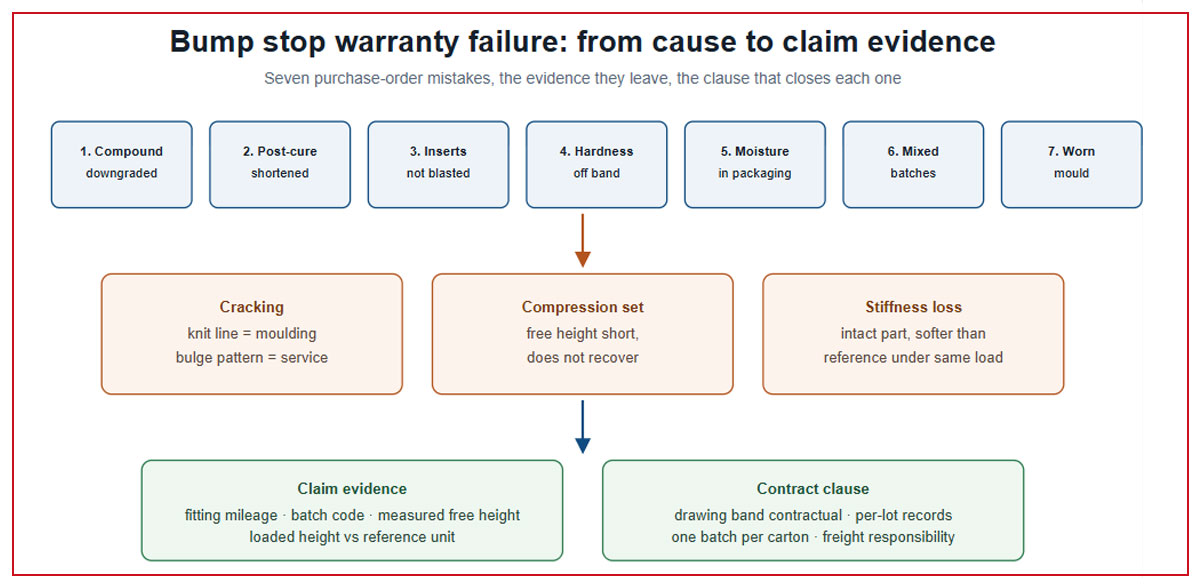
The compound is not a commodity
MDI-based polyurethane is the widely used system, offering a balance of resilience, tear resistance and cost that suits the majority of passenger-car positions. NDI-based polyurethane is selected where higher resilience, better dynamic performance and better retention under heat and repeated cycling are required, at a higher material cost and a more demanding casting process. A quotation that lands visibly below the field for the same drawing has usually changed something inside this choice, or raised filler — neither shows on the outside of the part, and both show in the curve and in the set.
Post-cure is where set is decided
Compression set is driven by temperature, by load and by time under load, and a part that has not completed its post-cure keeps taking set long after it is fitted. It is the mistake hardest to see on delivery and easiest to see in warranty data. A common specification for compression set in elastomer supply is expressed as a maximum percentage after a fixed duration at an elevated temperature — the exact figures should be verified with the supplier for the compound in question.
Bonding starts with the blast
An insert that has not been grit blasted leaves a failure face that tells the story on its own: the rubber peels away cleanly and the metal still shines. It is also the quickest mistake to check — no instruments, only a scrapped part and ten minutes.
Moisture, mixing and moulds
The remaining three mistakes are logistics and tooling discipline. Humidity, mixed batches and worn moulds do not change what the compound is; they change its traceability and geometry, which is why their evidence appears as patterns — claims clustered by shipment, untraceable cartons, flash-line cracks — rather than as one laboratory result.
How to Identify the Cause on a Returned Part
The factory-side inspection system behind a credible claim is the one the production line already runs. Bonpora controls quality under an IATF 16949 system with inspection of the static stiffness curve, compression set, hardness and appearance — four items that map directly onto the three failure conditions. A bump stop warranty failure is settled by evidence, and a claim is strongest when that evidence is what the workshop collects anyway.
| Observation on the return | Likely cause | Evidence to attach to the claim |
|---|---|---|
| Crack follows a visible flow or knit line, voids at the root, few road kilometres | Moulding condition — flash line, porosity or incomplete cure | Photographs of the fracture face, batch code, fitting mileage |
| Crack follows the bulge pattern, polished material around it | Service load or fatigue — check spring sag, overload, boot condition | Ride-height measurement, boot and mount condition photos |
| Height loss that does not recover after removal | Excessive permanent deformation — post-cure or compound issue | Measured free height against released dimension, batch code |
| Part intact but softer than a reference under the same load | Stiffness loss — compound downgrade or incomplete cure | Loaded-height comparison against a new reference part |
| Rubber separates cleanly from the insert | Bond failure — insert preparation missed | Photo of the peeled bonding surface |
| Failure pattern confined to one shipment or one season | Moisture in packaging | Container and packing-list records, void photographs |
| Batch codes differ within one carton | Mixed batches — traceability broken | Carton photographs, packing list |
Two bench habits separate an arguable claim from a settled one. First, measure free height as delivered, not as remembered: a bumper that engages late has usually lost height, and the number settles the discussion faster than an opinion. Second, compress the return against a known load and compare the height with a new reference unit — the formal version of that check is the static stiffness curve the production lot was already measured against. Record the mileage at fitting and the batch code on the job sheet, and confirm the reference number against the removed part rather than the appearance, because several profiles are visually similar and a near miss fits but does not behave correctly.
Request a specification sheet or a reference sample with the four inspection items and the drawing band filled in, so the acceptance criteria are agreed before the first shipment rather than argued at the first claim.
Five Contract Clauses to Agree Before the First PO
The clauses below turn the seven mistakes from a dispute into a checklist, and they are short enough to paste into a supply agreement.
Material system and drawing band are contractual: the compound named on the drawing, the hardness band, the profile dimensions and the free height are the acceptance criteria; any change requires written approval and re-run approval tests.
The four production inspections — static stiffness curve, compression set, hardness, appearance — are run per lot under the factory's IATF 16949 system, and the records remain available for the warranty period.
Insert preparation and post-cure are written into the control plan and may be verified during a buyer audit, including a destructive bond check on a defined sampling plan.
Packaging carries a sealed liner with desiccant, one production batch per carton, and a batch code on every part that links to the packing list and the production date.
Warranty terms state the window (commonly 1 to 2 years or 50,000 to 100,000 km in the market), the evidence required — fitting mileage, batch code, measured free height — and who carries return freight when the evidence supports the claim.
A clause is only worth what its evidence is worth. If the batch code is not recorded at fitting, clause 5 collapses into an argument about mileage; if the packing list does not carry the batch, clause 4 collapses into an argument about cartons. Workshop discipline on the buyer's side is part of the contract, even though it is not written in it.
A Warranty Season Cost Model
The model below is illustrative — every figure is an assumption for arithmetic, not a quotation — but its shape is what a distributor should reproduce with their own numbers before choosing between two quotes.
A distributor sells 12,000 bump stops a year across a 40-SKU range. One claim costs far more than the part: replacement unit 2.20, outbound freight 1.10, return freight 2.40, workshop inspection 15 minutes at 28 per hour (7.00) and claim administration 6.00 — 18.70 per claim against a part that may have cost 2.20 to buy. On top sits churn: one claimant in four stops reordering, and an average account buys 800 units a year at a 0.90 contribution margin, so each lost account costs 720 a year.
| Line | Quote A — low-priced part | Quote B — specified part |
|---|---|---|
| Assumed claim rate | 0.8% (96 claims) | 0.2% (24 claims) |
| Direct claim cost at 18.70 | 1,795 | 449 |
| Claimants lost (1 in 4) | 24 accounts | 6 accounts |
| Churn cost at 720 per account-year | 17,280 | 4,320 |
| Total annual exposure | 19,075 | 4,769 |
| Premium paid for Quote B (+0.30 per unit) | — | 3,600 |
The gap between the two exposures is 14,306 a year against a premium of 3,600 — roughly four to one. Even if the assumed rates are optimistic, the premium is covered as long as the specified part avoids a fraction of the claims the low-priced one would generate. The exact ratio belongs to the distributor; the direction of it belongs to the arithmetic.
A bump stop warranty failure is a purchasing problem before it is a quality department problem: each of the seven mistakes is closed by one clause, and the clauses cost nothing at signature — only the supplier a process it should already be running.
FAQ
If the vehicle was overloaded, is the claim automatically rejected?
Overload, a sagged spring or a lost gas charge push the bumper into continuous contact, and the failure guide is explicit that a part used as a spring wears out on schedule regardless of its quality. But the rejection needs evidence on the vehicle side — ride height, spring and damper condition — not an assertion. A crack following the bulge pattern on a vehicle with correct ride height and normal mileage supports the claim.
Do we need to return the physical part, or are photographs enough?
Photographs settle the visible failures; measurements settle the invisible ones. Height loss and stiffness loss both leave a part that looks intact, so a claim for either should carry the measured free height against the released dimension, or a loaded-height comparison against a reference, alongside the photos, the batch code and the fitting mileage.
Is a 2-year warranty the same as a 2-year design life?
No, and the difference matters in a dispute. The design life — at least 80,000 km or 2 years under normal use — describes what the part is engineered to do; the warranty describes what the supplier contractually stands behind, commonly 1 to 2 years or 50,000 to 100,000 km in the market. A supply agreement should state which figure governs a claim, because a part that fails at 90,000 km may be inside one definition and outside the other.
Should we specify NDI across the whole range to cut the claim rate?
NDI earns its cost where the bumper works hard — heavier vehicles, demanding positions, sustained heat. Specifying it everywhere raises material cost and casting complexity across a range where MDI was already adequate. Read the claim data by position first, then move the positions with heat- or set-related failures to NDI and leave the rest on the specified system.
Can we claim workshop labour time as well as the part?
Only if the clause says so. In the cost model above, inspection and administration (13.00 of 18.70) exceed the replacement part (2.20), so a distributor who recovers only the part recovers a minority of the loss. The labour rate, the allowed time and the documentation belong in clause 5, agreed before the first shipment.
Work With the Factory, Not Against the Claim
A warranty file is a purchasing document that arrived late. Seven buyer mistakes, one clause each — that is the whole discipline of preventing bump stop warranty failure before the shipment leaves. All seven can be verified with a durometer, a ruler, a peeled bond or a batch code — instruments a workshop already owns. Start from the on-road range, review the acceptance criteria in the Bonpora jounce bumper specification guide, and read the three failure conditions side by side with your own claim data in the failure guide. More working documents are collected in the buyer guides for suspension parts, and the Bonpora engineering team can review a drawing or a failed return before the next season's order.