
- 1. Tariff Auto Parts Exposure: What It Actually Covers
- 2. Where Bump Stops and Bushings Sit in the HS Schedule
- 3. Country of Origin: What a Certificate Does and Does Not Prove
- 4. Anti-Dumping and Countervailing Duty Screening Before the PO
- 5. Transshipment Risk: Third-Country Routing Does Not Change Origin
- 6. The Six-Point Tariff Auto Parts Self-Check Before You Sign
- 7. Duty Allocation Clauses and a Worked Example on a 20,000-Unit Order
- 8. FAQ
- 8.1. Does the HS code for a polyurethane bump stop change if it has a steel insert?
- 8.2. We buy through a trading company that invoices from another country. Is the origin still China?
- 8.3. Who pays if an anti-dumping measure is announced after our PO but before the goods arrive?
- 8.4. Is a commercial invoice from the supplier enough to prove country of origin?
- 8.5. Our broker classified a rubber bushing under one heading and customs re-determined it under another. What now?
- 8.6. Do tariff rules differ between the EU, the US and other markets?
Tariff Exposure for Chassis Parts: A Buyer's Checklist
Tariff auto parts exposure is the duty, tax and delay a chassis order picks up between quotation and customs clearance, and most of it can be managed before the PO. This checklist covers six checks: HS classification, country of origin evidence, anti-dumping screening, shipping routing, Incoterms alignment and the contract clauses that decide who pays when duties change.
Tariff Auto Parts Exposure: What It Actually Covers
When buyers talk about tariff auto parts exposure, they usually mean three layers stacked on top of each other. The first is the ordinary import duty that applies to the product heading in your market's tariff schedule. The second is the documentary layer: origin, value and classification must be consistent, because customs assesses duty on the story the file tells. The third is the political layer: anti-dumping and countervailing duties, safeguards and tariff-rate adjustments that can appear after a purchase order is signed and change the landed cost of parts priced months earlier.
All three layers hit chassis components hard for one structural reason: polyurethane bump stops, rubber bushings and stamped brackets are low-value, high-volume parts. When a unit cost is two dollars, a duty change of a few percentage points moves the landed cost by cents, but an anti-dumping measure of twenty percent moves it by tens of cents, and a mis-declared heading can freeze an entire container at the port.
There is also a timing asymmetry buyers underweight. Classification and origin are checked once at clearance, but the consequences follow the goods for the record-keeping period of your import market, which in many jurisdictions runs for years. A wrong heading found in an audit turns into retroactive duty plus interest on every shipment cleared under it. That is why this checklist runs from the most durable decisions — heading, origin, routing — to the most negotiable ones, the contract clauses, using six questions put in writing before the purchase order.
Where Bump Stops and Bushings Sit in the HS Schedule
The Harmonized System has no heading called "suspension parts". Classification follows the material and function of the part, which is why one chassis programme can involve several headings. Under the public tariff structure used by most WTO members, three headings cover most of what Bonpora produces:
| Heading | Typical scope in the public tariff | Chassis parts that usually land here | Classification drivers |
|---|---|---|---|
| 8708.99 | Parts and accessories of motor vehicles, other | Jounce bumpers, bushings and brackets assessed as vehicle parts | Function as a vehicle part, then material |
| 4016.99 | Other articles of vulcanised rubber | All-rubber bushings, rubber buffers without metal function | Predominantly rubber, not a vehicle sub-assembly |
| 3926.90 | Other articles of plastics | Polyurethane microcellular stops without metallic inserts | Polymer material dominates the part |
The order of thinking matters. Most customs authorities apply the general rules of interpretation in sequence: first ask what the part is by function, then by material composition, and only then look at residual headings. A polyurethane bump stop with a steel mounting plate is not classified by whichever component weighs more; it is classified by the analysis your national customs authority publishes. This is why the heading must be verified in the official tariff of your own import market rather than copied from a supplier's proforma invoice; the United States, for example, maintains a searchable official tariff at hts.usitc.gov.
Three consequences follow. First, the same part can clear under different headings in different markets, so a "final HS code" only exists per destination. Second, duty rates differ across those headings, so classification is a cost decision, not just paperwork. Third, classification risk sits with the buyer in most configurations — a point the clause section returns to.
What a supplier owes you here is not a legal opinion. It is a material and functional declaration precise enough for your broker to classify: the polymer system (cast MDI or NDI polyurethane, natural rubber, EPDM), the presence and role of any metal insert, weight breakdowns, and drawings showing the mounting function. Bonpora supplies that detail in the specification pack with every quotation, because without it the broker guesses and the guess is yours to pay for.
Country of Origin: What a Certificate Does and Does Not Prove
Origin is the second pillar of tariff auto parts exposure, and it answers a different question from classification: where was the product manufactured, in the sense your import market's customs law defines. For non-preferential purposes — the ordinary duty rate, origin marking, and most anti-dumping scopes — origin is generally the country where the goods are produced or substantially transformed. For chassis rubber parts moulded and finished in China, the origin is China; there is no ambiguity worth exploiting and plenty of risk in trying.
The document layer is where buyers get caught. A certificate of origin issued by an authorised body proves what the exporter declared; it does not prove the manufacturing story behind the declaration is accurate. So the check is not "does a CO exist" but "does the file agree with itself": origin country on the certificate, the invoice, the packing list, the carton marking and the production records should all match. Bonpora marks cartons with reference numbers and batch codes under its neutral export packaging standard, which keeps the production story traceable after the container is opened.
Origin also interacts with the dual-base structure buyers care about for supply risk. Production at two IATF 16949-certified bases — Luoyang and Wuxi for Bonpora — does not change the origin, but it matters for documentation in one specific way: the production site named in the file must be the site that actually made the goods in that shipment. If an order splits across plants, the documents should reflect the split; a certificate naming the wrong plant reads badly in an audit.
Two habits keep origin clean. First, request the certificate format at the quotation stage, not at the shipping stage — some markets require specific forms, and scrambling before a vessel cutoff is how errors happen. Second, keep one origin dossier per part family — CO, invoice, bill of lading and the supplier's material declaration filed together — so any later query is answered from the file instead of from memory. If you are building that dossier for a live programme, request the specification pack or samples today.
Anti-Dumping and Countervailing Duty Screening Before the PO
Anti-dumping (AD) and countervailing (CVD) duties are targeted measures against specific products from specific countries, and they are the sharpest form of tariff auto parts risk because they can multiply the duty rate rather than nudge it. The scope wording of a measure — which products, which materials, which HS headings at which level of detail, which countries — decides whether your part is covered, and scope wording is legal text, not intuition. The WTO maintains a public gateway to members' anti-dumping activity at wto.org, and major import markets publish their own official AD/CVD listings; screen both product scope and origin country before the PO, not after.
A screening pass takes four steps; put all four in writing even when the answer is "no measure applies".
Search the official AD/CVD listings of your import market for the product description and every HS heading from the classification step, not only the one your broker prefers.
Read the scope paragraph of any hit: the product wording, the exclusions, the countries covered. Rubber and polyurethane combinations are exactly where scope text gets argued case by case.
Check the procedural state: an investigation pending is not a duty today, but provisional measures can be imposed mid-investigation and applied retroactively to shipments in a defined window — the scenario that turns a signed PO into a problem.
Record the search: date, market, listings checked, result. If a measure appears later, that record shows the file was clean when you ordered.
One warning about thresholds. Any specific rate in this article — a base duty percentage, a provisional AD margin, an interest figure — is an illustrative number for the worked example, not a statement about any market or product. Rates differ by market, change with reviews and depend on classification; verify every rate against your destination's official tariff and measure text.
Transshipment Risk: Third-Country Routing Does Not Change Origin
When measures or high tariffs make one origin expensive, someone in the chain will eventually suggest a workaround: ship through a third country, re-invoice there, declare that country as origin. For chassis parts this is not a sourcing strategy; it is origin fraud, and customs looks at the buyer first, because the buyer is the importer of record in most configurations.
Origin follows production, not routing. Goods produced in China and merely re-labelled or re-invoiced elsewhere remain Chinese-origin, and customs authorities detect the pattern routinely — through vessel routing, production-capability checks and inconsistencies between the CO, the bill of lading and factory records. Consequences scale past the shipment: penalties, seizure, loss of trusted-trader status, retroactive duties across the entry history. No unit-cost saving survives that range.
Routing is not the only variable. A buyer-side restructuring — importing through a related distributor, splitting invoices for parts and tooling — changes the customs value duty is calculated on, and valuation is its own audit surface. The rule for the checklist: every structural change to how goods are sold, invoiced or routed gets the same treatment as a new product — a fresh pass through classification, origin and value with your broker, in writing. There is a legitimate version of multi-country supply: produce genuinely in another country and document it. That is the dual-site question covered in an earlier article on supply risk — it works because production moves, not because paper does.
The Six-Point Tariff Auto Parts Self-Check Before You Sign
The six checks below are the hard asset of this article. Run them before any first purchase order for chassis rubber or polyurethane parts, and re-run them when origin market, destination or material changes. Each row names the check, what to ask for, and the red flag that should stop the PO until it is resolved.
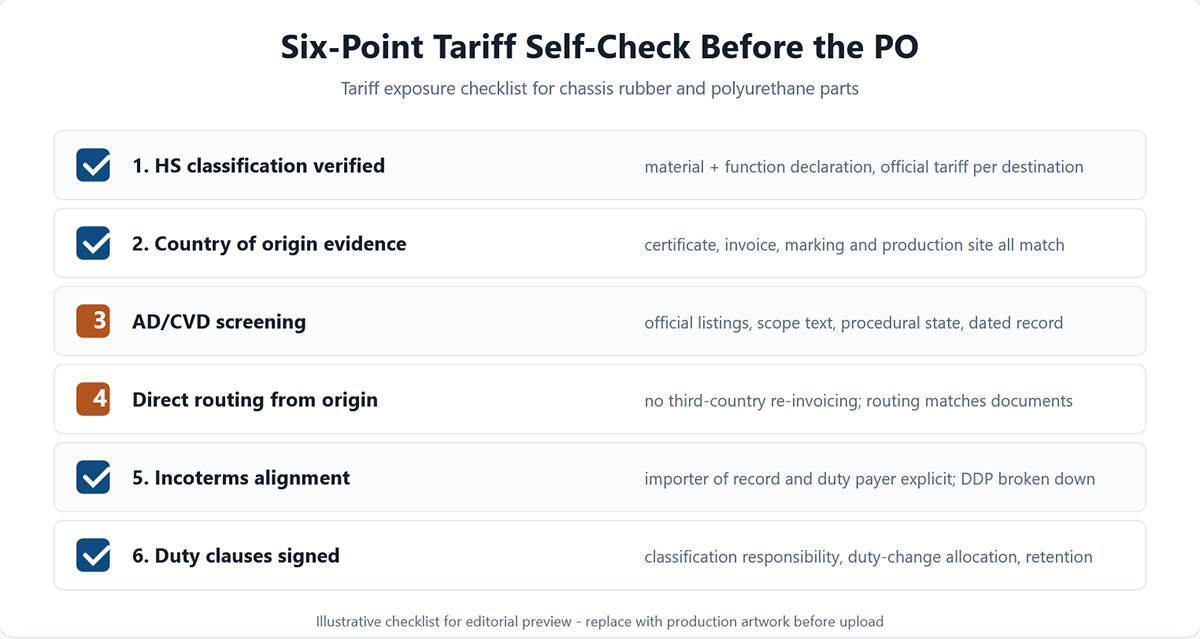
| # | Check | What to ask for and do | Red flag |
|---|---|---|---|
| 1 | HS classification | Supplier provides a material and function declaration (polymer system, metal insert role, weight breakdown); your broker confirms the heading per destination in the official tariff | Supplier offers a code with no material breakdown, or says "no classification needed" |
| 2 | Country of origin | CO format agreed at quotation; certificate, invoice, packing list, carton marking and production site all match | Origin blank on any document, or certificate names a plant that did not produce the goods |
| 3 | AD/CVD screening | Four-step written search (listing, scope, procedure, record) for the origin country and every candidate heading | "No measures" asserted without a dated record, or scope text never actually read |
| 4 | Routing | Direct shipment from the production country; routing matches the documents | Any offer to "improve" the origin by routing through a third country |
| 5 | Incoterms alignment | Importer of record, duty payer and clearance responsibility explicit; DDP quotes broken down | DDP quote with a flat duty percentage baked in and no origin or valuation basis stated |
| 6 | Contract clauses | Duty-change allocation, classification responsibility and document retention written into the agreement | Contract silent on who bears a retroactive duty assessment |
Rows 1 to 4 are factual checks; row 5 is configuration; row 6 is what makes the other five enforceable. A useful discipline is to attach the completed self-check to the PO file, so a customs query two years later starts from a dated document instead of a recollection.
Duty Allocation Clauses and a Worked Example on a 20,000-Unit Order
Contract clauses for tariff auto parts do not need to be long. They need to answer three questions the purchase agreement otherwise answers by default — and the default in most jurisdictions is "the importer of record pays everything". The clause elements below are drafting ideas to discuss with your own legal and customs advisers, not legal advice.
Classification responsibility. State the HS heading used for the order and on whose classification it was agreed — the buyer's broker's or the supplier's declaration's. That sentence decides most disputes when customs re-determines a heading.
Duty change allocation. Define what happens if a new or increased duty, AD/CVD measure or safeguard applies between PO signature and arrival. Common structures: each party absorbs its own stage; a renegotiation trigger at a defined threshold; or cancellation rights above it. Pick one you can administer.
Retroactive assessment. State that retroactive duties, interest and penalties arising from the buyer's declaration are buyer-side, and those arising from supplier-supplied information proven false — a false origin or material declaration — are supplier-side. The clause only bites if the evidence trail from rows 1 to 4 of the self-check exists.
Document retention. Require both sides to keep origin, classification and production records for the retention period of the import market, and to answer document requests within a defined number of working days.
Information accuracy. Require the supplier's material, composition and production-site declarations to be accurate and updated on process or site changes. For a dual-site supplier this is where a plant switch must be notified.
Broker communication. Name who communicates with customs and who authorises any binding ruling request or scope ruling application.
Now the worked example, entirely illustrative, with round numbers. An order of 20,000 polyurethane bump stops, CIF value 2.00 USD per unit, total 40,000 USD. Assume a base duty of 3.5%: planned duty 1,400 USD. Now assume an AD investigation on the product family from the origin country imposes a provisional measure of 22% before arrival, plus 560 USD of bond, interest and broker handling. The unplanned add-on is 4,400 + 560 = 4,960 USD, roughly 0.25 USD per unit on a 2.00 USD part — a 12.4% landed-cost increase that no unit-price negotiation can absorb.
| Cost line | Scenario A: contract silent | Scenario B: clause set above |
|---|---|---|
| Base duty 3.5% (planned) | 1,400 USD | 1,400 USD |
| Provisional AD 22% (unplanned) | 8,800 USD absorbed by importer of record | Renegotiation trigger met; order re-priced or cancelled per clause 2 |
| Bond, interest, broker (unplanned) | 560 USD absorbed by importer of record | Allocated per clause 3 |
| Per-unit landed effect | 2.00 + 0.478 = 2.478 USD | Re-priced within agreed structure |
| Administrative cost of the dispute | Weeks of unstructured claim and counter-claim | One clause-referenced email |
The table is not a prediction; the 3.5% and 22% figures are assumptions built to show magnitudes. What it shows is the real function of the clauses: they do not reduce the probability that trade policy moves, they convert an open-ended exposure into a bounded, pre-agreed process. The cost of running the six-point self-check is a few hours of broker and procurement time per part family; the exposure it bounds, in the example, is measured in thousands of dollars per order.
Two links belong here. For how the shipping term decides who pays duty, and why chassis parts usually move on FOB terms, see the Incoterms auto parts guide — the same responsibility matrix from the quotation side. And when the classification question turns on what a jounce bumper actually is and how it is inspected, the Bonpora jounce bumpers product page carries the material systems and the IATF 16949 inspection items that feed a defensible classification file.
FAQ
Does the HS code for a polyurethane bump stop change if it has a steel insert?
It can, and the answer depends on how your customs authority applies the classification rules to the part's function and composition, not the insert's weight share. Treat any heading quoted with a PU part as provisional until your broker confirms it per destination, and keep the supplier's material declaration in the file as the basis.
We buy through a trading company that invoices from another country. Is the origin still China?
Origin follows where the goods are produced, not who invoices. If the parts are manufactured in China, they remain Chinese-origin for customs purposes regardless of the invoicing route, and declaring the invoicing country as origin creates exactly the inconsistency that audits find first.
Who pays if an anti-dumping measure is announced after our PO but before the goods arrive?
The importer of record owes the duty at clearance, so operationally the buyer's side pays first. Who ultimately bears the cost is decided by the contract: with no clause the importer absorbs it; with a duty-change allocation clause it becomes a defined renegotiation or cancellation path.
Is a commercial invoice from the supplier enough to prove country of origin?
No. Invoices state a value and usually an origin line, but most markets require an origin certificate from an authorised body for clearance or for preferential claims, and some require specific forms. Agree the required format at quotation stage and file it with the shipment documents, not after customs asks for it.
Our broker classified a rubber bushing under one heading and customs re-determined it under another. What now?
Expect a re-determination with retroactive effect on entries cleared under the disputed heading. Respond with a technical file: material composition, function, drawings and any published classification practice for similar parts. This is the scenario the classification-responsibility and document-retention clauses exist for; a dated self-check record makes the defence far cheaper.
Do tariff rules differ between the EU, the US and other markets?
Yes — in rates, classification practice, AD/CVD procedure and origin documentation requirements. Nothing here substitutes for the official tariff and measure texts of your destination market; treat every rate in your cost model as verified or a clearly labelled assumption.
If you want the specification pack that supports rows 1 and 2 of the self-check — material system declaration, inspection items and production-site information — request it through our contact page, and the sales team will reply within one working day.