sales@bonporaparts.com
0086-10-64988621
English
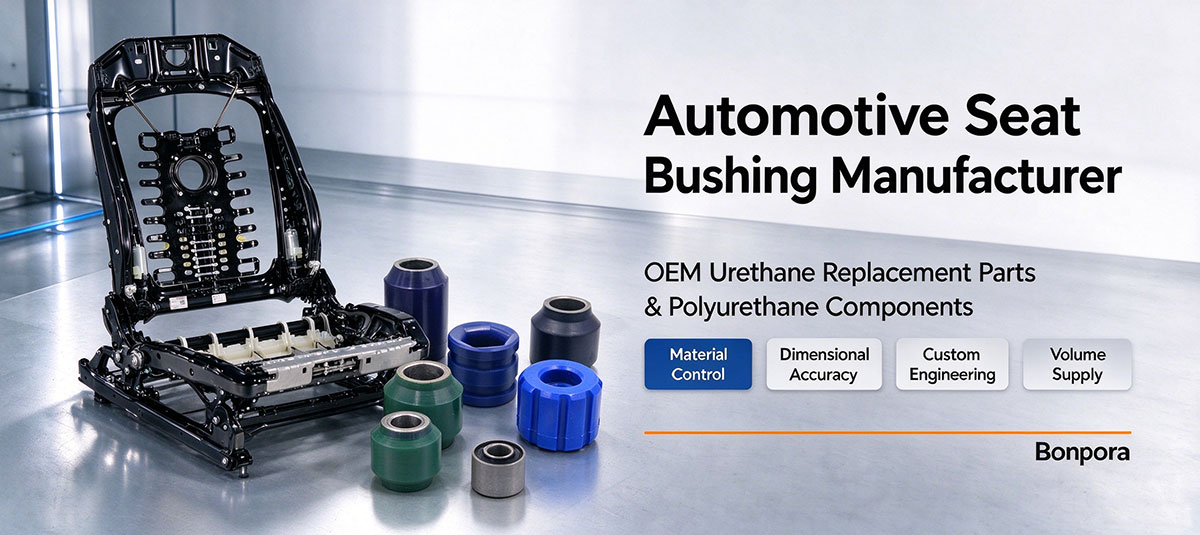
Global buyers searching for an automotive seat bushing manufacturer or OEM urethane replacement parts often need more than a standard component supplier. They look for material consistency, dimensional control, custom engineering support, and stable production capacity for automotive seating and related replacement programs.
This guide explains the role of automotive seat bushings, the advantages of urethane and polyurethane materials, and what buyers should evaluate when selecting an OEM supplier. It is written for aftermarket part distributors, repair suppliers, engineering teams and sourcing companies.
Automotive seat bushings are components used in seat adjustment mechanisms, seat frames, recliners, slides, hinges and mounting points. They help manage friction, wear, alignment and movement control in seating systems.
Common applications include:
Seat slide and adjuster mechanisms
Seat recliners and hinges
Seat frame mounting points
Armrest and folding seat structures
Interior control linkage components
Urethane and polyurethane are common material choices for automotive bushings and replacement parts because they can be engineered to balance hardness, wear resistance, impact absorption and dimensional stability.
| Material Characteristics | Potential Benefits |
|---|---|
| Abrasion resistance | Extended service life in moving mechanisms |
| Impact absorption | Reduced shock and noise in seat adjustment |
| Dimensional stability | Consistent fit in housing and mounting points |
| Custom hardness | Can be tuned for load and movement requirements |
| Chemical resistance | Better tolerance to certain automotive fluids and environmental conditions |
Material selection should be validated against load, temperature, wear rate, assembly method and vehicle application.
An experienced automotive seat bushing manufacturer may supply a range of urethane and polyurethane components for seating and related applications.
Used in seat slide, track and adjuster systems. These bushings help maintain alignment and reduce wear during repeated fore-and-aft or height adjustment.
Used in seat back recliners and folding mechanisms. They support rotational movement while helping control backlash and wear.
Installed at seat frame mounting points. They can help absorb vibration, support alignment and protect metal-to-metal contact.
OEM suppliers can also support custom urethane replacement parts based on drawings, samples, application requirements and material specifications.
When selecting an OEM urethane replacement parts supplier, buyers should consider:
Material formulation and hardness control
Dimensional accuracy and tooling capability
Production volume and batch consistency
Application engineering support
Sample validation and prototype capability
Surface finish and visual quality
Compliance documentation and traceability
Bonpora supplies automotive seat bushings and OEM urethane replacement parts for seating mechanisms, seat frames, adjusters, recliners and related interior components. Our product range includes polyurethane bushings, molded urethane parts, custom replacement components and application-specific engineering support.
Buyers evaluating Bonpora may focus on the following capabilities:
Automotive seat bushing manufacturing and custom urethane part supply
Material and hardness customization based on application requirements
Dimensional control and assembly fit validation
Prototype, sample and small-batch support
Coordination with buyers on drawings, samples and production requirements
You can view our polyurethane bump stops and related product page here: https://www.bonporaparts.com/en/polyurethane-bump-stops/
An automotive seat bushing manufacturer designs, develops and produces bushings for seat slides, recliners, hinges, frames and adjuster mechanisms, often using urethane or polyurethane materials.
OEM urethane replacement parts are developed to match specific application requirements, including material hardness, dimensions, load capacity and assembly fit.
Polyurethane can offer good abrasion resistance, impact absorption and dimensional stability, but the best material depends on load, temperature, wear rate, noise requirements and assembly design.
Yes. Manufacturers can produce custom urethane parts based on drawings, samples, material specifications and application conditions.
Evaluate material capability, tooling, dimensional control, production volume, sample validation, engineering support and documentation.
Provide drawings or samples, material or hardness requirements, quantity, application conditions, assembly details and any required compliance or traceability information.
For technical inquiry, sample request or OEM production discussion, please contact our sales team: sales@bonporaparts.com.
