sales@bonporaparts.com
0086-10-64988621
English
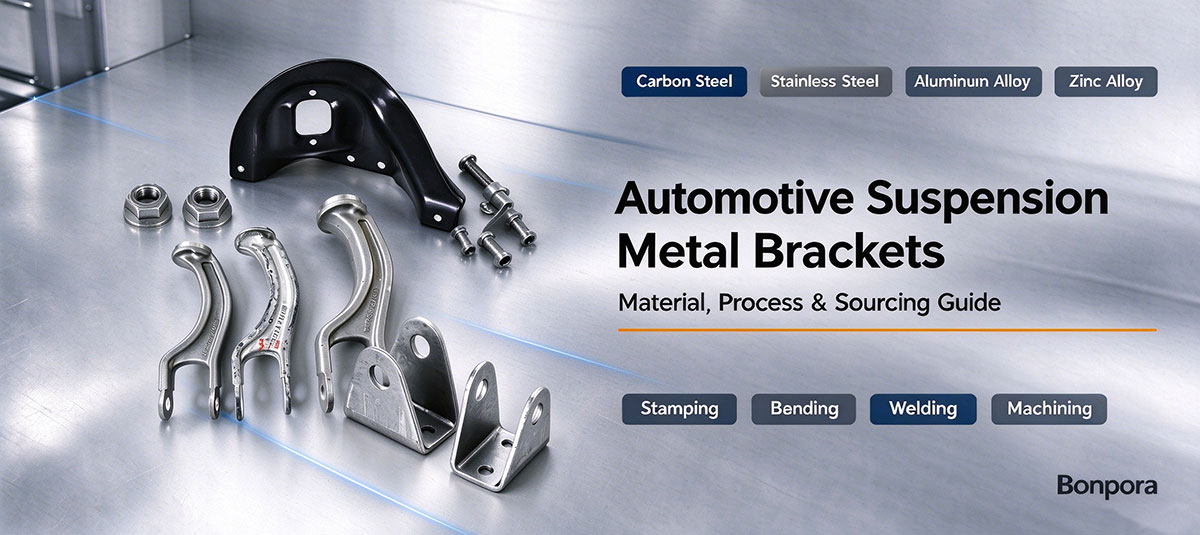
Global buyers searching for automotive suspension metal brackets or chassis bracket suppliers often need more than standard parts. They look for material suitability, manufacturing capability, dimensional control, surface treatment quality, batch consistency and stable delivery for suspension, chassis and structural programs.
This guide explains common material options, manufacturing processes and supplier evaluation points for automotive suspension metal brackets. It is written for aftermarket distributors, repair suppliers, engineering teams and sourcing professionals.
Automotive suspension metal brackets are structural or mounting components used to support, connect, fix or reinforce parts within the suspension and chassis system. They may be found in control arm assemblies, stabilizer systems, mounting structures, frame connections and related chassis components.
Common functions include:
Mounting and fixing suspension components
Connecting parts to the chassis or frame
Reinforcing local structure
Supporting load transfer
Maintaining alignment and assembly position
Material selection depends on load, strength, weight, corrosion requirement, cost and manufacturing method.
Carbon steel is widely used in structural brackets where strength, formability and weldability are important. It is often selected for high-load chassis and suspension applications.
Stainless steel is chosen where corrosion resistance and durability are required. It may be used in brackets exposed to moisture, road chemicals or harsh environments.
Aluminum alloy offers lightweight potential and can be used in applications where weight reduction is important. Its specific strength and corrosion behavior depend on alloy selection and processing.
Zinc alloy is often used in die-cast components where complex shape, good dimensional control and certain corrosion properties are needed.
Suspension metal brackets can be produced by several processes, depending on material, shape, volume and performance requirements.
Stamping is suitable for sheet metal brackets with relatively simple shapes. It is often used for high-volume production of steel brackets.
Bending is used to form angled, channel or U-shaped profiles. It is common in the production of mounting brackets and support plates.
Welding is applied when multiple parts need to be joined into one assembly. Weld quality, distortion control and post-weld inspection are important.
Die casting can produce complex near-net-shape components. It is often associated with zinc alloy and some aluminum alloy applications.
Machining is used to improve dimensional accuracy, especially for holes, mounting surfaces, threaded features and critical interfaces.
Surface treatment can improve corrosion resistance, wear resistance, paint adhesion and appearance. Common options include plating, powder coating, painting, anodizing and passivation.
When sourcing automotive suspension metal brackets, buyers should evaluate:
Material grade and mechanical properties
Manufacturing process and production volume
Dimensional accuracy and tolerance control
Weld quality and assembly consistency
Surface treatment and corrosion performance
Tooling, prototyping and sample validation
Batch-to-batch stability and delivery capability
Control arm mounting brackets
Stabilizer bar brackets
Frame connection brackets
Shock absorber support brackets
Bracket assemblies with welded plates and sleeves
Custom chassis support components
Bonpora supplies automotive suspension metal brackets and chassis-related structural components for aftermarket replacement and engineering support programs. Our capabilities cover material selection, stamping, bending, welding, die casting, machining and surface treatment.
Buyers evaluating Bonpora may focus on the following points:
Supply of steel, stainless steel, aluminum alloy and zinc alloy based brackets
Process support including stamping, bending, welding, die casting and machining
Surface treatment coordination for corrosion and appearance requirements
Dimensional control and assembly fit evaluation
Sample validation, prototype support and volume production discussion
You can view our brackets product page here: https://www.bonporaparts.com/en/brackets/
A: They are structural or mounting components used to support, connect, fix or reinforce suspension and chassis parts. Material and process selection depend on load, environment and assembly requirements.
A: There is no universal best material. Carbon steel is common for strength, stainless steel for corrosion resistance, aluminum for weight reduction, and zinc alloy for complex die-cast shapes.
A: Common processes include stamping, bending, welding, die casting, machining and surface treatment. The choice depends on material, shape, volume, cost and performance requirements.
A: Evaluate material capability, process scope, dimensional control, weld quality, surface treatment, sample validation, production volume and delivery stability.
A: Provide drawings or samples, material specification, manufacturing process, quantity, surface treatment requirements, tolerance standard and any assembly or corrosion requirements.
For technical inquiry, sample request or volume production discussion, please contact our sales team: sales@bonporaparts.com.
