sales@bonporaparts.com
0086-10-64988621
English
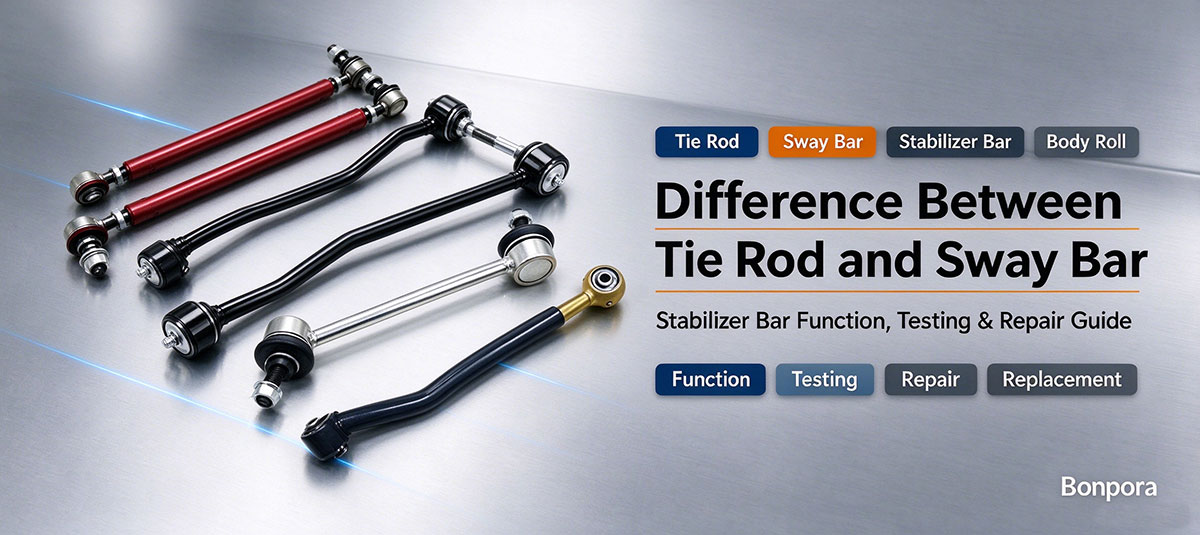
Many vehicle owners and even some aftermarket professionals confuse steering and suspension terms. Two commonly mixed parts are the tie rod and the sway bar. Understanding the difference between tie rod and sway bar helps vehicle service teams diagnose symptoms more accurately and choose the right replacement components.
This guide explains the basic function of each part, clarifies why they are not interchangeable, and discusses what buyers should look for in a rigorously tested stabilizer bar and stabilizer bar repair program. It is written for aftermarket distributors, repair shop networks, engineering teams and sourcing professionals.
A tie rod is part of the steering system. It connects the steering rack or center link to the steering knuckle and helps transmit steering motion to the wheels. Tie rods are directly related to steering control and wheel alignment.
A sway bar, also called a stabilizer bar, is part of the suspension system. It is designed to reduce body roll during cornering, lane changes and sudden maneuvers by transferring torsional force between the left and right sides of the suspension.
| Item | Tie Rod | Sway Bar / Stabilizer Bar |
|---|---|---|
| System | Steering system | Suspension system |
| Main Function | Transmit steering motion | Reduce body roll |
| Relationship to Alignment | Direct | Indirect |
| Wear Symptoms | Steering play, wander, uneven tire wear | Body roll, sway, noise over bumps |
| Interchangeable | No | No |
The stabilizer bar does not control steering input directly. Instead, it acts as a torsional spring between the left and right suspension sides. When one wheel moves up or down relative to the other, the bar twists and generates resistance, helping keep the vehicle level during dynamic maneuvers.
Common benefits associated with a properly functioning stabilizer bar include:
Reduced body roll during cornering
Improved vehicle stability during lane changes
More consistent handling feel
Better control during sudden maneuvers
Support for balanced suspension performance
Stabilizer bar repair needs can appear in several ways. Some common symptoms include:
Increased body roll or sway during turns
Clunking or rattling noise over rough roads
Loose feeling in the suspension
Uneven load support between left and right sides
Visible damage to the bar, links or mounting brackets
When buyers evaluate a rigorously tested stabilizer bar, they should look beyond marketing language. Meaningful testing should cover areas such as:
Material and hardness control
Torsional strength and fatigue resistance
Surface finish and corrosion protection
Fitment and mounting compatibility
Link and bracket assembly consistency
Vehicle-specific load and application validation
During stabilizer bar repair or service, technicians should inspect more than just the bar itself. A complete inspection usually includes:
Stabilizer bar for bending, cracking or surface damage
Stabilizer links for wear, play or broken studs
Bushings for deterioration, deformation or displacement
Mounting brackets for cracks, distortion or loose fasteners
Related suspension components for alignment and wear issues
Whether a stabilizer bar can be repaired depends on the condition. Minor bushing replacement or link replacement may be considered service operations. If the bar itself is bent, cracked, severely worn or structurally damaged, replacement is usually the more reliable option.
Bonpora supplies stabilizer bars, sway bars, stabilizer links, bushings and related suspension components for aftermarket replacement programs. Our product range supports vehicle-specific applications and replacement service needs.
Buyers evaluating Bonpora may focus on the following capabilities:
Stabilizer bar and sway bar supply for passenger vehicle applications
Related components including links, bushings and mounting brackets
Application-specific fitment focus
Material, surface treatment and assembly quality control
Sample validation and volume production discussion
You can view our stabilizer bars product page here: https://www.bonporaparts.com/en/stabilizer-bars/
A: No. A tie rod is part of the steering system and transmits steering motion. A sway bar is part of the suspension system and helps reduce body roll.
A: A stabilizer bar connects the left and right sides of the suspension and acts as a torsional spring to reduce body roll during cornering, lane changes and sudden maneuvers.
A: It means the part has been evaluated beyond basic dimensions. Meaningful tests should include material properties, torsional strength, fatigue resistance, corrosion protection, fitment and assembly consistency.
A: It depends on damage. Bushings or links can often be serviced separately. If the stabilizer bar is bent, cracked or structurally damaged, replacement is usually recommended.
A: Replace it when there is bending, cracking, severe wear, loss of torsional performance or structural damage that cannot be corrected by bushing or link service.
For technical inquiry, sample request or volume production discussion, please contact our sales team: sales@bonporaparts.com.
