sales@bonporaparts.com
0086-10-64988621
English
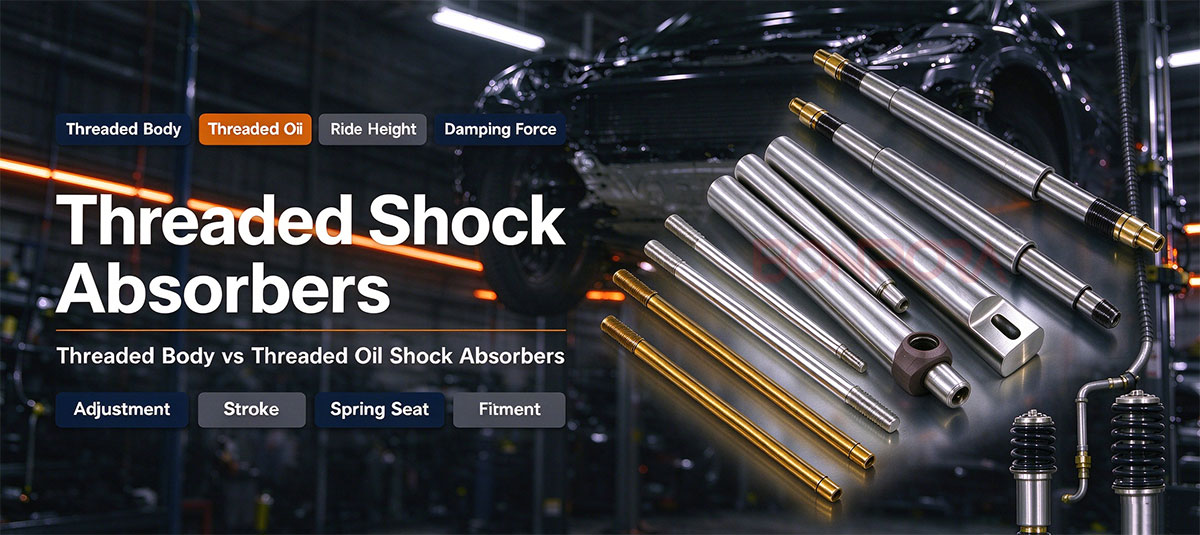
Global buyers searching for threaded shock absorber components often encounter similar terms that describe different design approaches. Among the most common are threaded body shock absorber and threaded oil shock absorber. While both may relate to adjustable suspension damping, they are not always identical in structure, intended use or adjustment method.
This guide explains the basic differences between these designs, how they are used in passenger and light commercial vehicle suspension systems, and what buyers should evaluate when sourcing them. It is written for aftermarket distributors, suspension part suppliers, engineering teams and sourcing professionals.
A threaded shock absorber is a damper that uses a threaded section somewhere in its structure to enable some form of adjustment. The thread may be used for ride height adjustment, spring seat positioning, preload setting, or external body positioning depending on the design.
Threaded shock absorbers are often found in applications where users want to fine-tune suspension setup within a limited range. Common examples include:
Passenger vehicle suspension adjustment
Light commercial vehicle suspension tuning
Aftermarket suspension upgrade programs
Custom vehicle build projects
Vehicle-specific replacement damper programs
A threaded body shock absorber typically has a threaded section on the main damper body or outer tube. This design is most often associated with ride height adjustment or spring seat positioning. The threaded section allows the spring seat or related component to be rotated and locked into different vertical positions.
A threaded oil shock absorber usually refers to an oil-filled damper with a threaded adjustment mechanism, often at the top or side of the unit. The thread may be used to adjust damping force, compression, rebound, or preload, depending on the internal valve design and adjustment layout.
| Item | Threaded Body Shock Absorber | Threaded Oil Shock Absorber |
|---|---|---|
| Main Thread Location | Damper body / outer tube | Top adjuster, side adjuster or oil-filled unit |
| Common Adjustment | Ride height, spring seat position, preload | Damping force, compression, rebound, preload |
| Primary Focus | Position / height setting | Damping force setting |
| Application Type | Coilover-style and height-adjustable systems | Adjustable oil dampers and performance-oriented units |
| Interchangeable | Not always | Not always |
The threaded section in a shock absorber provides a mechanical interface for incremental adjustment. When the user rotates an adjuster, spring seat or locking collar, it changes either the vertical position of the spring seat or the setting of an internal valve mechanism.
In a threaded body shock absorber, the thread primarily changes the spring seat position. This affects ride height and spring preload. In a threaded oil shock absorber, the threaded adjuster typically changes damping force by modifying oil flow through specific valve paths.
Height-adjustable suspension systems
Coilover damper assemblies
Aftermarket performance suspension kits
Light commercial vehicle suspension tuning
Custom classic and modern vehicle builds
Replacement damper programs with adjustment features
Buyers should not evaluate threaded shock absorbers only by appearance. Important criteria include:
Thread diameter, pitch and adjustment range
Damper stroke and collapsed/extended length
Spring seat compatibility and load rating
Damping force range and valve design
Oil sealing and temperature stability
Thread surface finish and corrosion protection
Mounting type, bushings and bracket compatibility
Vehicle-specific fitment validation
Bonpora supplies threaded shock absorbers, threaded body shock absorbers, threaded oil shock absorbers and related piston rod components for aftermarket suspension programs. Our range supports buyers looking for application-specific dampers and precision piston rod parts.
Buyers evaluating Bonpora may focus on the following capabilities:
Supply of threaded shock absorbers and adjustable damper units
Threaded body and threaded oil shock absorber variants
Precision piston rods for shock absorber assembly
Application-specific length, thread and mounting design
Material, surface treatment and corrosion resistance evaluation
Sample validation and volume production support
You can view our piston rods product page here: https://www.bonporaparts.com/en/piston-rods/
A: It is a damper with a threaded section used for adjustment. The thread may control ride height, spring seat position, preload, damping force, compression or rebound, depending on the design.
A: A threaded body shock absorber usually adjusts ride height or spring seat position via a thread on the damper body. A threaded oil shock absorber typically adjusts damping force through a threaded oil valve or adjuster mechanism.
A: Many are, but the type of adjustment varies. Some adjust height or preload, while others adjust damping force. Buyers must confirm which adjustment is included.
A: Only if the dimensions, mounting type, stroke, load rating and adjustment purpose match the application. They are not automatically interchangeable.
A: Check thread size and pitch, adjustment range, damper length, stroke, spring seat compatibility, damping design, sealing, corrosion protection, mounting style and vehicle-specific fitment.
A: Yes. Bonpora supplies piston rods and related components for shock absorber manufacturers and aftermarket assembly programs. Please contact us with your drawing, sample or application requirements.
For technical inquiry, sample request or volume production discussion, please contact our sales team: sales@bonporaparts.com.
