sales@bonporaparts.com
0086-10-64988621
English
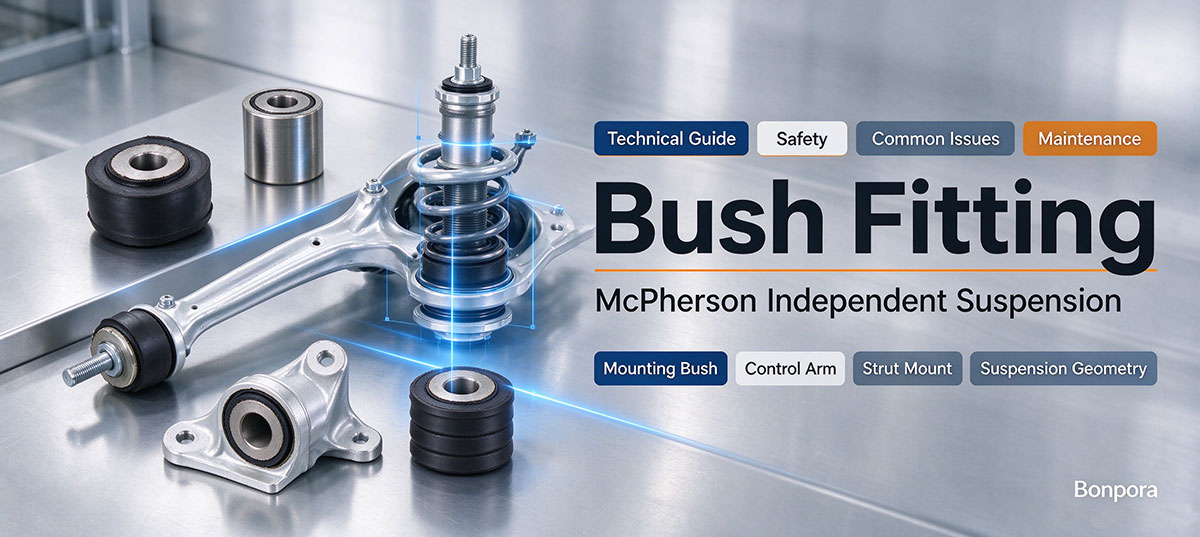
McPherson independent suspension is widely used in passenger vehicle front suspension systems due to its relatively compact layout and efficient use of space. In this design, the mounting points between the strut, control arm, subframe and body structure depend heavily on properly installed bushes. A bush fitting that is out of specification can affect not only noise, vibration and harshness but also wheel alignment, handling and long-term durability.
This article explains the technical principles of bush fitting in McPherson independent suspension, key safety considerations, common issues that may occur during daily use, and what buyers should look for when sourcing mounting bushes. It is intended for aftermarket distributors, repair shop networks, engineering teams and sourcing professionals.
McPherson independent suspension uses a strut assembly that combines a shock absorber and coil spring into a single unit. The strut is typically mounted at the top to the vehicle body or strut tower, while the lower part connects to a control arm or steering knuckle. Each front wheel can respond independently to road inputs, helping to maintain tire contact and vehicle stability.
Key components in this system usually include:
McPherson strut
Coil spring
Control arm
Mounting bushes and brackets
Stabilizer bar and links
Wheel hub and steering knuckle
Bushes are cylindrical or shaped components usually made of rubber, polyurethane or other elastomeric materials. They are installed between metal parts to provide controlled flexibility, absorb vibration and allow limited movement while maintaining structural location.
In a McPherson suspension, common bush positions include:
Strut top mount bushes
Control arm inner and outer bushes
Subframe mounting bushes
Stabilizer bar bushes
Bracket-to-body or bracket-to-frame bushes
Proper bush fitting is more than pressing a part into place. The installation must consider dimensional accuracy, interference fit, orientation, preload, compression and the relationship between the bush and its housing.
The bush outer diameter, housing bore diameter and inner sleeve diameter must be controlled within specification. An incorrect fit can cause looseness, creep, extrusion or damage during operation.
Some bushes have a specific installation direction, particularly when they are designed to handle different loads in compression, shear or torsion. Installing them backwards may change performance or reduce service life.
Bushes should be pressed in using controlled force and correct tooling. Excessive or uneven force can damage rubber, distort sleeves or create hidden cracks in the housing.
In some applications, bushes are designed to operate under a specific preload or compression. Too little preload can allow movement; too much can increase stiffness, wear or stress.
Where applicable, assembly lubricants should be used carefully. The contact surfaces must be clean, free of burrs and properly prepared to avoid cutting or abrading the bush during installation.
Improper bush fitting in McPherson independent suspension can create safety-related risks. These include:
Altered wheel alignment and reduced steering precision
Unexpected noise, vibration or loose handling
Premature tire wear
Reduced braking stability
Partial loss of control during sudden maneuvers
Premature failure of struts, control arms or brackets
For this reason, bush replacement should be carried out by qualified technicians using vehicle-specific procedures and correct tooling.
Worn or poorly fitted bushes can produce clunking, rattling or knocking noises when the suspension moves up and down.
Damaged bushes may no longer isolate vibration effectively, leading to increased steering wheel feedback or body vibration.
When bushes allow excessive movement or change suspension geometry, the result can be uneven tire wear.
Excessive play in suspension mounting points can make the vehicle feel less precise during cornering or lane changes.
In some cases, damaged bushes or seal failure can allow grease or fluid leakage near mounting points, indicating the need for inspection.
Regular inspection of McPherson suspension bushes should focus on:
Cracks, tears or deformation in the rubber
Looseness or separation between the bush and housing
Grease or fluid leakage
Change in suspension height or alignment
Noise during compression or rebound
Damage to brackets, sleeves or fasteners
Bonpora supplies mounting bushes, suspension bushes, control arm bushes, strut mount components and related mounting parts for passenger vehicle suspension systems. Our product range supports aftermarket repair programs and vehicle-specific replacement requirements.
Buyers evaluating Bonpora may focus on the following capabilities:
Mounting bushes for McPherson independent suspension systems
Control arm bushes, strut mount bushes and bracket bushes
Rubber and elastomeric component supply
Application-specific dimensional and load evaluation
Sample validation and volume production support
Technical discussion for replacement part programs
You can view our mounting bushes product page here: https://www.bonporaparts.com/en/mounting-bushes/
A: It refers to the installation of elastomeric bushes between suspension components such as struts, control arms, brackets and the vehicle body. Proper fitting helps control movement, isolate vibration and maintain suspension geometry.
A: Because it affects wheel alignment, handling, noise, vibration and component durability. Poorly fitted bushes can lead to premature wear and reduced vehicle stability.
A: In many cases, yes, but it depends on the application, housing condition, tooling and service requirements. If the housing is damaged or the arm is deformed, complete assembly replacement may be more reliable.
A: Safety risks include reduced steering precision, unstable handling, uneven tire wear, reduced braking stability and possible loss of control during sudden maneuvers.
A: There is no universal interval, but they should be inspected during routine suspension service, after impact, when abnormal noise appears, or when alignment issues are detected.
For technical inquiry, sample request or volume production discussion, please contact our sales team: sales@bonporaparts.com.
