sales@bonporaparts.com
0086-10-64988621
English
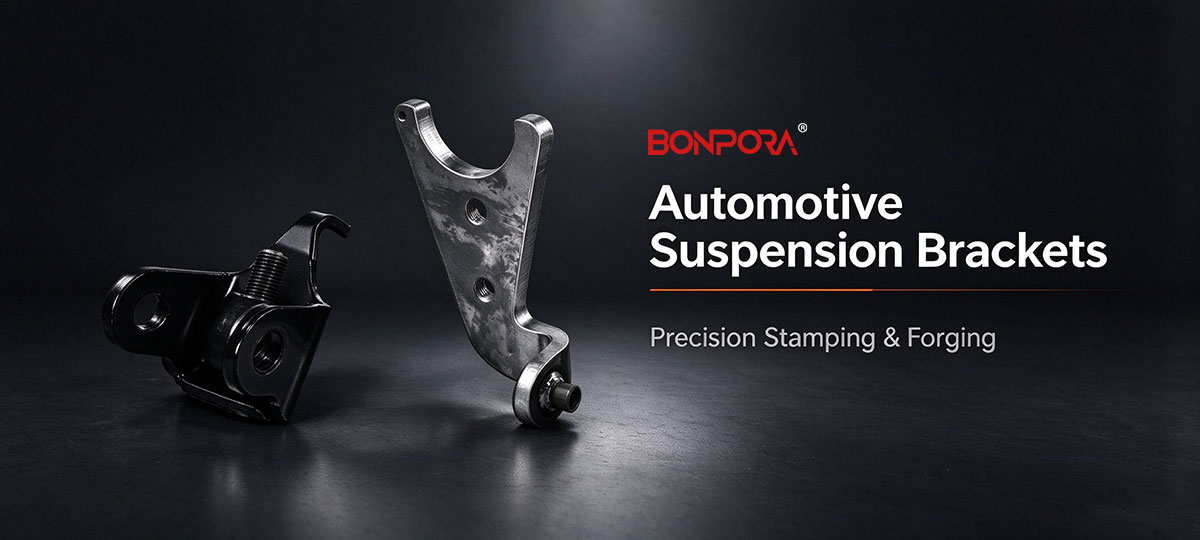
Suspension brackets may be small, but they carry a big responsibility. These metal components secure shock absorbers, springs, control arms, sway bars and other parts to the vehicle's body or subframe. They transmit loads, hold critical alignment, and keep the whole suspension system stable and safe — which is why their material, geometry and manufacturing process matter so much.
In this guide, we explain how automotive suspension brackets are made, compare the main manufacturing processes with their advantages and disadvantages, and share what procurement and engineering teams should look for in a supplier.
A suspension bracket is a load-bearing metal part that provides a mounting point between a suspension component and the vehicle structure. Depending on the design, it can:
Mount shock absorbers and struts to the body or subframe
Support control arms and steering knuckles
Locate sway bar (anti-roll bar) links and bushings
Anchor springs and leaf spring shackles
Reinforce crossmembers and subframe areas
Common application scenarios include:
Passenger cars, SUVs and light trucks — strut mounts, damper brackets, control arm brackets
Commercial vehicles and heavy trucks — leaf spring brackets, axle brackets
Performance and off-road vehicles — reinforced bracket kits designed for higher loads
Because these parts sit in a harsh environment — exposed to road salt, water, mud, vibration and impact — both the manufacturing process and the surface treatment play a decisive role in service life.
Different brackets need different processes. The right choice depends on part volume, load requirements, geometry, budget and lead time. Here are the main processes used in the industry, with their pros and cons.
Metal stamping forms sheet metal using a die in a press. It is the most common process for mass-produced automotive brackets.
Advantages:
Low per-part cost at high volumes
Excellent dimensional consistency and repeatability
Fast production cycles
High material utilization
Disadvantages:
High initial tooling (die) cost
Only economical for medium-to-large quantities
Limited to sheet-metal geometries and thicknesses
Typical use: mass-produced brackets for standard vehicle models — a core strength of Bonporaparts' metal stamping range.
Forging shapes metal under high pressure, aligning the grain flow with the part contour.
Advantages:
Superior strength and fatigue resistance
Grain flow follows part shape, improving reliability under stress
Durable under impact and shock loads
Disadvantages:
Higher cost than stamping or casting
Often requires secondary machining
Higher energy and tooling investment
Typical use: high-stress brackets such as shock absorber mounting brackets and control arm brackets for heavier or performance applications.
Casting pours molten metal (such as ductile iron or aluminium) into a mold to form the part.
Advantages:
Allows complex, three-dimensional shapes
Good economics for medium volumes
Wide choice of materials
Disadvantages:
Possible internal porosity or casting defects requiring inspection
Lower strength per unit weight than forging
High tooling cost and longer setup
Typical use: brackets with complex geometry where casting can consolidate multiple parts into one.
Sheet-metal fabrication cuts, bends and welds components into a custom assembly.
Advantages:
Very flexible; low tooling cost
Ideal for prototypes, small batches and custom designs
Can produce complex assemblies
Disadvantages:
Quality depends on operator skill
Risk of welding distortion
Slower per part than stamping or forging; inspection required
Typical use: custom brackets, low-volume runs and prototypes.
CNC machining removes material from a solid block using computer-controlled cutting.
Advantages:
High precision and excellent surface finish
Low tooling cost; good for prototyping
Tight tolerances for critical dimensions
Disadvantages:
More material waste
Higher per-part cost at volume
Slower than forming processes for large runs
Typical use: precision-critical brackets, small batches and pilot parts.
Surface treatment protects brackets from corrosion and extends service life. Common options include zinc plating, hot-dip galvanizing, powder coating and e-coating.
Advantages:
Strong corrosion and wear resistance
Improved appearance and durability
Cost-effective protection for suspension parts exposed to salt, water and debris
Disadvantages:
Adds cost and lead time
Coating thickness must be controlled to preserve tolerances
For suspension brackets, corrosion protection is not optional — it directly affects safety and longevity.
There is no single "best" process. The right choice balances several factors:
Production volume — stamping and forging become economical at higher volumes; fabrication and CNC suit lower volumes
Load and stress — forged or heavier sections for high-stress parts
Geometry — casting or fabrication for complex shapes; stamping for flat or formed sheet parts
Tolerance — CNC and precision stamping for tight dimensions
Budget and lead time — tooling investment, material cost and setup time all matter
Environment — harsher operating conditions demand better materials and surface treatment
A good supplier discusses these trade-offs with you rather than pushing a single process.
Suspension brackets are safety-related parts. A poorly made bracket can cause noise, premature wear, misalignment — or worse, failure under load. That is why working with an experienced manufacturer matters.
Bonporaparts is an automotive metal stamping and bracket manufacturer. Our bracket range covers a wide variety of stamped and formed brackets, and our product line extends to related suspension components, helping buyers consolidate multiple parts from one source.
We support OEM and ODM custom projects: brackets manufactured to your drawings, with the right material, process and surface treatment for your application. Our team works closely with customers on engineering and quality, so you get parts that fit, perform and last.
Want to explore our product range? Visit our Brackets page to see what we make — or email our team at sales@bonporaparts.com to discuss your project.
Stamped brackets are formed from sheet metal, which is cost-effective at volume and offers consistent dimensions. Forged brackets are shaped under high pressure, giving greater strength and fatigue resistance — ideal for high-stress applications. The best choice depends on your load requirements and quantity.
Common materials include carbon steel, stainless steel and aluminium. Carbon steel offers good strength at moderate cost and is usually surface-treated for corrosion resistance; stainless steel and aluminium suit specific weight or corrosion needs. Your supplier should recommend a material based on the part's function and operating environment.
Yes. Bonporaparts supports OEM/ODM custom manufacturing. Send us your drawings and requirements — including material, dimensions, tolerances and surface treatment — and we will confirm feasibility, process and cost.
MOQ and lead time depend on the part, process and surface treatment. Please contact us with your specifications, and we will provide an accurate quotation and delivery schedule for your project.
Yes, corrosion protection is available as part of our service. We can arrange suitable surface treatment for your brackets to meet your application and environment requirements.
Our brackets are used across passenger cars, SUVs, light trucks, commercial vehicles and more. We supply both original-equipment and aftermarket projects, and we are happy to discuss your specific application.
Looking for a reliable supplier for automotive suspension brackets? Browse our Brackets page, or contact us at sales@bonporaparts.com — we will help you find the right manufacturing process and solution for your project.
