sales@bonporaparts.com
0086-10-64988621
English
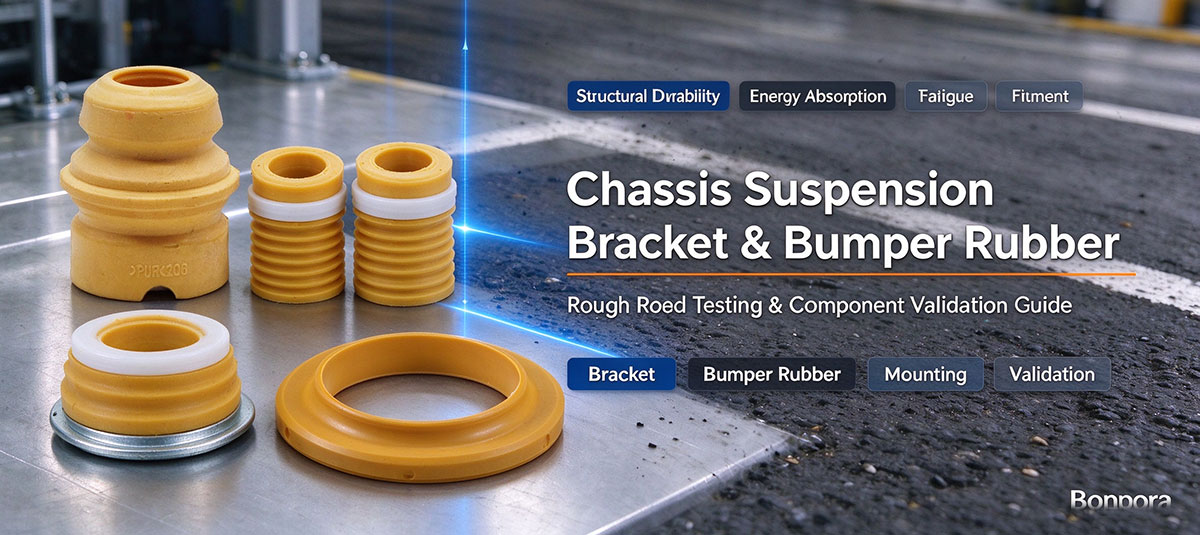
Automotive chassis and suspension components are repeatedly exposed to road-induced inputs such as potholes, speed bumps, rough pavement, curb impacts and heavy load variations. For buyers evaluating chassis suspension brackets and bumper rubber parts, laboratory analysis alone is not always enough. Realistic rough road testing helps validate whether components can hold their shape, maintain assembly integrity and protect surrounding systems over time.
This article explains what rough road testing involves, why it matters for suspension brackets and bumper rubber components, and what buyers should evaluate when selecting suppliers. It is written for aftermarket distributors, engineering teams, procurement managers and OEM-driven component buyers.
Rough road testing is a class of vehicle or component evaluation designed to simulate severe road conditions. It may include paved rough roads, gravel surfaces, pothole events, speed bumps, off-road sections and repeated dynamic loading. The goal is to identify structural weakness, loose assemblies, fatigue cracks, rubber degradation and fitment issues before series production.
Common test objectives for chassis and suspension components include:
Structural durability under repeated impact loads
Retention of mounting bolts and fasteners
Performance of brackets under torsion and bending
Compression behavior and rebound control of bumper rubber parts
Compatibility with struts, control arms and stabilizer bars
Long-term fitment and assembly consistency
A chassis suspension bracket is a load-bearing component that connects suspension parts to the vehicle body, frame or subframe. It may support struts, control arms, stabilizer bars, bumper rubber assemblies or other chassis-mounted systems.
Key evaluation criteria for suspension brackets include:
Material grade and yield strength
Weld quality and joint integrity
Bending and torsional stiffness
Surface coating and corrosion resistance
Mounting hole accuracy and fastener compatibility
Fatigue performance under dynamic loads
Bumper rubber parts, often called bump stops or jounce bumpers, are elastomeric components designed to absorb energy during extreme suspension travel. They help protect the suspension system, chassis structure and vehicle body from harsh bottom-out impacts.
Key evaluation criteria for bumper rubber components include:
Material hardness and modulus
Compression set and rebound behavior
Energy absorption capacity
Resistance to ozone, oil and temperature change
Bonding quality with metal sleeves or end plates
Compatibility with the associated bracket and suspension assembly
Suspension brackets and bumper rubber parts work together during extreme events. A bracket must sustain sudden impact loads without cracking or shifting, while the bumper rubber must manage energy absorption without permanent deformation.
Common failure modes that rough road testing may reveal include:
Cracks in bracket welds or base material
Bolt loosening or hole elongation
Bumper rubber permanent compression or cracking
Rubber separation from metal inserts
Shift in assembly position or alignment
Localized wear at contact interfaces
When sourcing chassis suspension brackets and bumper rubber components, buyers should go beyond drawings and samples. A structured supplier evaluation should cover:
Application-specific load requirements
Material specification and traceability
Welding, coating and rubber compound control
Dimensional inspection and fixture validation
Prototype testing and sample validation
Production process control and capability study
Packaging, labeling and logistics consistency
After-sales technical support
Components that perform poorly in rough road conditions may produce the following symptoms in service:
Abnormal clunking or impact noise
Suspension bottom-out feeling
Loose mounting points
Visible cracks in brackets or rubber
Change in vehicle height or alignment
Premature wear of struts, control arms or stabilizer bars
Bonpora supplies chassis suspension brackets, bumper rubber components, bump stops and related mounting parts for passenger vehicle and light commercial vehicle programs. Our product range supports buyers looking for application-specific chassis components and validated suspension assemblies.
Buyers evaluating Bonpora may focus on the following capabilities:
Chassis suspension bracket design and supply
Bumper rubber and bump stop components
Cooperation on prototype development and sample validation
Material, welding, coating and rubber compound evaluation
Application-specific load and durability discussion
Volume production and aftermarket replacement programs
You can view our product page here: https://www.bonporaparts.com/en/products/
A: It is an evaluation process that simulates severe road conditions such as potholes, speed bumps and rough pavement to check structural durability, assembly integrity and component performance under dynamic loads.
A: Because brackets carry and distribute suspension loads. Rough road testing helps identify cracks, bolt loosening, hole elongation and stiffness issues that may not appear in static analysis alone.
A: Bumper rubber absorbs energy during extreme suspension travel and helps limit bottom-out. It protects the suspension assembly, chassis structure and vehicle body from severe impact.
A: Yes, but it is advisable to verify their compatibility. The bracket must support the mounting interface, while the bumper rubber must match the required stroke, load and installation envelope.
A: Ask for material specifications, process control, sample validation, test results, production capacity, packaging standards and after-sales support. Technical data should match your application requirements.
For technical inquiry, sample request or volume production discussion, please contact our sales team: sales@bonporaparts.com.
