sales@bonporaparts.com
0086-10-64988621
English
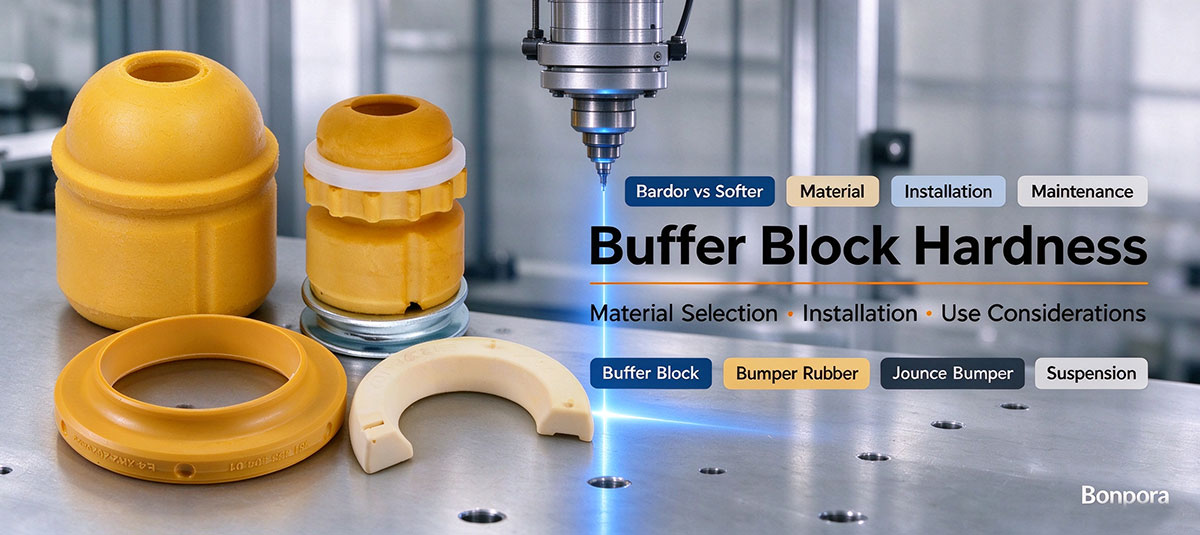
Buffer blocks, also known as bumper rubber or jounce bumpers, are elastomeric components installed in chassis suspension systems to absorb energy during extreme compression travel. While they are often seen as simple protective parts, their hardness, material design and installation quality can influence suspension performance, noise, durability and overall system compatibility.
This article discusses whether a harder or softer buffer block is better, what installation techniques apply to different materials, and what should be monitored during daily use. It is written for aftermarket distributors, repair shop networks, engineering teams and procurement managers.
Buffer block hardness is one of the most discussed parameters, but it should not be considered alone. The optimal choice depends on vehicle application, suspension travel, load condition, packaging space and the required balance between comfort and protection.
In general:
A softer buffer block may absorb small impacts more gradually and improve comfort.
A harder buffer block may provide greater energy absorption and support during severe compression.
However, hardness must be matched to the suspension system, not selected as an isolated preference.
Softer buffer blocks are more compliant at the beginning of compression. They can reduce the initial impact feel and help maintain ride quality during moderate compression events.
Potential advantages:
Better initial impact absorption
More gradual engagement
Improved comfort in minor compression events
Potential disadvantages:
May bottom out earlier under heavy load
Higher risk of excessive compression or permanent deformation
Less effective for severe impact protection
Harder buffer blocks offer greater resistance during compression. They are often used in applications where suspension travel is limited, vehicle loads are higher, or more progressive support is required near the end of travel.
Potential advantages:
Higher load-bearing capacity
Better resistance to bottom-out
More stable support during severe compression
Potential disadvantages:
May transmit harsher impact to the chassis
Less compliant during small compression events
Greater risk of stress on related components if mismatched
Buffer blocks are commonly made from rubber, polyurethane or other elastomeric materials. Each material has different compression behavior, rebound characteristics, temperature resistance and durability.
Rubber buffer blocks: Generally good elasticity and noise isolation, but may require careful control of hardness and compression set.
Polyurethane buffer blocks: Often offer higher stiffness, better wear resistance and improved load performance, but can be more sensitive to temperature and manufacturing consistency.
Foam buffer blocks: Lightweight and able to compress progressively, but may have lower long-term load capacity.
Before installation, verify the outer diameter, inner diameter, height, compression distance and mounting interface. A buffer block that is too long or too short can change suspension behavior.
Clean the mounting area and remove grease, rust and debris. Sharp edges or burrs can damage the buffer block during installation.
Some materials allow limited use of assembly lubricants, while others may be sensitive to certain oils. Use lubricants only when recommended by the component supplier.
Use uniform force and suitable tooling. Do not hammer the buffer block directly, as this can cause internal damage, cracking or misalignment.
Many buffer blocks have a specific installation direction, especially when they include grooves, stepped sections or progressive compression profiles. Installing them backwards can change performance.
Some applications require a specific preload or initial compression. Too little preload may allow movement; too much can increase stiffness and wear.
Abnormal noise or a sudden harsh impact during compression may indicate the buffer block is too hard, incorrectly installed, or not matched to the suspension system.
If the suspension bottoms out frequently or the buffer block deforms permanently, the hardness, size or compression travel may need to be reviewed.
Check for cracking, tearing, permanent compression, surface abrasion or separation from metal parts.
Some materials behave differently in extreme heat or cold. Performance changes during temperature extremes should be evaluated for the target market.
A buffer block does not work alone. It must be compatible with the shock absorber, spring, control arm, bracket and overall suspension geometry.
When sourcing buffer blocks, buyers should evaluate more than hardness alone. A complete technical evaluation should include:
Application-specific load and travel requirements
Material type and hardness range
Compression and rebound behavior
Dimension control and mounting interface
Temperature and durability performance
Compatibility with associated suspension components
Sample validation and testing
Production consistency and traceability
Bonpora supplies buffer blocks, bumper rubber, jounce bumpers and related suspension components for passenger vehicle programs. Our product range supports different material requirements, hardness specifications and application-specific validation needs.
Buyers evaluating Bonpora may focus on the following capabilities:
Buffer blocks and bumper rubber components
Polyurethane and elastomeric component supply
Application-specific hardness and material evaluation
Dimension and mounting interface validation
Sample development and volume production support
Technical discussion for suspension system compatibility
You can view our product page here: https://www.bonporaparts.com/en/products/
A: Neither is universally better. A softer buffer block may improve initial comfort, while a harder one may provide greater bottom-out protection. The choice must match the vehicle application, load, travel and suspension system.
A: If it is too hard, the suspension may transmit harsher impacts to the chassis, reduce comfort during moderate compression, and increase stress on related components.
A: If it is too soft, it may compress excessively under heavy load, bottom out earlier, or suffer permanent deformation, reducing its ability to protect the suspension system.
A: Installation techniques include dimension and fitment checking, surface preparation, controlled lubrication, uniform press-in force, correct orientation, and proper preload setting. Different materials may require different lubrication and tooling control.
A: Monitor noise, impact feel, bottom-out behavior, wear, cracking, permanent deformation, temperature influence and system compatibility. Any sudden change in suspension performance should be inspected.
For technical inquiry, sample request or volume production discussion, please contact our sales team: sales@bonporaparts.com.
