sales@bonporaparts.com
0086-10-64988621
English
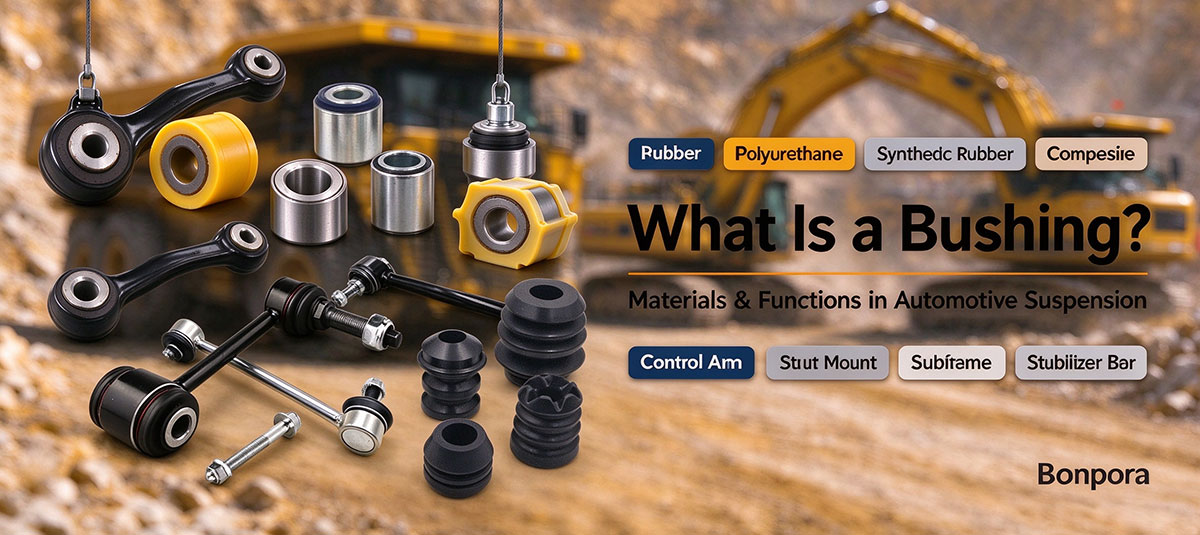
A bushing is an elastomeric or composite component installed between metal parts in a vehicle’s chassis and suspension system. Its job is to allow controlled movement while isolating vibration, maintaining structural position and reducing noise transfer. Although often small in size, bushings play a significant role in handling, comfort, durability and safety.
This article explains what a bushing does, what materials are commonly used, and how different materials perform in automotive suspension applications. It is intended for aftermarket distributors, repair shop networks, engineering teams and procurement managers.
Bushings act as flexible connectors between suspension components and the vehicle chassis. They are typically installed in joints and mounting points where metal-to-metal contact would create noise, wear or excessive rigidity.
The main functions of a suspension bushing include:
Isolating road and powertrain vibration
Allowing controlled angular and linear movement
Maintaining component alignment and position
Reducing noise and harshness
Protecting mounting points from wear and impact
Supporting controlled deflection under load
Bushings are found in many chassis and suspension locations. Common applications include:
Control arm inner and outer pivots
Strut mount and shock absorber attachments
Subframe mounting points
Stabilizer bar and stabilizer links
Radius arms, trailing arms and lateral links
Various bracket-to-body or bracket-to-frame connections
| Material | Key Features | Typical Applications |
|---|---|---|
| Rubber Bushing | Good elasticity, balanced vibration damping and aging resistance, low cost | OEM chassis suspension, control arms, stabilizer bars. Preferred for passenger family vehicles, delivers balanced comfort and durability. |
| Polyurethane Bushing | High hardness, strong deformation resistance, sharp road feedback | Modified vehicles and performance cars. Improves handling rigidity, but reduces ride comfort and may increase noise. |
| Spherical Bearing Bushing (All-Metal) | Fastest response, most direct handling feedback | Pure race track or extreme vehicle builds. Rigid metal connection, poor ride comfort and will inevitably produce abnormal noise. |
| Metal Bushing (Steel / Copper / Stainless Steel) | High rigidity, high temperature resistance, long service life | Industrial sectors including valves, bearings, engineering machinery, heat exchangers, and scenarios requiring electrical conductivity or corrosion resistance. |
| Engineering Plastic (POM, UHMWPE, PTFE) | Self-lubricating, wear-resistant, corrosion-resistant, maintenance-free | Harsh environments with humidity or dust, or hard-to-lubricate assemblies, such as mining equipment, port machinery and precision molds. |
Natural rubber is widely used in automotive suspension bushings due to its good elasticity, high resilience and excellent vibration isolation. It is generally effective at reducing noise and improving ride comfort. Synthetic rubber compounds are often formulated to improve oil resistance, heat resistance, aging resistance and durability for harsher working conditions.
Potential advantages:
Good elasticity and rebound
Effective vibration isolation
Better comfort performance
Mature material and processing history, cost-effective
Potential disadvantages:
May be sensitive to oil, grease and certain chemicals
Higher wear risk under severe dynamic loading
Compression set can occur over time
Polyurethane is a popular alternative for applications where higher stiffness, wear resistance and load capacity are required. Polyurethane bushings are often used in performance, heavy-duty and aftermarket applications.
Potential advantages:
Higher stiffness and load capacity
Good wear resistance
Improved dimensional stability
Better performance in demanding applications
Potential disadvantages:
May increase noise and vibration transfer
More sensitive to temperature and manufacturing consistency
Can require tighter tolerances and proper lubrication
All-metal spherical bushings, also known as rose joints, are built for maximum movement precision. They eliminate rubber deflection, giving drivers instant steering feedback. This material is not designed for daily road use.
Potential advantages:
Zero elastic deflection
Ultra-precise wheel control
Extreme angle movement capability
Potential disadvantages:
No vibration isolation
Constant noise on public roads
Not suitable for daily driving vehicles
Solid metal bushings focus on mechanical strength and heat resistance. They are less common in passenger car suspension and are mainly used in industrial equipment.
Potential advantages:
Excellent structural rigidity
High temperature endurance
Long working lifespan under stable load
Potential disadvantages:
No vibration absorption capability
Metal friction will create noise without lubrication
Engineering plastic bushings are designed for low-friction and maintenance-free operation. These materials are widely used in heavy industrial machinery rather than standard automotive suspension.
Potential advantages:
Built-in self-lubrication property
Strong wear and corrosion resistance
Can work without regular greasing
Potential disadvantages:
Limited load capacity compared to metal
Not ideal for high dynamic suspension cyclic load
Control arm bushings allow the arm to pivot while maintaining wheel alignment. Rubber is often chosen for comfort and isolation, while polyurethane may be selected for higher stiffness and performance applications. Spherical bushings are only fitted for race builds.
Strut mount bushings support the upper end of the strut and help isolate vibration. They must balance load support, NVH performance and durability. Rubber is the primary OEM choice.
Subframe bushings connect the subframe to the vehicle body. They play a key role in isolating chassis vibration and maintaining suspension geometry. Rubber formulations are the mainstream selection.
Stabilizer bar bushings allow the bar to rotate while holding it in position. They are commonly made of rubber or synthetic rubber, with wear resistance being an important requirement.
When selecting a bushing material, engineers and buyers should consider:
Load magnitude and direction
Required stiffness and deflection
Vibration and noise isolation targets
Temperature and environmental conditions
Oil, grease and chemical exposure
Wear and durability requirements
Assembly method and tolerance control
Compatibility with surrounding components
Bushing failure can affect more than comfort. Common symptoms include:
Clunking or rattling noise
Loose or imprecise steering
Uneven tire wear
Vehicle pulling
Increased vibration
Visible cracks, tears or deformation
Inspection should include checking for wear, damage, displacement, excessive play and abnormal contact with surrounding parts.
Bonpora supplies a wide range of suspension bushings, control arm bushings, strut mount bushings, subframe bushings, stabilizer bar bushings and related mounting components. Our product range supports passenger vehicle programs, aftermarket replacement lines and application-specific development projects.
Buyers evaluating Bonpora may focus on the following capabilities:
Rubber, synthetic rubber and polyurethane bushing supply
Control arm, strut mount, subframe and stabilizer bar bushings
Material and application-specific performance evaluation
Dimensional control and assembly validation
Sample development and volume production support
Technical cooperation for chassis and suspension programs
You can view our product page here: https://www.bonporaparts.com/en/products/
A: A bushing is a flexible component installed between metal parts in the chassis and suspension system. It allows controlled movement, isolates vibration, reduces noise and maintains component position.
A: The most common materials are natural rubber, synthetic rubber, polyurethane, spherical all-metal bushings, solid metal bushings, and engineering plastics such as POM, UHMWPE and PTFE. Each has different stiffness, isolation, wear and environmental resistance characteristics.
A: Rubber bushings generally offer better vibration isolation and comfort, while polyurethane bushings usually provide higher stiffness, better wear resistance and greater load capacity. Polyurethane may increase road noise.
A: Bushings are used in control arms, strut mounts, subframes, stabilizer bars, radius arms, trailing arms, lateral links and various bracket mounting points.
A: Choose based on load, stiffness requirements, vibration isolation targets, environmental conditions, wear needs and assembly compatibility. Daily passenger vehicles usually select rubber; performance builds may choose polyurethane; race applications may use spherical metal bushings.
For technical inquiry, sample request or volume production discussion, please contact our sales team: sales@bonporaparts.com.
