
- 1. 1. What a Strut Bump Stop Does on the Navara
- 2. 2. Platform Overview: D22, D23 and D40
- 3. 3. Microcellular Polyurethane vs Rubber
- 4. 4. Material Selection: NDI vs MDI Grades
- 5. 5. Dimensional Matching Checklist Before You Order
- 6. 6. Quality Checks We Apply Before Shipment
- 7. 7. Custom Development for Navara Aftermarket Programs
- 8. 8. FAQ
- 9. 9. Summary
Strut Bump Stop for Nissan Navara | Buyer Guide
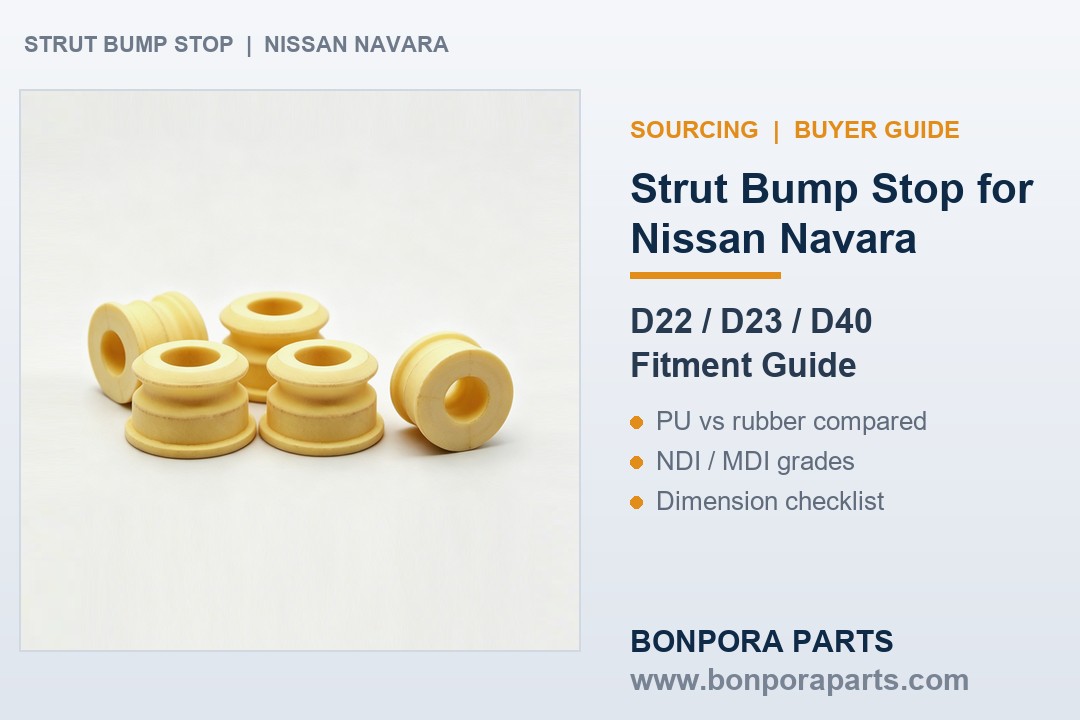
Nissan Navara owners and fleet buyers know the symptom well: a deep metallic clunk when the front suspension reaches full compression, especially on corrugated gravel roads or over speed bumps with a loaded bed. In many cases the root cause is a worn or collapsed strut bump stop — the polyurethane compression element mounted on the piston rod of the front strut assembly. This guide explains how the Navara strut bump stop functions across the D22, D23 and D40 platforms, how to match dimensions and material grades, and what quality checkpoints matter when you source these parts as a distributor or aftermarket brand owner.
1. What a Strut Bump Stop Does on the Navara
Inside a MacPherson-type front strut, the damper travels through a limited stroke. When the truck hits a sharp impact — a pothole edge, a rock step, an overloaded drop — the strut compresses until the remaining travel is used up. The 缓冲限位块 (bump stop), also called a jounce bumper or compression bumper, is the last line of defense at that point of travel. It is a progressive-rate element, typically made of microcellular polyurethane, that compresses under load and absorbs the final energy of the stroke.
Without a healthy bump stop, the metal-to-metal contact transfers impact energy directly into the 活塞杆 (piston rod), the rod guide, and the top mount. Repeated impacts of this kind are a leading cause of bent piston rods, oil seal failure, and top-mount bearing wear — all of which are far more expensive to repair than the bump stop itself. This is why experienced rebuilders treat the bump stop as a consumable 减震器配件 (shock absorber part) that should be inspected and replaced alongside the strut, not an optional extra.
1.1 How It Works With the Dust Cover and Spring Seat
On most Navara front struts, the bump stop sits on the piston rod inside the 防尘罩 (dust cover), working together with the 减震护罩 (shock absorber boot) that keeps grit and water away from the rod surface. The 弹簧座 (spring seat) above it locates the coil spring, and the whole assembly depends on the rod moving freely. If the boot tears and abrasive dust reaches the rod, the 活塞环 (piston ring) and rod guide wear faster, damping degrades, and the bump stop takes more frequent full-compression hits. In other words, the bump stop, the boot, and the damper internals form one protective chain — replacing only one link rarely solves the noise complaint.
2. Platform Overview: D22, D23 and D40
The Navara nameplate covers several very different front-suspension designs, and bump stop geometry differs accordingly:
| Platform | Front suspension | Bump stop layout | Sourcing notes |
|---|---|---|---|
| D22 (1997–2015) | Independent double wishbone with torsion bar or coil | Frame-mounted compression bumper near the lower arm | Check free height and mounting hole pattern; many variants share the same part across 2WD/4WD |
| D23 (NP300, 2015+) | Coil-over MacPherson-type strut | Rod-mounted internal bump stop inside the strut boot | Diameter and durometer must match OE; undersized parts cause frequent bottoming |
| D40 (2005–2015) | Coil-over front strut | Rod-mounted, progressive microcellular PU | Commonly replaced together with the boot kit and top mount on high-mileage units |
Before ordering, confirm three things against the sample or the vehicle: free length, outer diameter at the widest section, and the mounting interface (through-hole diameter, retainer washer size, or adhesive sleeve). A mismatch of even a few millimeters in free height changes the point at which the bumper engages and can alter ride harshness noticeably on a loaded vehicle.
3. Microcellular Polyurethane vs Rubber
Original-equipment bump stops on modern Navara platforms are almost always 聚氨酯缓冲块 (polyurethane bump stops) rather than solid rubber. The difference is structural: microcellular PU contains millions of closed gas cells, so it behaves like a progressive spring — soft at small deflection, firm at high compression — while solid rubber stiffens almost linearly and transmits more harshness.
| Property | Microcellular polyurethane | Solid rubber |
|---|---|---|
| Compression behavior | Progressive, energy-absorbing | Linear, transmits peak force |
| Permanent set after repeated hits | Low with correct grade | Higher; cracks at the base over time |
| Temperature stability | Stable from roughly -40°C to +100°C | Hardens in cold weather |
| Aging under ozone and road salt | Good resistance | Surface cracking common |
| Weight | Light, easy to handle | Heavier for the same rating |
For buyers, the practical takeaway is that a PU bumper that looks dimensionally correct may still underperform if the cell structure and density are wrong. Two samples with identical dimensions can differ greatly in load-deflection curves, which is why specimen testing matters (see Section 5).
4. Material Selection: NDI vs MDI Grades
Bonpora manufactures polyurethane bump stops in both NDI (naphthalene diisocyanate) and MDI (methylene diphenyl diisocyanate) systems. The two grades serve different duty cycles, and choosing between them is the single most important material decision in this product family.
4.1 When NDI Makes Sense
NDI-based microcellular elastomers offer superior dynamic performance: low hysteresis (less heat buildup under repeated compression), excellent rebound resilience, and outstanding resistance to permanent set. For a Navara used as a working vehicle — mining access roads, farm tracks, constant heavy loads — NDI is the grade that keeps its load-deflection curve stable over a long service life. The trade-off is higher raw material cost and a narrower processing window, which is why NDI parts tend to sit at the premium end of the aftermarket.
4.2 When MDI Is the Practical Choice
MDI systems are more economical to process and still deliver a clear performance advantage over rubber. For standard replacement programs, moderate-duty use, and price-sensitive distribution channels, MDI microcellular bump stops represent a balanced choice. A well-formulated MDI grade with correct density control will comfortably outlast an OE rubber part and is often the best value point for volume aftermarket supply.
As a rule of thumb used in our custom programs: if the end user complains about bottoming out under load or operates in high-ambient-temperature regions, specify NDI; for general replacement and mixed-duty fleets, MDI delivers dependable performance at a friendly cost. Buyers who want the full material comparison can review our polyurethane bump stop (NDI, MDI) product line for grade specifications.
5. Dimensional Matching Checklist Before You Order
Whether you send us a sample, a drawing, or an OE part number, the following checklist prevents most fitment and performance issues before tooling begins:
Free length and loaded length: measure at rest and at the point where the bumper begins to engage.
Maximum outer diameter and shape profile: tapered, barrel, or stepped profiles change the progression rate.
Mounting interface: through-hole size, retainer plate, or sleeve; confirm with the 活塞杆 (piston rod) diameter on the strut.
Density range: typically specified between 0.35 and 0.65 g/cm3 for microcellular grades; density drives the load curve.
Load-deflection requirement: if you have a target force at a given compression percentage, share the number — we can verify against it.
Clearance check: confirm clearance to the 转向拉杆 (steering tie rod) and surrounding 底盘悬挂件 (chassis and suspension parts) — an oversized bumper can contact adjacent components at full compression.
If any of these values are unknown, sending one used or new sample is usually enough. Our engineering team reverse-measures the sample, builds the load-deflection curve, and proposes a matching formulation — this is standard procedure in our custom parts development service.
6. Quality Checks We Apply Before Shipment
Bump stops fail quietly: a small batch with poor cell uniformity can pass visual inspection and still collapse after a few months on corrugated roads. Bonpora applies process and batch controls aimed at catching those invisible defects:
| Checkpoint | Method | Purpose |
|---|---|---|
| Density verification | Weight/volume sampling per batch | Confirms cell structure is within the specified range |
| Load-deflection testing | Compression curve against reference | Verifies progressive-rate behavior and engagement force |
| Permanent set test | Compressed recovery measurement | Ensures the bumper regains height after repeated hits |
| Dimensional audit | Sample measurement against drawing | Confirms fitment to the strut assembly |
| Visual cell inspection | Cross-section check | Detects coalesced cells or voids |
The same discipline applies across our wider range of shock absorber parts, including 阀片 (valve plates), rod guides, and mountings, so a rebuild program can source the full kit from one supplier with consistent documentation.
7. Custom Development for Navara Aftermarket Programs
Beyond catalog replacement parts, Bonpora supports distributors and brand owners building their own Navara product lines. A typical development flow runs through five stages: sample or drawing intake, material grade proposal (NDI vs MDI with a load-curve comparison), prototype tooling and first articles, customer bench testing or vehicle trials, then volume production with retained control samples. We support both drawings-based and samples-based development, and private-label packaging is available for customers who ship under their own brand.
For program buyers, the practical advantages are short first-article lead times, tooling retained exclusively for your account, and batch traceability so that a field complaint can be traced back to a production lot. These points are worth confirming with any supplier you evaluate, and we are glad to walk through them in detail during a sourcing conversation.
8. FAQ
Q1: How often should the strut bump stop be replaced on a Navara?
There is no fixed interval, but we recommend inspection at every damper replacement and whenever the vehicle is used heavily on rough roads. Warning signs include a visible reduction in free height (the bumper looks squashed at rest), surface cracking, powder residue near the boot, or the return of bottoming-out noise after damper replacement. Because the bumper works in compression constantly, treat it like brake pads — a wear item with a service-dependent life.
Q2: Can I fit a longer or stiffer bump stop to stop the truck from bottoming out?
Increasing engagement length or stiffness will raise the point at which the bumper engages, but it also changes ride harshness and can load the top mount and surrounding chassis parts harder than designed. If bottoming out is frequent, first check the dampers, spring rate, and payload conditions. If an upgraded bumper is genuinely needed, match the new load-deflection curve rather than simply picking a taller part, and confirm clearance to nearby components at full compression.
Q3: Are NDI and MDI bump stops interchangeable dimensionally?
Dimensionally yes — we can produce the same geometry in either system. Functionally they differ: NDI offers lower hysteresis and better resistance to heat and permanent set, which matters for heavy-duty and high-temperature use. For general replacement duty, a properly specified MDI grade performs reliably. The right question is not which grade is better in the abstract, but which grade matches the duty cycle and price target of your market.
Q4: What information do you need to quote a custom Navara bump stop?
Ideally: a sample or a dimensioned drawing (free length, diameter profile, mounting interface), the target density or load-deflection data if available, expected annual volume, and the target market duty cycle. With that, we can usually propose a grade, provide a prototype quotation, and deliver first articles for approval. Samples-based development is fully supported if no drawing exists.
9. Summary
The strut bump stop is a small component with an outsized effect on how a Navara rides and how long its dampers last. Matching the platform (D22, D23 or D40), verifying dimensions against a sample or drawing, and selecting between NDI and MDI microcellular polyurethane according to duty cycle are the three decisions that separate a reliable aftermarket part from a repeat-complaint one. Bonpora manufactures microcellular PU bump stops and a full range of shock absorber and chassis components for mainstream European, American, Korean and Japanese vehicle platforms, with custom development available from drawings or samples. Browse the product center or contact our team to discuss your Navara program — sample-based evaluation and OEM-grade material documentation are available on request.
- Prev.:How to Choose a Polyurethane Bump Stops Supplier
- Next.:Strut Bump Stop for Isuzu D-Max | Buyer Guide