
- 1. Why the VW Amarok Deserves Its Own Bump Stop Spec
- 2. Two Generations, Two Front-End Architectures
- 3. What Platform Sharing Means for Parts Buyers
- 4. Microcellular Polyurethane vs Rubber: The Material Decision
- 5. NDI vs MDI: Choosing the PU Grade
- 6. How the Bump Stop Interacts with Adjacent Parts
- 7. Size Matching Checklist Before You Order
- 8. Quality Control Points Buyers Should Demand
- 9. Custom Development from Bonpora
- 10. FAQ
- 11. Summary
Strut Bump Stop for VW Amarok | Buyer Guide
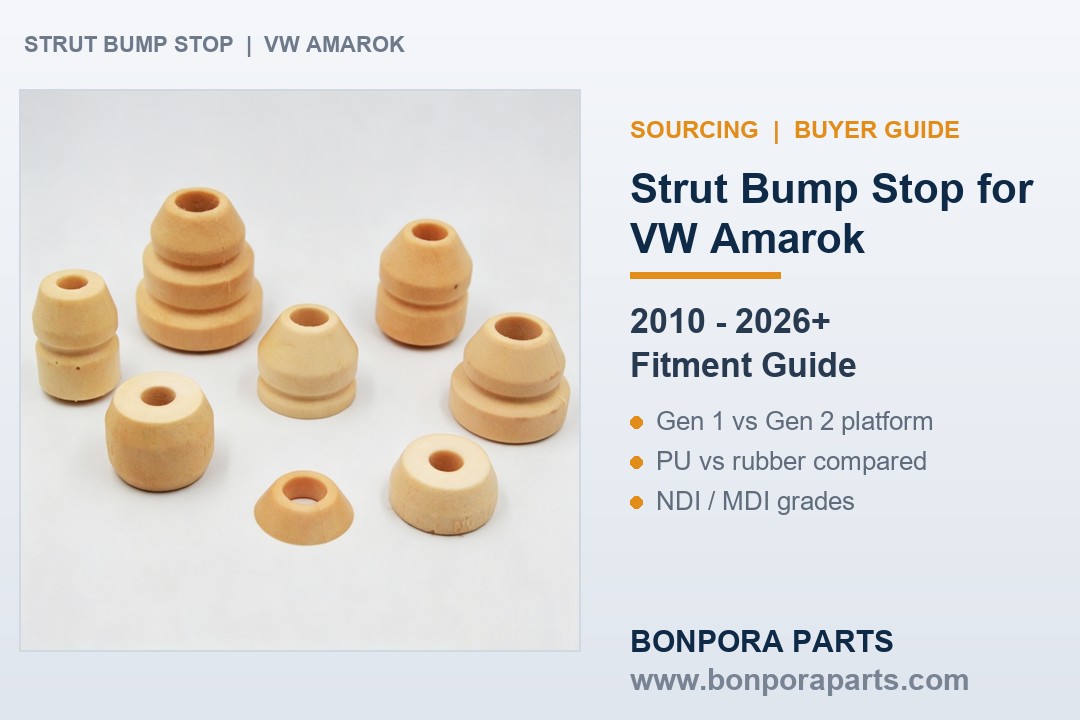
Why the VW Amarok Deserves Its Own Bump Stop Spec
The Volkswagen Amarok occupies a special position in the global pickup market: it was the only one-ton pickup engineered in-house by a European OEM, and since 2023 it has been built on a shared platform with one of the best-selling trucks in the world. For aftermarket buyers and fleet purchasing managers, that history creates a very practical question: which strut bump stop for VW Amarok fits which generation, and how should the part be specified? This guide answers both questions from a sourcing perspective, covering fitment by model year, material selection between microcellular polyurethane grades, and the dimension checks that prevent costly returns.
The bump stop — also called a jounce bumper or 缓冲限位块 — is the last line of defense in the suspension. When the strut bottoms out under a heavy load or a hard hit, the bump stop compresses and absorbs the energy that the damper cannot. A worn or incorrectly specified stop leads to metal-to-metal contact between the spring seat and the axle housing, damaged piston rods, and complaints of harsh clunking noises from the cabin. In markets where Amaroks carry mining, agricultural or overland loads, this small part works harder than almost anything else in the chassis.
Two Generations, Two Front-End Architectures
Generation 1 (2010–2022): Double Wishbone Front End
The first-generation Amarok was built on Volkswagen's own platform with a double wishbone front suspension and a rigid rear axle on leaf springs. In this layout, the bump stop is typically mounted on the frame rail or the upper control arm strike zone, and the front struts carry a separate, cylindrical microcellular pad. Because the wishbone geometry gives more travel before contact, the OEM stop is relatively tall and tapered. Aftermarket replacement therefore requires attention to mounting hole diameter, stem length, and taper angle — not just overall height. Buyers sourcing a strut bump stop for this generation should also verify whether the vehicle was fitted with the optional coil-sprung rear suspension, which uses different rear jounce bumpers from the leaf-spring version.
Generation 2 (2023–present): Shared Platform with Ford Ranger
The second-generation Amarok moved to the Ford Ranger T6.2 platform. The front end switched to a coil-over MacPherson-type strut with a coil spring seat integrated into the top mount, and the bump stop now sits as a cellular ring or rod inside the strut assembly, often paired with a dust cover (防尘罩) that shields the piston rod. This is a completely different package from Generation 1, and the parts are not interchangeable. A distributor stocking both generations must treat them as two separate product lines.
What Platform Sharing Means for Parts Buyers
Because Gen 2 Amarok and the contemporary Ford Ranger share their suspension architecture, many chassis and suspension parts are cross-referenced between the two nameplates. For a buyer, this has three consequences:
Shared geometry, shared stop dimensions. Where the strut assembly, spring seat and jounce bumper package are identical, one quality-assured aftermarket part can serve both applications — provided the OE part numbers cross-reference correctly.
Trim and payload variants still differ. Ranger Raptor-style performance derivatives and heavy-duty payloads may use stiffer or taller stops than the base Amarok Aventura. Never assume "same platform" means "same part".
Supplier capability matters more than catalogue coverage. A supplier who can match both OE references — and verify against sample dimensions — is more valuable than one with a long but unverified listing.
Microcellular Polyurethane vs Rubber: The Material Decision
Most original-equipment and quality aftermarket bump stops are made from microcellular polyurethane (microcellular PU, 微孔聚氨酯), a closed-cell foam whose cells collapse progressively under load. Compared with conventional rubber stops, microcellular PU offers:
| Property | Microcellular PU | Conventional Rubber |
|---|---|---|
| Load–deflection curve | Progressive, energy absorbed across full stroke | Stiffens abruptly near full compression |
| Low-temperature behaviour | Remains compliant in cold climates | Hardens, transmits harsh impacts |
| Compression set | Low; shape recovers after repeated hits | Higher; permanent flattening over time |
| Weight | Significantly lighter | Heavier |
| Aging / ozone resistance | Excellent | Surface cracking possible |
For a strut bump stop for VW Amarok applications in Northern Europe, Central Asia or the Australian outback, the cold-climate behaviour alone is usually decisive: a rubber stop that hardens at minus twenty degrees turns every pothole into a transmitted shock load through the top mount and into the steering tie rod (转向拉杆) and body mounts.
NDI vs MDI: Choosing the PU Grade
Within polyurethane, the isocyanate system defines the performance envelope. Bonpora manufactures 聚氨酯缓冲块 (polyurethane bump stops) in both NDI (naphthalene diisocyanate) and MDI (methylene diphenyl diisocyanate) based systems:
| Attribute | NDI-based PU | MDI-based PU |
|---|---|---|
| Heat build-up resistance | Excellent — suits repeated heavy hits, mining and haul roads | Moderate |
| Dynamic load capacity | Higher; retains damping under sustained abuse | Good for standard duty |
| Cost position | Higher raw material cost | More economical |
| Typical use | Heavy-duty fleets, mining spec, off-road kits | Standard road-use replacement, volume programmes |
A practical rule: specify NDI for fleets running sustained heavy payloads on rough roads, and MDI for standard road-use replacement volumes where cost control is the priority. Both grades are produced in-house, so a single supplier can serve both fleet and retail product tiers from one development base.
How the Bump Stop Interacts with Adjacent Parts
The bump stop never works alone. A correct specification considers the whole strut package:
Dust cover (防尘罩) and shock absorber boot (减震护罩): these keep grit off the piston rod (活塞杆). A torn boot accelerates rod and seal wear, which in turn changes strut travel and increases how often the bump stop is hit.
Spring seat (弹簧座): if the seat is deformed, the spring angle changes and loading on the stop becomes uneven, causing premature side wear.
Piston ring (活塞环) and valve plate (阀片) inside the damper: worn damper internals let the strut reach full compression far more often, transferring work to the bump stop and shortening its life.
Nitrogen gas chamber (氮气气囊): in gas-charged struts, lost gas pressure reduces rebound control — again pushing impact energy into the stop.
This is why Bonpora supplies bump stops as part of a complete shock absorber parts and chassis suspension programme: replacing the stop while ignoring a leaking boot or a weak strut simply moves the failure to the next component.
Size Matching Checklist Before You Order
Dimensional mismatch is the most common cause of warranty claims on bump stops. Before confirming a purchase order, check:
| Check | Why It Matters |
|---|---|
| Free height and diameter | Wrong height changes engagement point; oversize diameter prevents seating in the retainer |
| Mounting type (stem / bolt / press-in ring) | Gen 1 and Gen 2 Amarok use different mounting interfaces |
| Stem diameter and length | Loose fit causes rattle; too long can preload the stop |
| Density / hardness grade | Determines the load-deflection curve; match OE or fleet spec |
| Cross-reference OE number | Confirms application, especially for shared-platform Ranger/Amarok parts |
| Sample test on vehicle | One fitment trial per variant avoids bulk-order errors |
Quality Control Points Buyers Should Demand
When auditing a potential polyurethane bump stops supplier, request evidence of:
Raw material certification for the isocyanate and polyol system, batch by batch.
Density and hardness inspection records per production lot, not just per project.
Compression set and fatigue test reports on representative part numbers.
Dimensional inspection against approved drawings, with first-article samples retained.
Traceable packaging that distinguishes NDI and MDI grades in the warehouse.
Custom Development from Bonpora
Beyond catalogue parts, Bonpora (北京) supports 来图、来样定制开发 — development from customer drawings or physical samples. For a strut bump stop for VW Amarok programmes, a typical flow runs: sample or drawing review, material grade recommendation (NDI or MDI), prototype tooling, load-deflection verification, then volume production with retained first-article samples. The same engineering team handles related shock absorber parts and precision metal components, so buyers can consolidate a strut repair kit — stop, boot, spring seat and hardware — with one supplier and one quality standard.
FAQ
Are Gen 1 and Gen 2 VW Amarok bump stops interchangeable?
No. The first generation uses a double wishbone front end with a distinct stop geometry, while the second generation shares the Ford Ranger T6.2 strut package. Always specify by model year and cross-check the OE part number.
Can the Gen 2 Amarok use Ford Ranger bump stops?
On many standard variants the suspension package is shared, so a correctly cross-referenced part serves both. However, performance or heavy-payload derivatives may use different stops. Confirm dimensions against the checklist above or supply a sample for verification.
Which grade should I choose, NDI or MDI polyurethane?
For mining, haul-road and sustained heavy-payload duty, NDI offers superior heat build-up resistance and dynamic durability. For standard road-use replacement programmes, MDI delivers reliable performance at a more economical cost.
How long should a quality microcellular PU bump stop last?
Service life depends on road conditions and payload, not only the material. Inspect the stop at every strut or boot replacement; any visible cracking, permanent flattening below nominal height, or crumbling edges means it is due for renewal.
Summary
Sourcing a strut bump stop for VW Amarok fleets comes down to three disciplines: separate the two generations and their front-end architectures, choose the polyurethane grade that matches the duty cycle, and verify dimensions before committing to volume. With microcellular PU production in both NDI and MDI systems, in-house tooling, and a complete chassis and suspension parts programme, Bonpora supports distributors and fleet buyers from sample approval through to serial supply.
View the polyurethane bump stop range | Browse the full product catalogue | Request custom development
- Prev.:Strut Bump Stop for Isuzu D-Max | Buyer Guide
- Next.:Polyurethane Spring Seat Manufacturing Guide