
- 1. What PU Hydrolysis Actually Is
- 2. Polyester vs Polyether: The Backbone Behind the Data Sheet
- 3. Five Field Signatures of PU Hydrolysis
- 4. Test Conditions Worth Writing Into a Specification
- 5. A Hydrolysis Exposure Index You Can Build in a Spreadsheet
- 6. What the Grade Choice Costs: A 20,000-Piece Model
- 7. The Twelve-Field Hydrolysis Specification
- 8. Frequently Asked Questions
- 8.1. Is polyether always the right choice for a humid market?
- 8.2. Can I tell polyester from polyether by looking at the part?
- 8.3. Does humidity in the factory cause the same problem?
- 8.4. Does a 21-day test at 70 °C and 95 % RH prove five years of life?
- 8.5. Should I switch to NDI in a humid market?
- 8.6. What should the purchase order say if the supplier will not share the formulation?
PU Hydrolysis in Bump Stops: Polyester vs Polyether Grades
PU hydrolysis is the splitting of a polyurethane backbone by water, and in bumper blocks it is most often a polyester-grade problem: ester linkages take water in and break, ether linkages resist it. In a hot, humid market that difference decides whether a stop holds its height for five years or loses it in two.
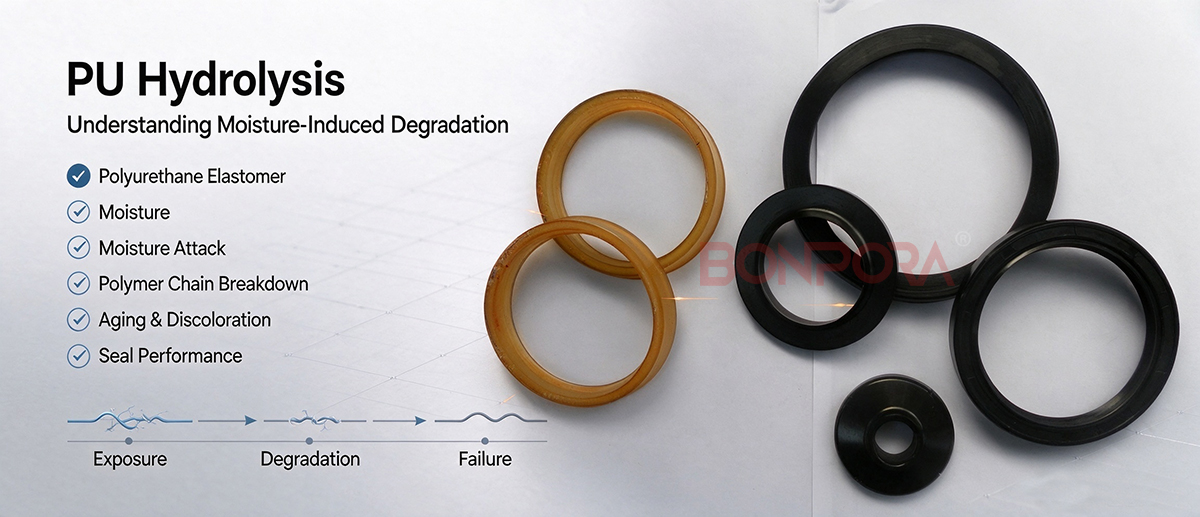
What PU Hydrolysis Actually Is
A cast polyurethane is made from three streams: an isocyanate, a polyol and a chain extender. The reaction happens in the mould, which is why the shape and the material are created at the same time, and why the formulation can be tuned across a wide range of resilience, hardness and dynamic behaviour rather than taken as fixed by the material family.
The polyol is where the hydrolysis question lives. In a polyester-based system the polymer backbone contains ester groups. Water diffusing into the part adds across those groups and cuts the chain. One of the fragments is acidic, and acid catalyses the next cut, so the reaction is autocatalytic: once it starts, the rate rises instead of staying flat. That is the mechanism behind the pattern buyers report, where a bumper looks acceptable at inspection, shows a chalky bloom a season later, and then crumbles at the tip within a few months.
Two other mechanisms get confused with it, and separating them early saves a wrong corrective action.
Porosity is not hydrolysis. Water present during casting reacts with isocyanate and releases carbon dioxide, which stays in the part as bubbles or surface pits. That is a process fault, visible in a section cut on day one, and it is a stress raiser in fatigue. Hydrolysis is a service-ageing effect: the part is sound when it ships and degrades from the surface inward over months. A supplier who answers a hydrolysis complaint with a drying procedure has answered the wrong question.
Compression set is not hydrolysis. Set is a shape change in a network that is still intact, so the part loses height but the material still behaves like polyurethane. Hydrolysis removes network. A hydrolysed part does not only sit lower, it feels weak, and material rubs off between the fingers. Both show up as height loss on a bench check, which is why the surface condition and the feel belong in the same inspection step as the height reading.
Temperature accelerates the reaction, and the usual rule of thumb in polymer ageing is that the rate roughly doubles for every 10 K. Treat that as a planning heuristic rather than a service-life calculation: it explains why a part that lasts in a temperate market fails in a Gulf summer, but it does not convert a 21-day laboratory result into a five-year warranty.
The base material statement for the Bonpora range is high elasticity polyurethane in an MDI or NDI system, with the note that the compound can be adjusted for conditions outside the standard −40 °C to +90 °C range. Which polyol family sits underneath that statement is a project-level detail, and the next section explains why it should be asked rather than assumed.
Polyester vs Polyether: The Backbone Behind the Data Sheet
Both families are cast polyurethane, and both can be processed on the same casting line. The difference is the polyol: a polyester polyol leaves ester groups in the backbone, a polyether polyol (PTMEG or PPG based) leaves ether groups. Almost every property difference that matters to a chassis buyer follows from that single structural fact.
| Property | Polyester-based cast PU | Polyether-based cast PU |
|---|---|---|
| Hydrolysis resistance | Low: ester groups are the attack site | High: ether backbone resists water |
| Water uptake | Higher, and it swells the part slightly | Lower |
| Tensile and tear strength | Generally higher | Generally lower |
| Abrasion resistance | Better | Fair to good |
| Oil, fuel and solvent resistance | Good | Poor |
| Low-temperature flexibility | Fair | Better |
| Resilience and dynamic behaviour | Good, grade dependent | Often higher with PTMEG polyols |
| Raw material cost | Often lower | Often higher |
| Typical humid-climate failure | Surface bloom, crumbling, height loss | Set, tearing, wear at the load face |
The table is the general industry position, not a ranking of suppliers, and the numbers behind it vary by formulation and hard segment content. Three consequences are worth carrying into a sourcing decision.
First, a polyester grade is not a defective part. It is the correct choice where mechanical strength, tear resistance or oil contact dominates and the service climate is dry. The failure mode only becomes likely when water, warmth and time are all present, which is a market question before it is a material question.
Second, the two axes are independent. MDI and NDI describe the isocyanate; polyester and polyether describe the polyol. A part can be MDI with a polyester polyol, MDI with a polyether polyol, or NDI with either. Bonpora states that MDI and NDI systems are not interchangeable, and the same discipline applies to the polyol: the drawing or the material declaration should name both, because a substitution on either axis changes the aged behaviour even when the new part passes a hardness check.
Third, the grade is invisible on the finished part. No moulded marking distinguishes a polyester bumper from a polyether one, and a hardness reading will not separate them. The only reliable evidence is a material declaration plus a wet-heat report with control values, which is why the next two sections deal with signatures and tests rather than with appearance.
For the product side of the same family, the Bonpora jounce bumper range states the inspection items and the design life, and the polyurethane bump stops hub lists the on-road, off-road and commercial positions that use them.
Five Field Signatures of PU Hydrolysis
A returned bumper carries more information than a claim form, provided the inspection separates the signatures. PU hydrolysis leaves patterns that release agent residue and ozone cracking do not, and each one has a confirming check. The table pairs each visible pattern with the check that confirms or rejects it.
| Signature | Where it appears | What it suggests | Next check |
|---|---|---|---|
| Chalky white bloom, surface dull and dry | Tip and waist, the thin sections first | Surface chain scission from humidity | Wipe and re-inspect: mould release residue does not return after wiping, bloom does |
| Friable, crumbling load face; material rubs off | Contact face, rib roots | Advanced hydrolysis | Free height against drawing, then wet-heat check on a retained sample |
| Height loss with a soft, rough surface | Whole part | Hydrolysis plus set together | Height gauge, then hardness against the batch record |
| Cracks at the bore or rib root running outward | High-stress features | Degraded material at a stress raiser | Compare with the first-article section; rule out a knit line |
| Swelling of a few tenths of a millimetre, part feels soft | Diameter and bore | Water uptake before scission | Weigh dry and after 24 h at 70 °C; a mass loss confirms absorbed water |
Two rules make the reading more reliable. Inspect the thin sections first, because a thin wall saturates faster than a thick one and shows the earliest evidence. And compare against a retained sample from the same batch rather than against a new part from stock, since a compound change between batches produces a difference that looks like ageing but is not.
Request a specification sheet or a sample with the wet-heat data attached, so both grades can be compared on the same conditions instead of on two different data sheets.
Test Conditions Worth Writing Into a Specification
Most PU hydrolysis disputes are not about whether the part failed. They are about what the supplier's test actually demonstrated. The conditions below are common industry practice for cast polyurethane, and each one answers a different question.
| Condition | Duration | What it shows | What it does not show |
|---|---|---|---|
| 70 °C / 95 % RH | 7 days | Whether the grade is obviously unsuitable | Ranking between two resistant grades |
| 70 °C / 95 % RH | 21 days | Ranking between candidate grades | Service life in years |
| Water immersion at 80 °C | 7 days | Aggressive screen; unstabilised polyester fails fast | Realistic humidity cycling |
| Cyclic 40 → 95 % RH with temperature | 10 cycles | Condensation and evaporation, closer to diurnal behaviour | Long-term diffusion effects |
| Water soak at 23 °C | 30 days | Water uptake and swelling | Discriminates poorly between grades |
Write the pass criteria with numbers, and ask for the control values beside the aged values. A typical target set is a hardness change within ±5 Shore A, a free height change within 2 %, no surface crumbling against a photo reference, and a retained tensile strength of at least 80 % of the unaged control. Those figures are a starting point for negotiation, not a universal standard, and they should be agreed in writing with the supplier before the first shipment.
Three cautions belong in the same paragraph as the test method. A salt spray result is a corrosion test on metal inserts and says nothing about polymer hydrolysis. A seven-day result ranks candidates; it does not forecast five years. And a report that states "passed" without the before and after numbers is not evidence, because the reader cannot tell whether the margin was one point or thirty.
The mechanism behind porosity is covered in the cell structure guide, which is worth reading alongside this one: process moisture and service humidity produce different defects, and the corrective actions do not overlap.
A Hydrolysis Exposure Index You Can Build in a Spreadsheet
Specification effort should follow exposure. A distributor in a coastal tropical port and one in a dry inland market do not need the same evidence, and the difference can be quantified with public climate data and one line of arithmetic.
The index sums the hours a part spends in each relative-humidity band, weights the bands, and multiplies by a temperature factor:
index = (h60–80 × 1 + h80–90 × 2 + h>90 × 4) × temperature multiplier
Use 1.8 as the temperature multiplier where the annual mean is above 28 °C, and 1.0 below it. The multipliers are a screening device, not a kinetic model; their job is to put two markets on one scale so that the specification decision is made on exposure rather than on habit.
| Market profile | h 60–80 % | h 80–90 % | h > 90 % | Raw score | Temp. × | Index | Reading |
|---|---|---|---|---|---|---|---|
| Coastal tropical port | 2,800 | 1,600 | 700 | 8,800 | 1.8 | 15,840 | Specify hydrolysis-resistant grade with wet-heat evidence |
| Humid subtropical inland | 2,400 | 900 | 180 | 4,920 | 1.8 | 8,856 | Ask for the data, request the 21-day result |
| Temperate coastal | 2,000 | 600 | 80 | 3,520 | 1.0 | 3,520 | Standard grade acceptable if storage is controlled |
| Hot dry coastal | 800 | 250 | 30 | 1,420 | 1.8 | 2,556 | Standard grade, watch the warehouse rather than the part |
The thresholds that follow from the model are simple enough to put in a purchasing guideline. Above 10,000, require a hydrolysis-resistant grade and a 21-day wet-heat report before the first order, and specify sealed packaging with desiccant. Between 5,000 and 10,000, ask for the report and check the storage conditions at the distributor, because a correctly specified part stored in a humid warehouse can still arrive degraded. Below 5,000, a standard grade is defensible, but the shelf-life and storage clause should still be written.
The index also explains a pattern in claim data. Two distributors carry the same part number, one reports surface bloom after eighteen months and the other reports nothing. The difference is usually the market and the warehouse, not the batch. PU hydrolysis follows exposure, and the index is the least expensive way to see that before the claim arrives.
What the Grade Choice Costs: A 20,000-Piece Model
The commercial argument is easier to settle with a model than with adjectives. The figures below are illustrative and built for a distributor taking 20,000 pieces a year into a coastal tropical market, with a landed claim cost of 41.00 USD per failure covering the replacement part, labour, return freight and administration.
| Grade | Unit price | Parts cost | Claim rate | Claims | Claim cost | Total | Against baseline |
|---|---|---|---|---|---|---|---|
| Polyester, standard | 1.62 | 32,400 | 1.80 % | 360 | 14,760 | 47,160 | baseline |
| Polyether, standard | 1.78 | 35,600 | 0.45 % | 90 | 3,690 | 39,290 | −7,870 |
| Polyether, hydrolysis-stabilised | 1.94 | 38,800 | 0.25 % | 50 | 2,050 | 40,850 | −6,310 |
The polyether grade pays for its 0.16 USD premium several times over, and the interesting number is the third row. Moving from standard polyether to the stabilised grade adds 3,200 USD of parts cost to remove 1,640 USD of claims, so it only breaks even if the claim rate falls below roughly 0.06 %, which is close to zero. Two conclusions follow.
The first is that PU hydrolysis exposure makes the backbone decision carry most of the money. Choosing polyether instead of polyester is where the 7,870 USD sits, and no amount of stabiliser additive compensates for shipping the wrong backbone into a wet market.
The second is that the premium grade should be justified by something other than the claim rate: a specification requirement from the vehicle manufacturer, an extended warranty term, or a market where a single failure costs more than the part. Where none of those applies, standard polyether with a written wet-heat report is the better commercial position.
The Twelve-Field Hydrolysis Specification
A purchase order that names hardness and dimensions leaves the hydrolysis question open. The fields below close it, and they can be copied into a drawing note or a supplier questionnaire.
Polyol family: polyester or polyether, named explicitly.
Isocyanate system: MDI or NDI, with the index stated.
Hardness with tolerance, measured on the finished part rather than on a test sheet.
Density with tolerance, where the part is microcellular.
Wet-heat ageing condition and duration, from the table above.
Pass criteria with numbers: hardness change, height change, surface condition.
Control values reported beside the aged values, per test run.
Photo reference for acceptable surface after ageing.
Storage and packaging: sealed bag, desiccant, shelf life from production date.
Batch code linking the carton to the cure and post-cure records.
Change control: any polyol or isocyanate substitution re-triggers the wet-heat test.
Warranty wording that distinguishes a material fault from use outside the design envelope.
Field 11 is the one that prevents the quiet failure. A supplier who changes polyol source to protect a price can deliver parts that meet every dimensional and hardness requirement and still fail in the field two seasons later, because the aged behaviour moved and nobody re-tested it. A change-notification clause plus a retained sample per batch turns that into a documented event.
Field 12 matters for the same reason in the other direction. A bumper that has been asked to carry the suspension continuously, on a vehicle with a failed spring, is outside its design envelope, and a warranty discussion should be able to say so with the inspection data rather than with an opinion.
Frequently Asked Questions
Is polyether always the right choice for a humid market?
No. Polyether is the right default where humidity dominates, but it gives up oil resistance and some tear strength. A part that sits in oil mist or takes heavy abrasion may still be better served by a polyester grade, with the humidity controlled by the design and the storage clause. The decision follows the exposure index and the contact medium together.
Can I tell polyester from polyether by looking at the part?
No. There is no moulded marking and no hardness reading that separates them. Ask for the material declaration and a wet-heat report with control values. A supplier who cannot name the polyol family has not specified the material, only the shape.
Does humidity in the factory cause the same problem?
No, and the distinction matters when a claim is being argued. Moisture present during casting reacts with isocyanate and creates porosity, which is a process fault visible in a section cut. Service humidity attacks the finished backbone months later. Fixing the drying procedure does not fix a hydrolysis claim, and adding desiccant to the shipping carton does not fix porosity.
Does a 21-day test at 70 °C and 95 % RH prove five years of life?
It ranks grades; it does not forecast life. The test is useful for choosing between two candidates and for confirming that a batch matches the approved material, and it is not a substitute for field data or for a warranty that is priced on realistic exposure.
Should I switch to NDI in a humid market?
That is a separate question. NDI is chosen for higher resilience and better retention of properties under heat and repeated cycling, at a higher material cost and a more demanding casting process. It does not answer the polyol question, and an NDI part on a polyester polyol is still a polyester part as far as water is concerned.
What should the purchase order say if the supplier will not share the formulation?
Ask for the polyol family, the wet-heat condition, the pass criteria and the before and after values. Those four items can be supplied without disclosing a full formulation, and a supplier who refuses all four is asking to be trusted on a property that cannot be inspected on the part.