
- 1. Why private label bump stops lose weeks before production starts
- 2. The six-week plan, gate by gate
- 3. Brand authorisation and artwork: from week one to week three
- 4. Barcodes, GTINs and part numbers: the data layer
- 5. First-article packing: the twelve-point sign-off
- 6. Four places private label bump stops lose a week
- 7. What a packaging mistake costs: a worked model
- 8. FAQ
- 8.1. Can private label bump stops be supplied in our own packaging?
- 8.2. Does the six-week schedule hold if we need a new profile?
- 8.3. Should we use our own GTINs or accept numbers from the factory?
- 8.4. Can the logo be moulded into the part instead of printed on the pack?
- 8.5. What if our market needs a language other than English?
- 8.6. Who owns the artwork and the printing plates after the run?
Private Label Bump Stops: Barcodes and Artwork in Six Weeks
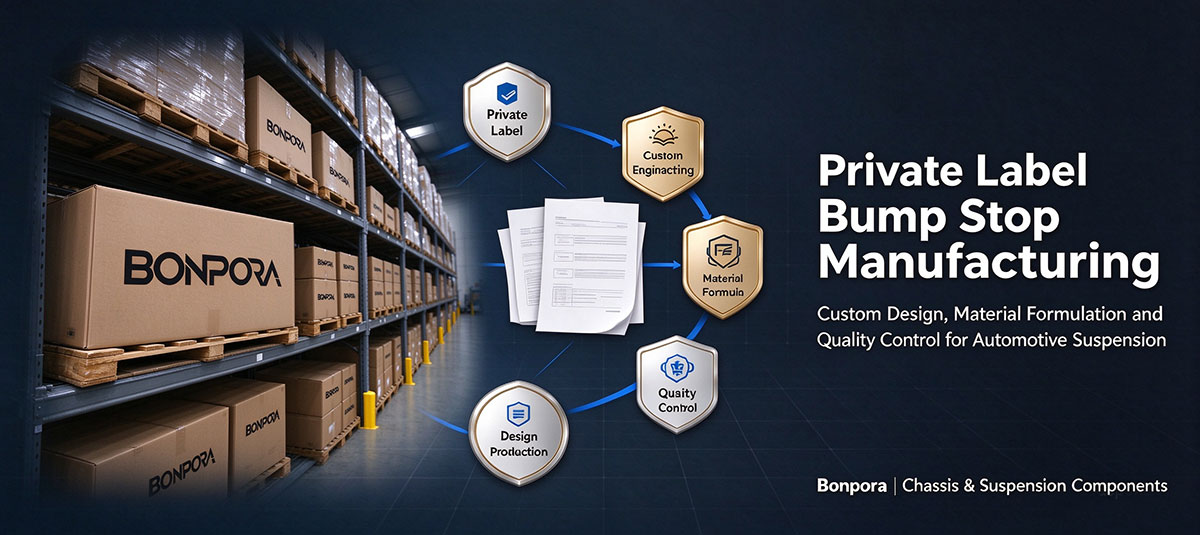
Private label bump stops reach shelf-ready status in six weeks when packaging runs alongside production instead of behind it. The sequence that holds: brand authorisation in week one, artwork and GTIN data in weeks two and three, printed packaging released by week four, first-article pack signed in week five, shipment in week six.
Why private label bump stops lose weeks before production starts
Casting a polyurethane bumper and printing its carton are two clocks that start together and finish apart. The part is usually ready first. The box delays the shipment, and the box depends on approvals no factory can grant on the buyer's behalf.
Three approvals sit on the critical path: evidence that the buyer may use the brand, artwork that survives a printer's dieline, and barcode data that scans at the receiving bay. Each is a serial dependency, cheap to start early and expensive to start late. That is the argument for a six-week plan rather than a six-week hope.
The reason the packaging side slips is structural. A bumper is bought on a part number and a drawing, so the technical conversation closes quickly. Packaging is bought on a brand decision, and brand decisions involve marketing, legal, a printer and sometimes a distributor in a third country. Buyers new to private label bump stops often find the factory is the last party to see the decision and the first party blamed for it.
The wholesale packaging and landed cost guidance makes the same point from the production side: packaging is a cost line and a risk line at once, which is how it behaves.
The six-week plan, gate by gate
The table is the schedule. It assumes an existing profile and a standard compound, so no tooling sits in the path; a new geometry inserts sampling and a mould in front of week one. Each gate has an owner and one filed document, because a gate without paper is a conversation.
| Week | Gate | What has to be true to pass | Typical owner | Evidence filed |
|---|---|---|---|---|
| 0 | Scope freeze | SKU list, brand ownership status, markets, channel per SKU | Buyer purchasing | Signed SKU sheet |
| 1 | Brand authorisation | Trademark evidence or brand-owner letter, scope, territory, period | Buyer legal | Authorisation file |
| 2 | Artwork version 1 | Dieline, label panel, language set, warning text, barcode window | Buyer marketing | Proof PDF on dieline |
| 3 | Artwork approval | Signed proof, colour reference, print process, pack material | Buyer marketing | Signed proof and colour chips |
| 3 | Barcode data | GTINs per pack level, check digits verified, carton mapping | Buyer supply chain | Barcode register |
| 4 | Packaging order released | Print quantity, allowance, delivery date into the factory | Buyer purchasing | Printer PO and schedule |
| 5 | First-article pack | Twelve-point sign-off on a packed sample | Both parties | Signed packing record |
| 6 | Pre-shipment | Carton compression and stack check, scan audit, documents | Both parties | Inspection report |
Two tracks run in parallel. Parts are cast, post-cured, deflashed and inspected on their own timeline, which is days for an established profile. Printing runs in the same window, and the tracks meet at the packing bench. If either starts after the other finishes, the programme becomes ten weeks.
Week three is the gate buyers underestimate. Artwork approval is a manufacturing release, not a design review. Once plates are cut, one wrong digit costs a plate set and a reprint, so the signed proof is frozen and later corrections go into the next run.
Brand authorisation and artwork: from week one to week three
What the factory needs before it prints someone else's mark
A manufacturer printing a third-party brand takes on legal exposure, and a serious one asks for evidence before plates are cut. The request is routine rather than suspicious, and faster to answer in week one than in week four.
Confirmation of who owns the mark, with the registration or application number.
Where the buyer is not the owner, a letter from the owner naming the factory, the part numbers, the territories and the period.
Artwork in vector format, with the logo as a path rather than an image placed in a document.
The part number map: buyer number, factory reference and supersessions.
Label text in every language on the pack, agreed as final copy rather than work in progress.
Market-specific warning or identification text the destination requires.
The authorisation letter stalls most often, because it sits with a legal team in another time zone from the purchasing team chasing the schedule. Asking in week zero costs one email. Asking in week four costs a week.
The label panel, field by field
Private label bump stops carry a short label, which makes every missing field visible. The fields below are the ones that cause receiving queries rather than the ones that look good in a presentation.
| Field | Why it is on the pack | Common failure |
|---|---|---|
| Brand and part number | Identifies the SKU to counter and warehouse | Buyer number printed, factory reference omitted, claim untraceable |
| Application or fitment line | Lets a workshop confirm position without a catalogue | Model year range vague or copied from a neighbouring SKU |
| Quantity per pack and carton | Drives receiving counts and resale | Pack quantity changed after artwork approval |
| Country of origin | Required by most destinations in some form | Field blank because origin was not confirmed at artwork stage |
| Material identification | Supports recycling and disposal instructions | Material family stated loosely or omitted |
| Batch field | Links the part to the production record | Field printed where a sticker can cover it |
| Barcode | Machine identification of the pack level | Symbol over a fold, a varnish zone or a dark panel |
| Warning or notice text | Fitment and handling instructions | Text shortened to fit, changing the meaning |
Two rules prevent most of those failures: keep the barcode clear of every fold by a margin the printer confirms, and keep the batch field in a window nothing else may occupy. Both are dieline decisions, which is why the proof is reviewed on the dieline rather than as a flat page.
Where the brand wants a marking that outlasts the carton, a moulded logo or moulded part number is the durable route on a cast polyurethane part, because it is formed into the surface rather than applied to it. The trade-off is timing: it is engraved into the tool, so it must be agreed before the mould is cut, and fine detail loses definition on a flexible microcellular surface.
The Chinese-label rework pattern
The most expensive packaging mistake here is not a design error. It is a second label applied over the first.
The pattern, described as a scenario rather than a specific client case: a buyer approves an English carton for export. A colleague orders a Chinese-language sticker for the domestic warehouse, because the receiving team reads Chinese. The sticker covers the batch field on part of the run and overlaps the barcode quiet zone on some cartons. The goods arrive, the scanner reads two attempts in three, and the buyer rejects cartons rather than parts. Removing self-adhesive labels without tearing print takes minutes per carton, and torn cartons are scrap.
Three fixes cost less than the rework. Define one language panel per market at artwork stage and print both versions as separate SKUs. If a local label is genuinely needed, put a measured label window on the dieline and cap its size. And print the batch field rather than labelling it, so traceability never depends on a sticker.
Request the packaging specification and a packed sample. Send the SKU list, the markets and the brand-owner status, and Bonpora will confirm label fields, carton construction and marking options before a quotation is issued. Request a specification sheet or a packed sample.
Barcodes, GTINs and part numbers: the data layer
Artwork is visible and data is not, which is why the data layer is where late changes hide. A GTIN is licensed rather than invented: the brand owner obtains a company prefix from the GS1 member organisation in its own country and allocates numbers from it. A factory cannot legitimately issue numbers on the buyer's behalf, and borrowed numbers create an ownership problem the day the supplier changes.
One GTIN per pack level scanned separately: a unit pack, an inner pack and a master carton are different trade items.
Never reuse a number for another quantity or variant. Receiving systems match on the number, not the description.
Treat the last digit as a calculated check digit. A hand-typed number fails at the scanner, and the failure appears at the customer rather than the printer.
Use a symbol that suits corrugated. A 14-digit ITF-14 is common on master cartons because it tolerates a coarser print surface.
Print inside the quiet zones, with no varnish, fold or overprint there, at a magnification the customer's scanners accept.
The register below keeps artwork and data from drifting apart. It fits in a spreadsheet and settles an argument.
| SKU | Buyer part number | Factory reference | Unit GTIN | Carton GTIN | Pack quantity | Label version | Approved |
|---|---|---|---|---|---|---|---|
| BP-101 | 22-4410 | JB-ON-58 | 0 000000 000001 | 1 000000 000001 | 2 per box, 40 per carton | A / EN | Week 3 |
| BP-102 | 22-4411 | JB-ON-58H | 0 000000 000002 | 1 000000 000002 | 2 per box, 40 per carton | A / EN | Week 3 |
| BP-115 | 22-4490 | JB-ON-72 | 0 000000 000015 | 1 000000 000015 | 1 per bag, 25 per carton | B / EN + FR | Week 4 |
The numbers above are structural placeholders, not live GTINs. The value of the register is the version column: when a label changes, the version moves and the approval date records which print run carries it. A carton without a version cannot be reconciled with a proof.
Part numbering needs the same discipline. Two numbers appear on every pack, the buyer's and the factory reference, and the mapping is what lets a claim or a reorder work. Where a buyer number supersedes an older one, print both through a transition period rather than switching silently, because the counter still orders by the old number. The custom parts route covers profiles no existing reference serves.
First-article packing: the twelve-point sign-off
An inspection that stops at the part misses the product that ships. First-article packing for private label bump stops is done on a packed sample, opened on a bench, with the approved proof and the barcode register in hand.
Part number on the pack matches the approved artwork and the drawing.
Factory reference appears where the register places it.
Barcode scans first time on three different scanners, unit pack and carton.
Batch field is printed, visible and unoccupied by any label.
Pack quantity matches the artwork, and the count in the sample carton matches the print.
No sustained load on the profile: parts sit in their natural shape, not compressed by the pack.
Label position matches the dieline, with the agreed margin from every fold.
Language panel is complete and correct for the destination.
Warning or notice text is present and unedited from approved copy.
Material identification and country of origin are printed, not blank.
Carton grade and stacking limit are marked, and a loaded carton carries the stack it claims.
Pallet pattern, layer count and strapping match the instruction, and photos are filed with the record.
Two of the twelve are worth arguing about at the gate. Item 3 cannot be judged from a photograph, which is why the sample travels by courier. Item 6 produces claims months later, because a bumper compressed in a carton for six weeks in a hot container arrives with a memory of the journey.
Four places private label bump stops lose a week
Most delays in this category come from four handoffs. None is a manufacturing problem, and all are visible early if someone watches for the signal.
| Where it stalls | Early signal | What it costs | Fix that works |
|---|---|---|---|
| Brand authorisation sits with legal | Week one passes without a document | A week, and a pushed print slot | Request the letter in week zero, in the factory's format |
| Artwork proofed as a flat PDF | Fold-position comments arrive in week three | One proof cycle, several working days | Proof on the printer's dieline with the label window shown |
| GTIN requested after printing | Artwork approved with a blank barcode box | Reprint, plate set, air freight | Allocate numbers before artwork version 1 |
| Packing approved from photos | Sign-off email says "looks fine" | Rejected carton at destination, or a claim | Courier a packed sample and sign the twelve points on it |
A flat PDF shows the design and hides the product. Folds land in the middle of text, a label window shifts two millimetres and clips a warning line, and a barcode that looked generous on screen sits against a dark panel. None of this appears in a design review; all of it appears on the first printed sheet. A photograph has the same blind spot for the fourth row, because it cannot show a scan grade, board stiffness or the way a part sits in a bag.
What a packaging mistake costs: a worked model
The arithmetic is illustrative, built to show the shape of the exposure rather than to quote a price. It assumes a launch of 4,000 pieces packed two per box, so 2,000 printed cartons, and a barcode error found after the run.
| Line | Assumption | Amount |
|---|---|---|
| Cartons as planned | 2,000 cartons at USD 0.34 | 680 |
| Reprint | Same 2,000 cartons | 680 |
| Plate set | Four-colour carton, one set | 120 |
| Air freight to protect the launch | 260 kg chargeable at USD 5.40 per kg | 1,404 |
| Relabel labour | 4,000 units at 40 seconds, USD 4.50 per hour | 200 |
| Total | 2,404 |
The original packaging spend was 680. The correction is 2,404, roughly 3.5 times the budget, before anyone counts the twelve working days. If the first container misses its sailing, the replacement typically arrives three to four weeks later by sea, which is a launch window rather than a cost line.
Relabelling is not the cheap workaround it looks like. Forty seconds per unit sounds manageable until the quantity is real: 6,000 units at 45 seconds is 75 hours, or two people for a working week, on a task that adds nothing to the part. A printed field costs nothing per unit once the plate exists.
The conclusion is not to spend more on packaging. It is to spend the same money earlier, on a dieline proof and a barcode register, so the print run happens once. Where the programme needs a profile that does not exist, packaging cannot start in week one, because sampling and tooling come first. Bonpora produces polyurethane bump stops in MDI and NDI at two bases, Luoyang for high-end OE and Wuxi for mid-range OE, aftermarket and tuning, both under ISO 9001 and IATF 16949, and supports custom development from a drawing or a sample. The polyurethane jounce bumper range lists the standard profiles a programme can adopt without new tooling.
FAQ
Can private label bump stops be supplied in our own packaging?
Yes. Private label packaging is a normal part of a bumper programme rather than a special project. The requirements are approved artwork and a packaging drawing before the run, plus confirmation of the reference and application text on the unit pack, because a mislabelled carton on a fitment-critical part creates returns quickly. Neutral packaging is available for buyers who label in their own warehouse.
Does the six-week schedule hold if we need a new profile?
No. The six weeks assume an existing profile and a standard compound, so the schedule contains no sampling or tooling. A new geometry adds a sample round and a mould before the packaging gates begin, and the added time is quoted per project.
Should we use our own GTINs or accept numbers from the factory?
Use your own. A GTIN licensed by the brand owner stays with the brand if the supplier changes, and it keeps the pack level structure consistent. Numbers issued by a factory often belong to that factory's prefix, so labels have to be redone when production moves.
Can the logo be moulded into the part instead of printed on the pack?
Yes, and on a cast polyurethane part a moulded marking outlasts ink because it is formed into the surface. It has to be agreed before the mould is cut, and fine detail loses definition on a flexible microcellular surface, so a bold layout with adequate character height works better.
What if our market needs a language other than English?
Treat it as a separate label version and a separate SKU in the register. A second language changes the panel size and therefore the carton layout, so it belongs in artwork version 1. Copy should arrive final, because a translation finished after the proof is signed usually produces a second print run.
Who owns the artwork and the printing plates after the run?
Agree it in the purchase order, with where files and plates are stored and what happens if production moves. The clause decides whether a reprint is a phone call or a new project.
Get a quotation for private label bump stops. Send the SKU list, the destination markets and the packaging format per channel, and Bonpora will reply with a packed sample plan, a label field review and a quotation covering parts and packaging. Request a quotation.