
- 1. NDI vs MDI Polyurethane: The Short Answer
- 2. Heat Build-Up: Where NDI vs MDI Polyurethane Separates
- 3. Fatigue: Read the Report, Not the Cycle Count
- 4. Cost: Break-Even on a Premium of 0.24 per Part
- 5. When MDI Is Right, and When Neither Grade Fixes the Problem
- 6. Verifying the Grade You Paid For: Five Process Evidences
- 7. The Specification Sheet: Fourteen Fields That Survive a Supplier Change
- 8. FAQ
- 8.1. In NDI vs MDI polyurethane, is the more expensive grade always the safer choice?
- 8.2. Can the same mould run both NDI and MDI compounds?
- 8.3. Why does NDI carry a longer lead time than MDI?
- 8.4. What temperature should I put on the drawing?
- 8.5. How is compression set actually verified in production?
- 8.6. How can I tell in service whether a stop has taken a set?
NDI vs MDI Polyurethane Bump Stops: Heat, Fatigue, Cost
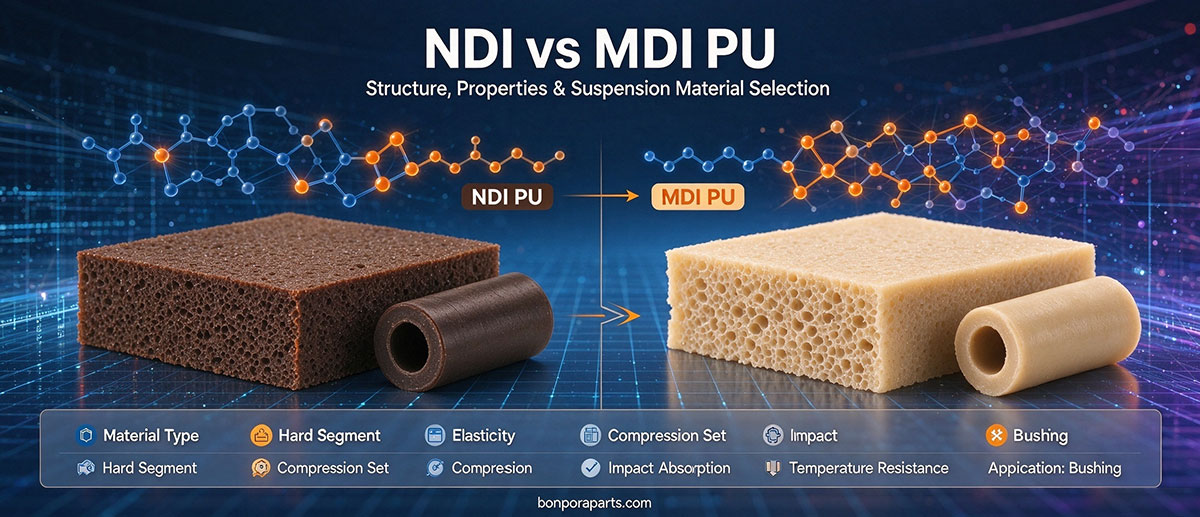
The NDI vs MDI polyurethane choice for bump stops is set by duty cycle, not by preference: NDI holds stiffness and height where the part runs hot and cycles fast, while MDI covers most road-car positions at lower cost. This guide puts heat, fatigue and cost into numbers, then shows how to verify the grade you actually receive.
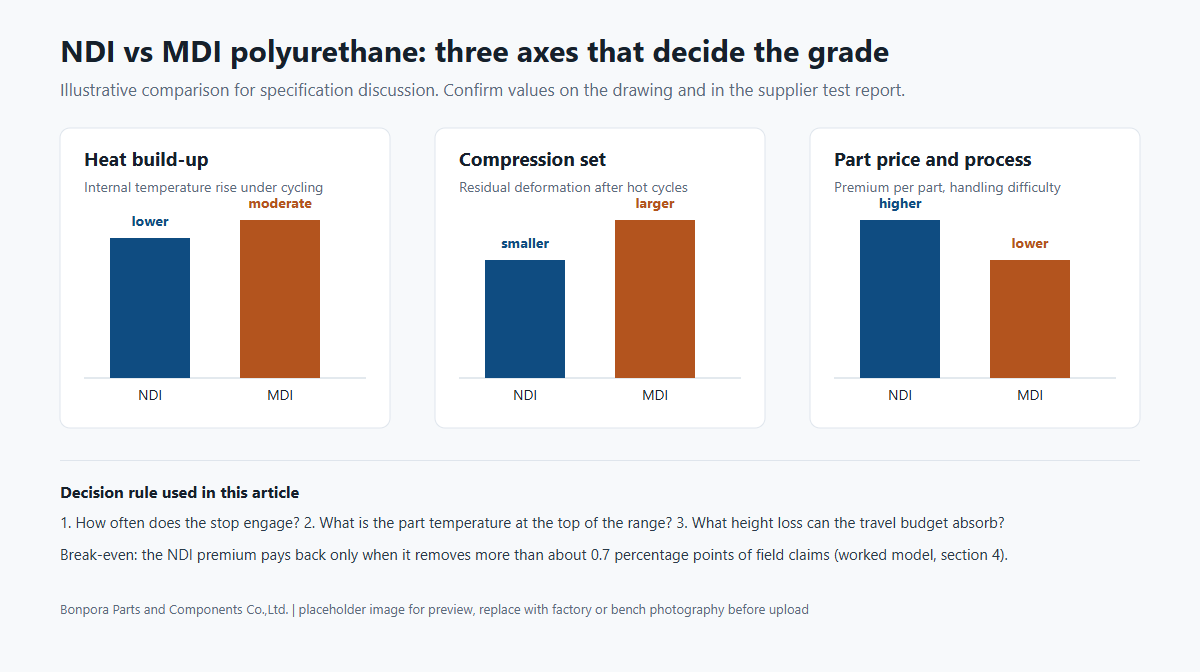
NDI vs MDI Polyurethane: The Short Answer
Both grades are cast polyurethane: an isocyanate reacts with a polyol and a chain extender in the mould, so the part and the material are made in the same step, and the formulation can be tuned across a wide range of hardness, resilience and dynamic behaviour. The difference is the isocyanate itself, and it shows up in the three places this article covers: heat, permanent deformation under repeated compression, and cost.
On the Bonpora polyurethane jounce bumpers range, the stated positions are consistent. MDI is the widely used system with a good balance of resilience, tear resistance and cost, covering the majority of passenger car bumper positions. NDI is selected where higher resilience and better retention of properties under heat and repeated cycling are required — heavier vehicles, demanding positions, applications where the bumper must not take a set. The trade-off is a higher material cost and a more demanding casting process.
Two boundaries matter before any comparison. First, the two systems behave differently in the same mould, so a compound change is a product change: the stiffness curve has to be re-verified against the drawing, not assumed. Second, the stated selection rule is "match the released drawing", not "NDI where possible". Where the drawing is silent, the duty cycle decides — the table compresses the NDI vs MDI polyurethane comparison to eight rows.
| Property | MDI system | NDI system |
|---|---|---|
| Resilience and rebound | Good general purpose | Higher, better rebound |
| Heat build-up under repeated cycling | Acceptable at moderate cycle rates | Generally lower hysteresis in demanding cycles |
| Compression set resistance | Good | Better when properly post-cured |
| Property retention when hot | Adequate for standard positions | Holds dynamic stiffness better |
| Casting process | Wide window, volume production | Narrower window, longer post-cure |
| Material cost | Lower | Higher |
| Typical duty | Passenger cars, light commercial | Trucks, off-road, heavy trailers |
| Specified by | Hardness, stiffness curve, geometry | Hardness, curve, fatigue and tear performance |
Heat Build-Up: Where NDI vs MDI Polyurethane Separates
A bump stop is an energy absorber, and energy not returned as rebound becomes heat inside the part. One compression event does not matter. Repeated events — a loaded truck on a washboard road, a commercial vehicle on a dock apron — push internal temperature above ambient, and elastomer properties move with temperature. That lost energy per cycle is hysteresis, and the off-road documentation states the difference directly: MDI is acceptable at moderate cycle rates, NDI shows generally lower hysteresis in demanding cycles.
Three consequences follow for a buyer.
The part temperature is not the ambient temperature. Underbody soak, exhaust and brake heat, and self-heating from cycling all stack, so two stops with the same compound can run tens of degrees apart. The on-road range states −40 °C to +90 °C and the off-road range −40 °C to +100 °C; both note the material can be adjusted for special conditions, and the manufacturing guide calls such an adjustment a development activity — compound, cure and sometimes profile reviewed together, curve and compression set re-verified before release. The temperature entry on the drawing should describe the position, not the continent.
Stiffness at temperature is the property to ask for. A stop that measures correctly at 23 °C can go progressively softer as it heats, letting the suspension reach the hard stop earlier and loading the strut, the top mount and the surrounding structure. Where the stop works for its living, the first-article report should include the force–deflection curve at the top of the stated range, not only at room temperature.
Heat and cure interact. The manufacturing documentation warns that a shortened cure produces a part that measures close to nominal when new and keeps changing afterwards; heat also completes the reaction, which is why the part is post-cured after demoulding so properties stabilise. A supplier who shortens post-cure ships a part whose properties are still moving — in the wrong direction for height and set.
Fatigue: Read the Report, Not the Cycle Count
Compression fatigue is where the grades separate most visibly, and where reports are easiest to misread. A report that says "passed 100,000 cycles" without frequency, amplitude, fixture or criterion says almost nothing: the same part can pass at a low frequency and fail at a high one through heat build-up alone. The arithmetic of height loss shows why the criterion matters.
The failure modes to expect are the ones the design-life statement names: cracking, and permanent deformation — the part no longer recovers its free height. End-of-test criteria are commonly a percentage of height loss plus visible cracking; the exact numbers belong on the drawing and should be verified with the supplier, since they are set per programme rather than fixed by the material family.
Take an illustrative stop with an 80 mm free height and a 32 mm gap at ride height, so 48 mm of usable compression. A 6% set after a season of hot, frequent engagement leaves a free height of 75.2 mm and 43.2 mm of usable compression — one tenth of the travel budget lost to set alone. The suspension touches the stop 4.8 mm earlier on every event, which the driver reads as a car that rides harsher than it used to.
A report counts as evidence only if its conditions are complete:
| Report element | What to demand | Why it decides the comparison |
|---|---|---|
| Test temperature | Stated, with one run at the top of the service range | Room-temperature results hide heat build-up |
| Frequency | Stated in hertz or cycles per minute | High frequency is where hysteresis separates grades |
| Amplitude and preload | Deflection range and static preload, in millimetres | Set and heat depend on how far the stop is driven |
| Fixture | Mounting matching the real installation | A free-standing block fatigues differently |
| Criterion | Height-loss limit and cracking definition, agreed beforehand | Without it, "passed" is undefined |
| Measurement points | Free height and curve before, at intervals, after recovery | Shows whether degradation is gradual or sudden |
| Sample identity | Batch code and post-cure dates | Links the result to compound and process |
| Raw data | Force–deflection curves attached, not a summary | Your own engineer can re-plot and compare |
One red flag: a summary reporting cycles but not temperature usually means the test ran cool enough for both grades to look alike, erasing the difference the buyer is paying for.
Request a sample specification and first-article report template — include the duty cycle and the top-of-range temperature, and the comparison runs on your own numbers.
Cost: Break-Even on a Premium of 0.24 per Part
The NDI premium is certain; the failure reduction it buys is an estimate. The honest decision needs two lines: what the premium costs per year, and what claim reduction pays for it. All figures are illustrative — they show the arithmetic, not a price.
Consider a hot-climate fleet distributor buying 18,000 bump stops per year against a drawing permitting either grade. MDI is quoted at an illustrative 2.10 and NDI at 2.34, so the premium is 0.24 per part, 4,320 per year. Field experience with the current MDI supply is a 1.4% claim rate, and the fully loaded cost per claim — part, workshop labour, return freight, administration — is 34.50. If NDI reduces the claim rate to 0.5%:
| Line | MDI supply | NDI supply |
|---|---|---|
| Annual volume | 18,000 | 18,000 |
| Unit price (illustrative) | 2.10 | 2.34 |
| Parts spend | 37,800 | 42,120 |
| Claim rate (illustrative) | 1.4% | 0.5% |
| Claims per year | 252 | 90 |
| Cost per claim (illustrative) | 34.50 | 34.50 |
| Claim cost per year | 8,694 | 3,105 |
| Total annual cost | 46,494 | 45,225 |
The NDI supply costs 4,320 more in parts and saves 5,589 in claims, a net gain of 1,269 per year. The more useful number is the break-even: 4,320 over 18,000 parts is 0.24 per part, and 0.24 over 34.50 per claim is roughly 0.70 percentage points. The premium pays back only if it removes more than 0.70 points of claim rate.
Run the same model for a temperate passenger-car programme where the current MDI claim rate is 0.30% and a better grade might reach 0.20%. The gap is 0.10 points — far below the break-even — so the premium buys nothing; and wherever the failure mode is not material-driven, a stop that fails from extrusion or a wrong gap fails on either chemistry.
Two disciplines keep this model honest: claim rates must come from your own field data or a pilot lot, not a brochure; and cost per claim must include labour and freight, because a part costing 6.50 to replace can cost 34.50 all-in.
When MDI Is Right, and When Neither Grade Fixes the Problem
Over-specifying into NDI has a cost that never appears on the quote: a narrower processing window, a longer post-cure, a smaller supply base and a higher price, all spent on duty the material will never see. The polyurethane bump stops range splits by duty.
MDI is the correct choice when most of these hold: the drawing names MDI; the vehicle is a passenger car, crossover or light commercial with stock travel; the stop engages on severe events rather than continuously; the climate is temperate; the programme is volume-sensitive. NDI earns its place when the duty flips: heavier vehicles and solid axles, off-road builds where the stop engages on jumps and rock steps, hot climates, and fleet duty with high annual mileage.
There is a third case buyers wrongly solve with a chemistry change. If a stop collapses early, check whether the suspension is in continuous contact because a spring has sagged — the design-life statement qualifies life "under normal use", and continuous contact is outside that envelope. If the complaint is extrusion, the stop is driven into a gap smaller than its section, and no compound resists that. If it appeared after a lift kit, the travel changed. Diagnose in this order:
Measure the gap at ride height, at kerb weight and at full load; compare with the drawing.
Check whether the stop is in continuous contact in normal driving — if so, the spring or load case is the fault, not the grade.
Look for extrusion deformation at the base, which indicates a section-to-gap mismatch.
Bench-compare the returned part's free height and curve against a new part of each grade.
Only then raise a compound question, with the duty cycle data attached.
Verifying the Grade You Paid For: Five Process Evidences
The most expensive outcome is not the wrong grade — it is paying an NDI price and receiving an MDI part, or an under-cured NDI part still drifting when packed. Both grades look identical in a photograph, so verification runs through the process; the NDI microcellular polyurethane manufacturing documentation describes what genuine casting requires.
The evidence chain is specific. NDI prepolymers are typically solid at room temperature, so a real NDI line melts the prepolymer in a heated tank in a narrow temperature band, then degasses under vacuum. The prepolymer is moisture-sensitive — free isocyanate reacts with water to form carbon dioxide, which appears in the part as bubbles, voids and weak spots — so it is stored in sealed, nitrogen-blanketed containers with shelf life and open time tracked. The pot life of NDI casting grades is often only a few minutes, demanding high-shear mixing and short transfer lines. After demoulding, NDI needs a long post-cure — typically one to several days at elevated temperature — for the network to fully develop; parts sold early drift in hardness and set in their first weeks.
A factory without a melting tank, nitrogen-blanketed storage and a post-cure schedule cannot cast NDI properly. The batch documentation makes this checkable without a plant visit. The on-road manufacturing guide sets the control-plan frequencies the paperwork should reflect: raw material identity and certificates at every delivery; dosing and degassing records at every mix; first-off appearance, dimensions and hardness at every production start; in-process checks at defined intervals; and — the two lines that matter most here — a static stiffness curve and a compression set on a sample from every batch, with the batch code on marking and packing list.
Twelve-point checklist before the first PO:
Confirm the drawing names the system, or obtain a written grade recommendation against the duty cycle.
Ask for the stiffness curve at the top of the stated temperature range, not only at room temperature.
Ask how many post-cure days at what temperature the NDI schedule runs, and whether parts are held through the full schedule before packing.
Verify by video walk-through or audit report the melting tank, degassing step and nitrogen-blanketed storage.
Ask how pot life is managed on the mixing head for NDI grades.
Request the control plan; check stiffness curve and compression set appear at per-batch frequency.
Request a batch record and check it carries post-cure start and end dates.
Agree the compression set condition — level, time, temperature — in writing before comparing results.
Agree the fatigue end-of-test criteria: height-loss limit and cracking definition.
Check that marking and packing lists carry batch codes, so claims trace to a mix.
For hot markets, ask how compression set is sampled on NDI grades sold there.
Run a pilot lot in the harshest duty available before releasing annual volume.
The Specification Sheet: Fourteen Fields That Survive a Supplier Change
A grade decision that lives only in an email thread dies at the next supplier change. These fourteen fields turn the NDI vs MDI polyurethane comparison into a document any qualified caster can quote against.
| Field | What to write | Common omission |
|---|---|---|
| 1. System and reference | MDI or NDI, with the system grade reference where fixed | "Polyurethane" alone |
| 2. Hardness | Shore A with tolerance, measured on the finished part on a flat face | A number with no tolerance |
| 3. Density band | Target density with upper and lower limits | Omitted, though it governs the curve |
| 4. Static stiffness curve | Force–deflection target with tolerance band at defined points | Hardness quoted instead of the curve |
| 5. Curve at temperature | Same curve at the top of the service range | Room temperature only |
| 6. Compression set | Condition (compression, time, temperature) and limit, agreed as typical industry practice | A limit with no test condition |
| 7. Fatigue requirement | Cycles, frequency, amplitude, fixture, end-of-test criteria | A bare cycle number |
| 8. Tear performance | Required tear strength and test method where the duty demands it | Omitted for heavy-duty parts |
| 9. Temperature range | Service range for the position, e.g. −40 to +90 °C or −40 to +100 °C | Climate quoted instead of position temperature |
| 10. Geometry and gap | Free height, diameter, bore, fixing, gap at ride height | Gap left to installation |
| 11. Insert and interface | Insert material and retention feature where fitted | Assumed from the sample |
| 12. Post-cure requirement | Minimum post-cure schedule before packing | Not stated, so the first shortcut taken |
| 13. Batch records | Curve and set per batch, retained with batch code | Records not linked to shipments |
| 14. Marking | Part number and batch code on part and packing list | Unmarked stock mixed across batches |
Fields 4, 6 and 12 carry the grade difference in writing. If a quotation accepts those three lines unchanged, the grade discussion is over; if it returns counter-conditions, the counter-conditions are the real comparison.
FAQ
In NDI vs MDI polyurethane, is the more expensive grade always the safer choice?
No. The premium buys lower hysteresis and better set behaviour, which pays only in hot or high-cycle duty; the model here puts the break-even at roughly 0.70 percentage points of claim rate. In temperate passenger-car duty MDI is correct, and the released drawing comes first.
Can the same mould run both NDI and MDI compounds?
The tooling can be the same, but the compound change is a product change: the two systems behave differently in the same mould, so the curve must be re-verified against the release drawing and the first article re-approved.
Why does NDI carry a longer lead time than MDI?
The casting itself is not the difference. NDI needs a longer post-cure — typically one to several days at elevated temperature — for the network to fully develop, and parts released early drift in hardness and set. The schedule should carry the post-cure deliberately.
What temperature should I put on the drawing?
State the temperature the position sees, not the market: the on-road range is −40 °C to +90 °C and the off-road range −40 °C to +100 °C, and anything outside is a development activity reviewing compound, cure and profile together. Confirm position temperature from underbody measurements where duty is severe.
How is compression set actually verified in production?
It is a destructive test, run on a sample from every batch and retained with the batch documentation. The condition — compression level, time, temperature — must be agreed in writing; results under different conditions are not comparable between suppliers.
How can I tell in service whether a stop has taken a set?
Measure free height against a new part and compress it by hand: a stop that has lost stand-out height engages earlier and feels softer. Cracking and permanent height loss are the two conditions the design-life statement names; either justifies a bench comparison.