sales@bonporaparts.com
0086-10-64988621
English
A washer or spacer is installed between two connecting components, typically at the mating surfaces of bolts, nuts or flanges. That sentence fixes the position, but it does not explain the duty. Once a fastener is tightened, the joint becomes a spring: the bolt stretches, the clamped parts compress, and the washer sits exactly at the interface where those two movements meet. Everything the washer does, from adjusting assembly clearance and compensating dimensional chain tolerances to protecting a machined face from scratches or stress concentration, follows from that position.
For a purchasing engineer the practical question is rarely whether a washer is needed at all. It is which washer, of what thickness and material, and how it should be fitted so that the preload written on the drawing still exists inside the joint a thousand cycles later. This guide covers the assembly side of that question: surface preparation, washer placement, tightening order, the effect of thickness and material on clamp load, reuse limits, and the field symptoms that point to a fitting error rather than a defective part.
The same flat washer behaves differently depending on which side of the joint it is placed, and on what it is pressed against. Three positions cover most automotive and industrial cases.
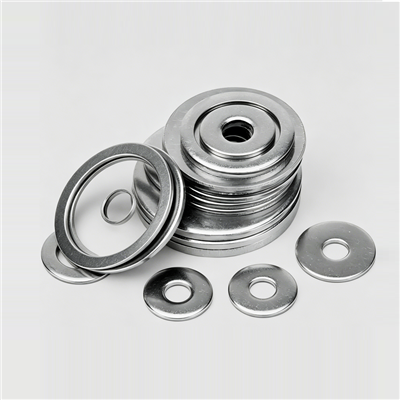
A washer under a rotating head spreads the bearing stress over a wider ring of the clamped part and lets the head turn without galling the parent metal. A washer under the nut does the same on the opposite face and is the usual choice when the nut is the part being turned. Fitting washers on both sides is common on aluminium housings and on thin formed brackets, where the bearing area of a bare fastener head would be marginal.
On flanges, covers and end caps the washer often doubles as a load spreader for a soft gasket line. Here the washer has to be flat, and the surface finish of the mating face matters as much as the washer itself: a burr left by a punching operation will be pressed into the washer and stay there as a stress raiser.
A spacer or shim type washer is used when the joint needs a defined gap. Because it sits inside the dimensional chain, its thickness tolerance decides the final clearance of the assembly. Where two or more spacers are stacked, the tolerances add; where a single thicker spacer can be used instead, the chain is shorter and easier to control.
Most fitting complaints that reach a supplier are resolved before the first bolt is turned. Two preparation steps carry most of the benefit.
Wipe the mating faces free of cutting fluid, paint overspray and loose scale. A washer fitted over a burr cannot sit flat, and a washer fitted over swarf cannot sit at all. Check the edges of punched holes and drilled holes with a fingernail or a light file; a raised lip of a few hundredths of a millimetre is enough to tilt a thin washer and to show up later as a loose joint.
Confirm that the clearance hole is larger than the washer bore by the amount the drawing intends. If the clearance hole is smaller than the washer bore, the washer will be pressed against the hole edge instead of the face, and the clamp load path changes. If the two holes in a pair are misaligned, do not use a thicker washer to bridge the offset; realign the parts, then fit the washer of the specified thickness.
Fit the washers dry and square, then bring all fasteners up to a light snug torque in a crossing pattern. Only after every fastener is snug should the final torque be applied, again in a crossing pattern. On a four bolt pattern the order is diagonal; on a longer flange the order runs from the centre outwards. Tightening one fastener to full torque before its neighbour is snug is the most common cause of a washer that ends up crushed on one side and loose on the other.
Torque is only a proxy for clamp load, and every interface in the joint consumes part of it. A dry steel washer on a dry steel face can swallow a substantial share of the applied torque as thread and bearing friction. Change the washer to a coated or stainless type, add a lubricant, or fit a sealing washer, and the same torque figure produces a noticeably different preload. When a washer material is changed, the assembly torque should be reviewed rather than carried over unchanged.
Where spacers set a gap, fit the stack first, check the gap with a feeler gauge or a depth gauge, then tighten. Measuring after tightening tells you the residual gap, not the designed one, because the parts have already seated against the spacers.
A washer does not only spread load; it also changes how much of the clamp load survives the first hours after tightening. Micro unevenness on the washer faces is flattened under load, and the joint loses a small amount of preload as a result. Thicker and softer washers settle more. The table below shows the direction of the effect rather than a universal figure, because the amount depends on surface finish, hardness and load.
| Washer condition | Effect on settling | Practical consequence |
|---|---|---|
| Thin hardened steel, ground faces | Low | Preload holds well; re-torque often unnecessary |
| Standard low carbon steel, as supplied | Moderate | A re-torque check after run in is useful on critical joints |
| Copper or aluminium | Higher | Soft metal flows into surface peaks; check the gap after settling |
| PTFE, nylon or other non metal | Highest | Use where insulation or sealing is the priority, not where high sustained preload is needed |
| Sealing washer with bonded elastomer | Moderate to high | Compression of the seal sets the usable torque band |
Thickness is the parameter buyers most often treat as free, and it is the one that most often comes back as a complaint. A thicker washer raises the stack height, which on a suspension or steering assembly can change the installed length of a bushing or the preload of a spring seat. It also reduces the length of thread engaged below the nut, which matters when the fastener was selected with little spare thread. On a thin walled housing, a very thick washer can concentrate the load on a small ring rather than spreading it, which is the opposite of the intended effect. In practice, the sensible approach is to keep the washer thickness as supplied by the original drawing, and to change it only after the dimensional chain from the fastener head to the clamped face has been re-checked.
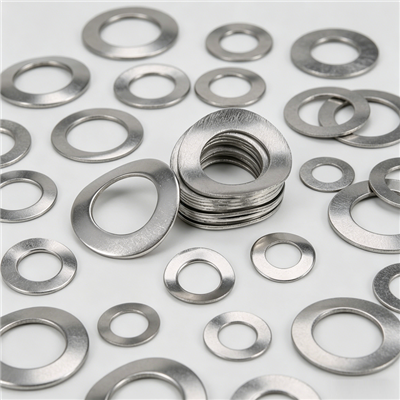
Bonpora supplies washers in low carbon steel, stainless steel, copper, aluminium and non metallic composite materials such as PTFE and nylon, and the choice changes both the friction at the interface and the corrosion behaviour of the joint. Plain carbon steel with a zinc or phosphate finish is the general purpose choice for indoor and underbody locations where the washer is protected by the surrounding coating. Stainless steel suits visible fasteners, wash down areas and any joint that will be opened repeatedly, though it is worth remembering that stainless against stainless can gall, so a coated counterpart is often selected. Copper and aluminium are used where the washer also has to conduct heat or electricity, or where a softer interface protects a machined face. Non metallic washers are used for insulation, for low friction sliding adjustment, and for chemical resistance. Surface condition matters as much as the base material: burrs, scale and sharp punched edges all raise the local bearing stress and give corrosion a place to start.
A flat washer is a cheap part and a joint failure is not, so the default rule is to fit new washers whenever a fastener is released. The exceptions worth considering are thick machined spacers and heavy flat washers in a joint that is dismantled for inspection only, where the washer is undamaged, still flat, and free of corrosion. Reject any washer that shows a bright ring pressed into the face, a cupped or dished profile, nicks on the bearing face, or corrosion pitting, because each of those reduces the bearing area it can offer on the second fitting. Sealing washers with a bonded elastomer are single use by nature: once the elastomer has been crushed to the flange profile it will not seal again at the same torque. Re-torque checks after the first hours of running are worth scheduling on critical joints, since the settling described earlier happens quickly and then stabilises.
| Symptom on the vehicle or machine | Likely fitting cause | Corrective action |
|---|---|---|
| Fastener loses torque within days | Washer fitted over a burr, or surfaces contaminated with oil | Clean and deburr, replace the washer, re-torque in a crossing pattern |
| Bright ring or dent on the washer face | Over-torque, or washer too thin for the bearing load | Review torque against the washer grade, increase bearing area |
| Leak at a flange after reassembly | Sealing washer reused, or seal lip cut during fitting | Fit a new sealing washer, check the flange face for scratches |
| Assembly gap wrong after build | Spacer stack thickness tolerance accumulated | Measure the chain, replace the stack with a single controlled thickness |
| Noise or movement in the joint | Washer bore larger than intended, poor centring | Check bore against the clearance hole, refit with a matched bore |
| Corrosion staining around the fastener | Mixed metals without a barrier, damaged coating | Switch to a coated or stainless washer, touch up coating |
In shock absorber and strut assemblies the washer has three separate jobs. It seats the piston rod nut against the upper mounting, it protects the mounting rubber or bearing from the rotating nut during tightening, and in the form of a spacer it sets the length of the rod above the mounting. All three are fitting sensitive. A rod nut tightened without the correct washer can cut into the mounting, and a spacer of the wrong thickness changes the installed length of the assembly, which shows up as a ride height or spring seat problem rather than as a washer problem. In chassis and suspension work the same rules apply to subframe bolts, control arm pivots and stabiliser links, where washers are used to spread load and to set the position of the bushing in its bracket.
Because the washer has to match a specific joint, ordering on the basis of a sample or a drawing is normal. Bonpora supports customisation of any shape, size and thickness, and accepts single pieces or batch production to meet assembly requirements, so a fitted kit can be packed with the fasteners it belongs to. When sending an enquiry, include the inside diameter, outside diameter and thickness with their tolerances, the material or the service environment, the surface finish or coating, the annual quantity and the packing format. Buyers working on a new assembly usually start from a custom parts enquiry and then move to a scheduled call off once the drawing is frozen. As with any other supplied component, a first article approval step before volume production keeps the dimensional chain under control.
Fit it on the side that is turned, because that is where galling and bearing stress are highest, and add a second washer on the opposite face when the clamped material is soft or thin. On aluminium housings and thin formed brackets, washers on both sides are common. Where a sealing washer is specified, it goes against the face to be sealed, not against the nut.
In most automotive work, no. Fit new washers as a rule and reserve reuse for heavy machined spacers that are still flat and free of corrosion, dents and pressed rings. Sealing washers and any washer with a bonded elastomer are single use, because the elastomer takes a set during the first tightening.
Not automatically. A thicker washer spreads load over a wider area only if the bearing area is also wider. Increasing thickness alone raises the stack height, shortens the engaged thread and lengthens the dimensional chain. Strength comes from bearing area, material grade and correct torque, not from thickness on its own.
Stainless steel is the usual starting point for wash down and road spray areas, with a coated steel washer as a lower cost alternative where the joint is painted after assembly. Copper and aluminium are selected when thermal or electrical conduction is part of the duty, and non metallic materials such as PTFE or nylon are chosen for insulation, low friction adjustment or chemical resistance.
Send Bonpora Parts and Components Co.,Ltd. the drawing or the sample, the material, the thickness and both diameters with tolerances, and the expected annual quantity. The engineering team will confirm the feasible tolerances, the surface treatment and the packing format, and can quote single pieces or batch production for assembly line use. For fasteners and mountings around the washer, see the full washer and spacer range or contact the factory directly.