sales@bonporaparts.com
0086-10-64988621
English
A washer, or spacer, is the small component that sits between two connecting parts, most often at the mating surfaces of bolts, nuts, and flanges. It is one of the cheapest items on a bill of materials and one of the most frequently mis specified, because it is usually treated as an accessory to the fastener rather than as an engineered part in its own right. In suspension and shock absorber work a washer often performs three functions at once: it sets the assembly clearance so that the dimensional chain closes correctly, it helps to prevent the joint from loosening, and it protects a machined or coated surface from scratches and stress concentration.
This guide is written for design engineers, production planners, and purchasing teams who need to choose a washer or spacer and buy it repeatably. It covers what each washer type actually does, how the material choice follows the job, the dimensions worth writing on a drawing, and how washers and spacers are used to close a dimensional chain in a damper or strut assembly. Custom shapes, sizes, and thicknesses are produced to customer drawings or samples, and both single pieces and batch production are available.
All washers share the same basic geometry, a flat part with a hole, but their purpose divides into three groups that should be considered separately at design stage. A clearance washer or spacer sets a distance or takes up a gap in the tolerance chain. A friction or locking washer resists loosening by increasing friction or by adding a spring action. A protective or sealing washer spreads load, protects a surface, or closes a fluid path. Identifying which of the three jobs is required usually narrows the choice to one or two candidate types immediately.
When a washer is asked to do two jobs at once, the requirements can conflict. A hard steel washer spreads load well but does not seal. A soft PTFE washer seals well but deforms under load and cannot be reused after the joint is loosened. Where both functions are genuinely needed, the answer is usually two parts in the stack rather than one part doing an impossible combination.
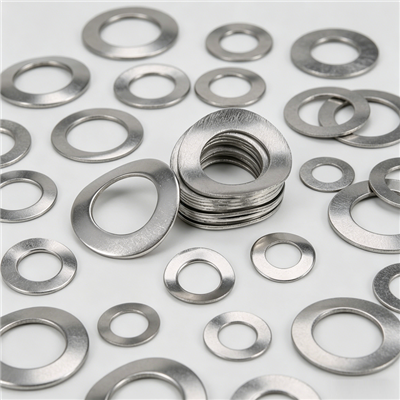
Every assembly is a stack of parts, and each part has a tolerance. When the stack is added up, the result varies more than the design intends. A washer or spacer of a defined thickness, sometimes selected at assembly from a small range of thicknesses, absorbs that variation so that the visible gap or preload lands inside specification. This is the classic use of a shim or spacer in a strut, where the distance between two faces determines the geometry of everything above. Our steel shim range covers the thin end of that application.
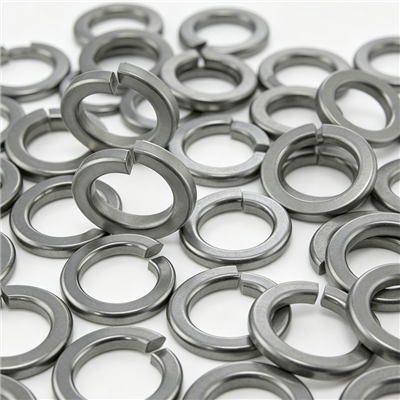
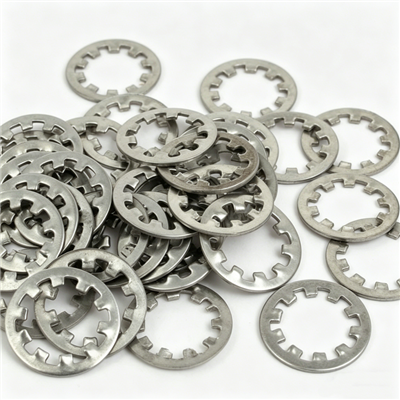
A bolted joint holds because friction between the faces resists sliding, and because the bolt stays stretched. Anything that reduces friction under the head, or that lets the joint relax, allows the bolt to lose preload. A plain flat washer can actually reduce friction, because a washer face slides more easily than a machined surface. Where resistance to loosening is the requirement, the correct part is a spring washer, a serrated or ribbed washer, or a wedge locking washer, each of which adds either spring energy or a mechanical interlock.
A soft or thin mating surface, such as an aluminium casting or a coated panel, will be damaged by a bolt head tightening directly onto it. A washer spreads the clamp load over a larger area, lowers the bearing stress, and keeps the fastener from digging in. This is also why washer outer diameter matters: doubling the bearing area halves the contact pressure. On coated parts, a washer also prevents the tightening torque from scraping the coating off locally, which is where corrosion usually starts.
The material list is short but the consequences of choosing the wrong one are not. A washer that deforms under a repeated load disappears from the joint, and the bolt then loses preload with no external sign.
| Material | Best suited to | Strength and stiffness | Watch points |
|---|---|---|---|
| Low carbon steel | General flat washers and spacers, protective washers | High stiffness when hardened, moderate soft | Needs coating, will rust, can yield if soft and heavily loaded |
| Stainless steel | Corrosive and wet environments, visible fittings | High stiffness, good corrosion resistance | Higher cost, galling risk on threads, different thermal expansion |
| Copper | Sealing washers, electrical contact, heat transfer | Soft, conforms to surface irregularities | Deforms plastically, normally single use for sealing |
| Aluminium | Light assemblies, non magnetic applications | Lower stiffness than steel | Galvanic corrosion against steel, softer bearing surface |
| PTFE | Low friction, chemical resistance, sealing | Low stiffness, creeps under sustained load | Loses thickness over time, not for structural spacing |
| Nylon | Insulation, light sealing, cushioning, low friction | Low stiffness, absorbs vibration | Water absorption, temperature limits, creep under load |
The choice follows three questions. What load and bearing stress must the washer carry. What environment must it survive. And does it need to be removable and reusable. A structural spacer wants a hard steel or stainless part. A sealing joint under a drain plug wants copper or a composite. A low friction bearing surface for a shaft wants PTFE or nylon. Mixing the categories is where problems start.
Steel is the default because it is stiff, strong, cheap, and available in any thickness. Low carbon grades suit protective and spacing duty, while hardened steel is used where the washer forms part of the loaded joint. Stainless steel is selected for corrosion resistance, and it is important to note that stainless fasteners and washers are more prone to galling, so lubrication and correct assembly technique matter.
Copper is chosen for sealing, because it deforms into the surface and closes small imperfections, and for electrical or thermal contact. Aluminium is chosen for weight and non magnetic requirements. Both are softer than steel, which means they are used as the conforming element in a joint rather than as the load path.
These materials are used when the requirement is a low friction interface, chemical resistance, electrical insulation, or cushioning. They have a significant limitation: under sustained compressive load they creep, meaning the thickness reduces over time. A PTFE or nylon washer must never be used where a defined and stable gap is required, because the gap will close as the material settles. Where low friction is needed in a structural joint, a PTFE faced steel washer gives the friction benefit with the dimensional stability of a metal backing.
| Type | Primary function | Typical application | Reusable |
|---|---|---|---|
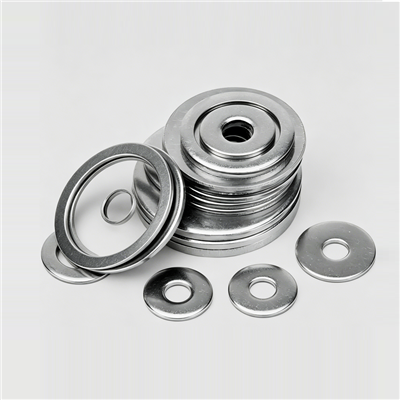
| Plain flat washer | Spread load, protect surface, set spacing | Under bolt heads, on coated and soft surfaces | Yes, if not deformed |
| Spacer or distance washer | Hold a defined gap | Suspension stack up, bearing preload setting | Yes |
| Spring washer | Resist loosening, maintain preload | Vibration exposed joints | Limited, check for flattening |
| Serrated or ribbed washer | Mechanical grip against rotation | Electrical bonding, earth points | Single use recommended |
| Sealing washer | Close a fluid path | Drain plugs, hydraulic fittings | Normally single use |
| Shoulder washer | Locate and insulate | Bushes, insulated mountings | Yes, depending on material |
A common design error is to specify a plain flat washer in a place where the requirement is anti loosening. A flat washer performs no locking function; in some joints it slightly increases the risk of relaxation by lowering friction under the head. If vibration resistance is the objective, state it on the drawing and use a part designed for it.
The inner diameter must clear the fastener or shaft it goes over, and the clearance should be deliberate rather than incidental. Too tight and the washer will not seat on the face; too loose and the washer will not be centred, which can make the bearing area partially ineffective. On a coated part, the coating thickness reduces the hole, so the nominal inner diameter usually needs to allow for it.
Outer diameter sets the bearing area and therefore the contact pressure on the mating surface. Where the washer is protecting a soft material, the outer diameter is a function of the allowable bearing stress, not a cosmetic choice. Where it is spacing a component, the outer diameter may be limited by an adjacent feature, so the free space should be checked on the assembly drawing rather than assumed.
Thickness is usually the critical dimension on a spacer and the least critical on a protective washer. Thickness tolerance should be stated according to the function: a spacer that sets a gap needs a tight tolerance, while a washer that simply protects a surface does not. Where a tight gap is required, using a stack of thin shims allows fine adjustment by adding or removing layers rather than stocking many individual thicknesses.
A spacer is a washer used as a structural element to set a distance. In an assembly, the dimensional chain is the sum of every part height in the stack, and the variation in that sum is the tolerance stack up. A spacer is the cheapest place to correct the stack, because changing a spacer thickness costs less than changing a machined housing.
Two approaches are common. The first is to design a fixed spacer thickness and hold the individual part tolerances tightly enough that the stack always lands in specification, which is simple to assemble but demands capability from every upstream part. The second is to make the last dimension adjustable by selecting from a small range of spacer thicknesses or by adding shims at assembly, which relaxes the upstream tolerances at the cost of an assembly step. On damper and strut work the second approach is often the practical one, because it converts a machining capability problem into a sorting step.
In a damper or strut there are several positions where a washer or spacer does real work. At the top mount, a flat washer spreads the load from the nut into the rubber or polyurethane element and prevents the nut from cutting into the elastomer. On a piston rod eye, spacers set the axial position of the rubber bush so that the correct squeeze is achieved. At a bound or rebound stop, washers locate the elastomer and prevent it from extruding sideways. On a valve stack, thin shims set the preload and therefore the damping force at low rod speed.
In each of these positions the washer is part of the load path rather than a detail, which is why the material, the hardness, and the thickness tolerance should be specified with the same care as the neighbouring components. For the elastomer and mount parts that work with these washers, see the wider shock absorber parts catalogue.
Customisation is supported for any shape, size, and thickness, based on a customer drawing or a physical sample. That flexibility is useful, but the fastest route to a correct part is still a clear request. Provide the inner and outer diameter with tolerances, the thickness with tolerance, the material and finish, the quantity, and a note on the function the washer performs in the assembly. Adding the function is what allows the factory to flag a specification that would not meet the requirement, for example a soft material asked to hold a structural gap.
Both single pieces, for a prototype or a repair, and batch production, for series use, can be supplied, so a new design can be validated with a small order before tooling or volume commitments are made.
Washers are simple parts, which makes it easy to skip inspection and equally easy to receive a batch that does not assemble. The features below are the ones worth checking on receipt.
| Feature | Why it matters | Typical check |
|---|---|---|
| Inner diameter | Must clear the fastener or shaft | Plug gauge or caliper on a sample |
| Outer diameter | Sets bearing area and clearance to adjacent parts | Caliper, several parts per batch |
| Thickness | Critical on spacers, sets the gap | Micrometer, several points across the face |
| Flatness | A bowed washer distorts the joint | Surface plate with feeler gauge |
| Burrs and edge condition | Burrs prevent seating and damage coating | Visual and tactile inspection |
| Material and finish | Strength and corrosion resistance | Certificate review, coating thickness gauge |
No. A plain flat washer spreads load and protects the surface, but it provides no locking action, and by reducing friction under the head it can slightly increase the chance of relaxation. Where vibration resistance is required, specify a spring, serrated, or wedge locking washer instead.
Not where the gap must stay constant. Both materials creep under sustained compressive load, so the thickness reduces over time and the gap closes. Use them for low friction, insulation, or sealing, and use a metal spacer or a PTFE faced metal washer where dimensional stability is needed.
State a nominal thickness with a tight tolerance, and consider supplying the joint as a stack of thin shims so that the exact gap can be set at assembly by adding or removing layers. This avoids stocking many individual thicknesses and removes the need for tight tolerances on every upstream part.
Inner and outer diameter with tolerances, thickness with tolerance, material and surface finish, quantity, and a short description of what the washer does in the assembly. The function note allows the factory to check that the specification actually achieves the requirement before the batch is made.
Send a drawing or sample with the dimensions, the material, the finish, and the intended function, and our engineers will confirm the specification and the production route. Any shape, size, and thickness can be produced, from single pieces to batch quantities. Review the washer and spacer range, look at the wider shock absorber parts catalogue, see the custom manufacturing service, or contact our sales engineers with your requirement.