sales@bonporaparts.com
0086-10-64988621
English
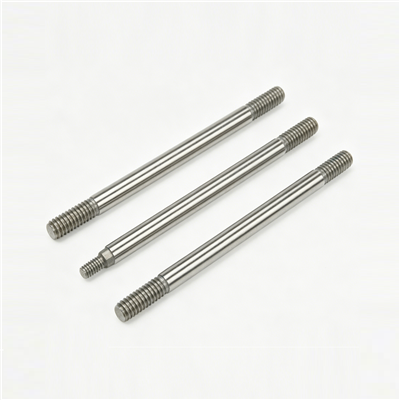
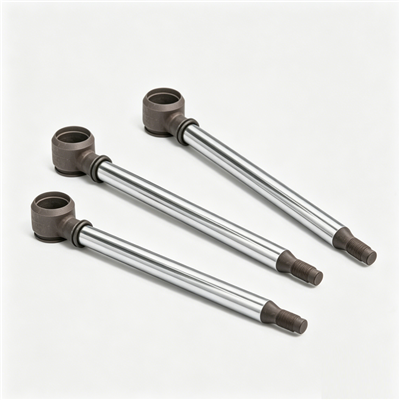
The row behind this article describes a shock piston rod as the core moving component of a shock absorber. One end is connected to the piston assembly and runs inside the working cylinder, while the other end passes through the oil seal and guide seat and connects to the vehicle body or the suspension. Its material is high strength carbon steel such as S45C or S55C, or an alloy steel such as 40Cr, with surface induction hardening or carburising treatment.
In service it does two jobs at once. It transmits the relative motion between the wheel and the body, driving the piston through the oil so that damping force is generated. And it acts as the guiding and sealing mating surface, carrying bending loads while sliding through the seal under friction. Those two duties are the reason a piston rod is specified as much by its surface as by its diameter.
The source row names S45C and S55C as typical carbon steels and 40Cr as the alloy option. The difference shows up in hardenability rather than in cost alone.
| Material | Typical use | Note for buyers |
|---|---|---|
| S45C | General road dampers, moderate load | Widest availability, lowest cost |
| S55C | Higher load or larger diameter rods | Better core strength after hardening |
| 40Cr | Heavy duty, off-road and performance dampers | Deeper hardening, better fatigue resistance |
Hardening method matters as much as the grade. Induction hardening hardens the surface layer while leaving a tough core, which is the usual route for a sliding rod. Carburising is used where a deeper case is required. Either way the specification should state the case depth and the surface hardness band, because those two values decide how the rod behaves against the seal over time.
Hard chrome is the traditional finish for a sliding rod. It provides a low friction surface, resists corrosion and gives the seal a stable counterface. Thickness and adhesion both need to be controlled: a plating that flakes is worse than no plating, because the flakes become abrasive particles inside the damper.
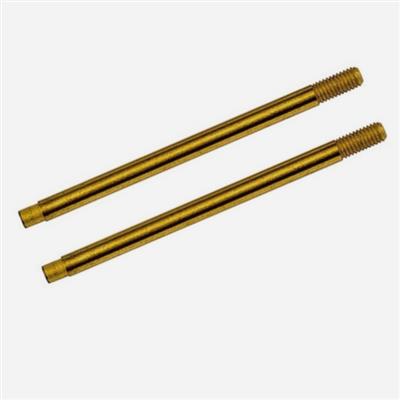
The source row mentions nitriding and special coatings among the options available. Nitriding raises surface hardness without a plating layer, which suits applications where corrosion resistance and wear resistance must come from the base material rather than from a deposit. Special coatings are used where the vehicle environment is aggressive or where friction against the seal has to be reduced further.
| Finish | Main benefit | Best suited to |
|---|---|---|
| Hard chrome | Low friction, proven seal compatibility | Volume road damper production |
| Nitrided | High surface hardness without a deposit | Heavy duty and off-road dampers |
| Special coating | Specific friction or corrosion target | Performance and special applications |
On an off-road or gravel vehicle the exposed part of the rod can be struck by debris. A dented or chipped surface destroys the seal within a short distance, so protection such as a dust boot or guard is a system decision, not an accessory.
Rod diameter sets the bending stiffness of the exposed section and the area that displaces oil. Length is usually defined between the mounting features rather than overall, because the end connection geometry differs between designs. A drawing that quotes only overall length invites a mismatch.
Straightness tolerance is the value most often omitted from an enquiry and most often the cause of a rejection. A rod that is slightly bowed loads the seal unevenly on one side, which produces a leak long before the material is worn out.
Roughness has an optimum rather than a minimum. Too rough and the surface acts as an abrasive against the seal; too smooth and the seal cannot retain the thin oil film it needs, which increases friction and running temperature. The drawing should state a roughness band, not a single figure.
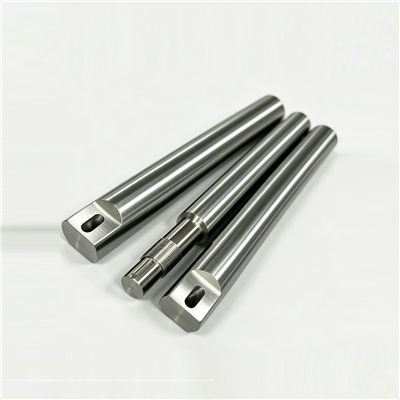
Threaded ends, eye ends, welded flanges and machined shoulders are all produced to drawing. The end type also determines how the rod is gripped during manufacture and how straightness is measured, so it belongs in the RFQ even when the customer plans to machine the end in house.
| Drawing value | What it controls | Typical format |
|---|---|---|
| Rod diameter | Bending stiffness, oil displacement | Nominal with tolerance |
| Rated length | Fitment and stroke | Between defining features |
| Straightness | Seal loading and leak risk | Maximum runout over the exposed length |
| Roughness | Seal life and friction | Band, such as a defined Ra range |
| Case depth | Wear resistance against the seal | Minimum and maximum depth |
| Surface hardness | Durability of the running surface | Hardness band with method |
| Coating thickness | Corrosion and friction performance | Minimum thickness with adhesion test |
| End geometry | Assembly and mounting | Full detail or customer drawing revision |
An incoming or outgoing inspection does not need a laboratory. It needs a short list of values recorded consistently, so that a trend can be seen before a complaint arrives.
The visual check deserves the same status as the dimensional one. Most seal failures traced back to a rod begin with a mark that was visible at goods inwards and was not recorded.
The source row states a service life under normal operating conditions of 80,000 km or 5 years, a warranty of 2 years or 80,000 km whichever comes first, and quality compliance with the IATF 16949 system. Read those two figures together, because they describe different things. Service life is the design expectation under normal use, while the warranty is a commercial commitment for material and manufacturing defects.
For a buyer, the practical points are that the warranty is measured from fitment, that it covers defects rather than wear from a damaged dust seal, and that a claim is far easier to settle when the failed rod and the vehicle data are available. Photographs of the surface, the measured dimensions and the mileage at failure are usually enough to resolve a straightforward case.
The source row confirms that customisation is accepted from customer drawings or samples, covering custom lengths, diameters, surface treatments and end connection types. That opens the door to replacing a discontinued rod or to building a damper for a modified vehicle, but only if the enquiry is complete.
Sample based development follows the same route with one addition: the sample should be measured and recorded in detail before it is sent, so that the returned part can be compared with the original on paper as well as by eye.
S45C or S55C with induction hardening covers the majority of road applications. Where the damper works harder, or where a larger diameter rod carries higher bending load, 40Cr with a controlled case depth is the usual upgrade.
For most volume production, yes. It has a long history of seal compatibility and is well understood. Where corrosion resistance must come from the base material, nitriding or a special coating is the alternative, and the source row lists both as available options.
As a maximum runout over the exposed length, measured on a bench. It should appear on the drawing, because a rod that passes a diameter check and fails straightness still fails in the damper.
It is not recommended. Straightening leaves residual stress and may crack the coating or the hardened layer, and the surface damage is exactly what the seal cannot tolerate. Replacement is the reliable route.
Bonpora Parts and Components supplies shock piston rods in carbon and alloy steel with induction hardening, carburising, hard chrome, nitriding and special coatings, produced to drawing or sample. Review the piston rod range and the standard rod reference, compare the shock absorber component range, and read the steel shim selection guide for the parts that work alongside the rod inside the damper. Send your drawing and annual quantity through the contact page, or use the custom parts service for a rod that is no longer catalogued.