sales@bonporaparts.com
0086-10-64988621
English
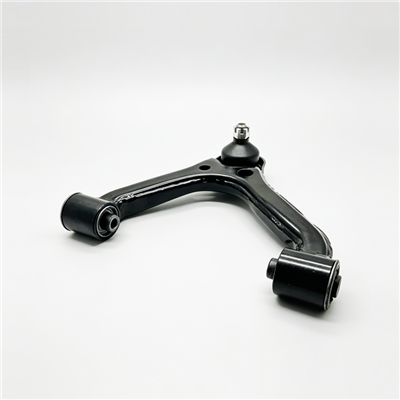
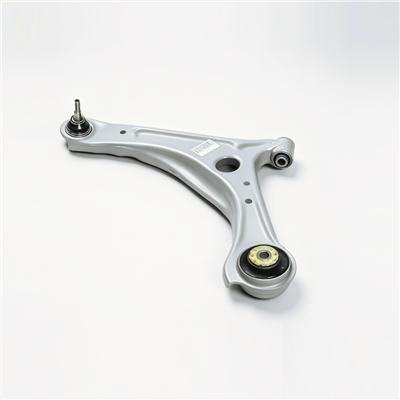
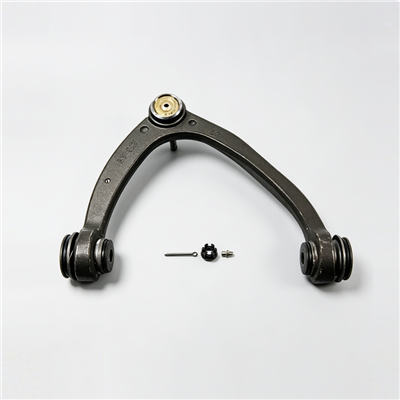
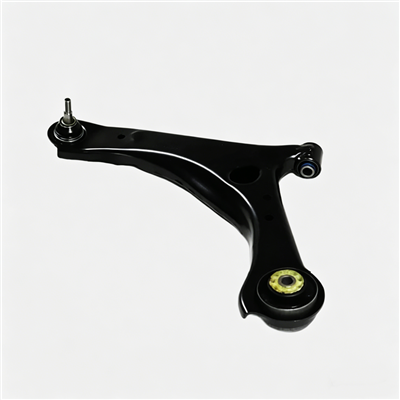
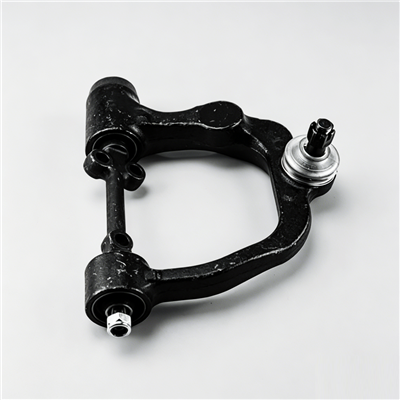
A control arm, also written as A-arm, A-frame, suspension arm, trailing arm or track control arm, is a guiding component of the suspension system. One end is connected to the subframe or the body through a bushing, and the other end is connected to the knuckle through a ball joint. It transmits longitudinal and lateral forces between the wheel and the vehicle body, controls the path of wheel motion and maintains alignment parameters such as camber and toe, and it withstands the loads generated during braking, acceleration and cornering. Bonpora supplies the part as a stamped steel plate welded structure, a forged aluminium alloy part or a cast iron part, states compliance with IATF 16949, lists critical inspection as dimensional accuracy of the mounting points, welding strength, ball joint starting torque and fatigue life, gives a warranty of two years or 50,000 km for cast and welded parts, and supports development from customer drawings or scanned data with matching ball joints and bushings provided. For a distributor or a workshop chain, the part is a slow moving, safety related item that is bought in small quantities over a long period, and that changes how the purchase should be planned. This guide covers the sourcing side: how to build the range, what to send with a request, how to read a quotation, and how to judge whether a supplier will still be answering questions three years from now.
A control arm range is usually built around a vehicle parc rather than around a price list, because the part is replaced when a bushing or a ball joint fails and the customer expects the correct arm to be on the shelf.
List the models that the workshop or the distributor actually services, then the axle positions, then the left and right hand versions. Two arms that look similar in a catalogue can differ by the position in the layout and by the hand, and ordering the wrong one creates a return as well as a delay. Sorting the list this way also shows where volume really sits, which is usually a small set of high frequency applications plus a long tail of occasional ones.
Because stamped and welded steel, forged aluminium and cast iron arms carry different tooling cost and different lead times, group the range by construction route. A group of stampings from one supplier can be amortised over several part numbers, while a single forged application may carry the whole tooling cost on one number. Seeing the range this way explains most of the price differences that otherwise look arbitrary.
The clearer the data pack, the fewer the round trips, and the more comparable the quotations that come back.
Vehicle model and year range, layout position, left or right hand, and the original equipment number where one exists. Then the interfaces: bushing bore and type, ball joint specification and starting torque window, and whether the interfaces are supplied with the arm. Then the commercial frame: expected annual volume, order pattern, packaging and marking requirements, and the destination market with its road and climate conditions. Development from a drawing or a scan should be stated up front so that the tooling question is answered in the first reply.
Where no drawing exists, an existing arm or a scan of it is the practical starting point, and Bonpora states that development is supported from customer drawings or scanned data. A scan captures shape but not material grade or heat treatment, so state which values still have to be agreed, and keep one original arm aside as the reference for the first article comparison.
| Request field | Why the supplier needs it | Effect on the quotation |
|---|---|---|
| Vehicle model, position, hand | Decides the geometry and the interfaces | Prevents a quotation for the wrong part number |
| Original equipment number | Gives a cross reference point | Speeds up an existing tooling lookup |
| Bushing and ball joint specification | Decides whether the interfaces are included | Changes the unit content and the price |
| Construction route preference | Sets material, mass and tooling route | Drives the tooling cost and the lead time |
| Annual volume and order pattern | Sets the production batch size | Spreads tooling cost over a known quantity |
| Destination market and climate | Sets coating and corrosion requirements | May add a coating step to the price |
| Packaging and marking | Decides the shipping unit and identification | Adds a packaging line item |
Two quotations for the same application can differ by a wide margin without either supplier being dishonest, because the content of the offer is not identical.
Material and mass come first: a forged aluminium arm costs more per piece than a stamped steel arm, and a cast iron arm carries more mass in freight. Tooling and its amortisation come next, and the way that cost is spread over the volume is a commercial decision, not a technical one. Whether the interfaces are included decides a large part of the unit price, since a ball joint and a bushing are real content. Coating, packaging and marking add cost, and so does any testing that the buyer requires as evidence, because fatigue and dimensional verification consume bench time.
Line up the offers with the same content: same interfaces, same coating, same packaging, same documentation, same volume band. Where one offer is missing a test report or a coating step, price it back in before deciding. It also helps to ask what happens at a volume below the quoted band, because a range that turns over slowly will often order below the band that produced the attractive price.
| Cost driver | What changes it | Question to put to the supplier |
|---|---|---|
| Material and mass | Construction route and grade | Which grade and mass are quoted |
| Tooling and amortisation | Volume band and part count in the tool | Is the tooling charged once or per unit |
| Interfaces | Bushing and ball joint included or not | Is the ball joint supplied and at which torque window |
| Coating | Corrosion requirement of the market | Which coating system and what thickness |
| Testing and documentation | Evidence requested by the buyer | Which inspection records come with the batch |
| Packaging and freight | Unit count, protection and destination | How the ball joint and boot are protected in transit |
IATF 16949 compliance is a useful floor, not a complete answer. The certification says that a quality system exists; it does not say that this particular arm will be made consistently.
Bonpora names four critical inspection items: dimensional accuracy of the mounting points, welding strength, ball joint starting torque and fatigue life. Convert each into a question with an answer that can be checked. How are mounting points measured, and on what proportion of production. How is weld quality verified on a stamped and welded arm, and what happens when a sample fails. How is starting torque measured and at what temperature. Has a fatigue test been run on this design, and is the report available. A supplier who answers those four questions with records is a different risk from one who answers with assurances.
Score the suppliers on the same sheet, and keep the sheet for the next purchase round. Technical fit, evidence quality, quoted lead time, response time on questions, packaging standard and commercial terms are the columns that matter for a slow moving, safety related part.
| Evaluation area | What to check | Weak signal to look for |
|---|---|---|
| Technical fit | Geometry, mass, interfaces match the request | Answers that describe the catalogue in general terms |
| Evidence quality | Dimension, weld, torque and fatigue records | Certificates offered without a batch reference |
| Process control | How the four critical items are verified in production | No measuring method named for mounting points |
| Lead time | Quoted time for a repeat order and for a new number | Lead time quoted without a volume assumption |
| Response | Time taken to answer a technical question | Technical questions routed only through a sales channel |
| Packaging | Protection of the boot, the ball joint and the coating | Bulk loose packing for a coated arm |
| Terms | Warranty, returns policy, minimum order | Warranty stated without conditions |
A sample that fits on a bench is not the same as an arm that performs in service, so the approval stage should include a fitment trial on the vehicle.
The first article report should carry the dimensional results for the mounting points, the material certificate, the weld inspection record on a welded arm, the starting torque measurement, and the coating thickness or salt spray result where a coating is specified. Compare the first article with the original arm on the vehicle, not only in the workshop, because ride height and alignment behaviour show up only under load.
Keep the agreed drawing or scan, the interface specification, the first article report and the trial result together as one approval file. When a batch later arrives with a question, that file is what makes the comparison possible, and it is also what supports a warranty discussion.
Bonpora gives a warranty of two years or 50,000 km for cast and welded parts. For a distributor, the practical reading of that figure is that a returned arm within the period should be traceable to a batch, and that the claim should be judged on the condition of the part. Ask the supplier how a claim is handled: what evidence is required, how a returned arm is assessed, and whether a matching interface is covered as part of the arm. A supplier who can describe that process in detail is usually the one that also keeps production records.
Suspension arms are heavy, oddly shaped and coated, and the ball joint end is the most easily damaged part of the whole item.
The ball joint stud, its thread and its boot should be protected so that no load is applied to the taper in transit. Where several arms share a carton, separators prevent metal to metal contact that damages the coating before the part reaches the shelf. Coating damage on arrival is not a cosmetic issue on a road vehicle, because the damaged area becomes the start of corrosion.
Each arm should carry a marking that ties it to the part number and the batch, and each carton should state the content and the quantity. Where a distributor supplies several workshops, clear marking on the arm itself saves a fitting error at the vehicle, which is the most expensive mistake in this part of the business.
The errors below appear repeatedly in control arm purchasing, and each one converts a price advantage into a service cost.
Ask for the interfaces, the evidence and the packaging before comparing prices. Confirm the position and the hand on every order. Keep the approval file. Those three habits remove most of the avoidable cost from this category.
| Mistake | Cost it creates | Prevention |
|---|---|---|
| Comparing prices with different interface content | Apparent saving that disappears at fitting | Equalise content across all offers |
| Ordering without confirming position and hand | Return freight and a delayed repair | Confirm layout position and hand on the order |
| Accepting a certificate without a batch reference | No traceability when a claim arises | Require batch linked records |
| Choosing a volume band the range will not reach | Price renegotiation later | Quote at the realistic order quantity |
| Ignoring packaging of the ball joint end | Damaged boots and coating on arrival | Specify protection and separators |
| Skipping the vehicle fitment trial | Alignment complaints after sale | Trial the first article on the vehicle |
Stocking the assembly with matching interfaces supplied reduces fitting errors and returns, because the arm and its ball joint are approved together. Stocking bare arms suits workshops that already hold the correct joints and have the equipment to press them.
Vehicle model, layout position, left or right hand, the construction route if there is a preference, and whether the bushings and the ball joint should be included. An existing arm or a scan helps where no drawing exists.
Ask for the fatigue test report on the design in question, together with the load case it was run against. Where a test is not available, the material certificate, the weld inspection record and the geometry control plan are the evidence that remains.
Bonpora gives two years or 50,000 km for cast and welded parts. In practice a claim is assessed on the condition of the part and the installation record, so keeping the fitment record with the sale is worthwhile for a distributor.
Send the vehicle list, the interface requirement and the expected order pattern to the team at Bonpora Parts and Components Co.,Ltd. for a quotation that states exactly what is included. The control arm range shows the three construction routes, the selection and specification guide explains the drawing data behind an order, the failure analysis describes how a claim is assessed, and the custom development service covers drawing and scan based projects.