sales@bonporaparts.com
0086-10-64988621
English
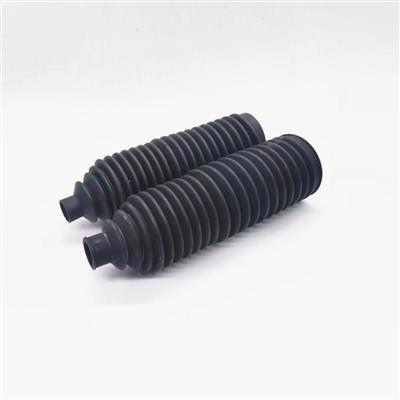
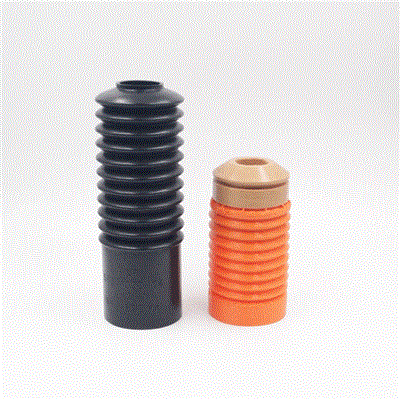
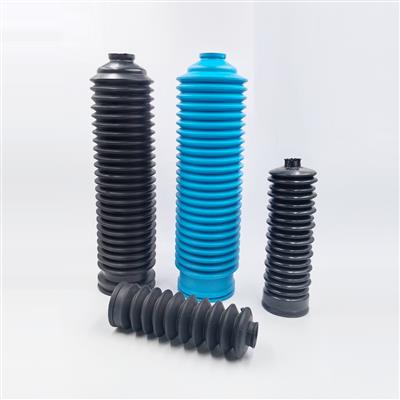
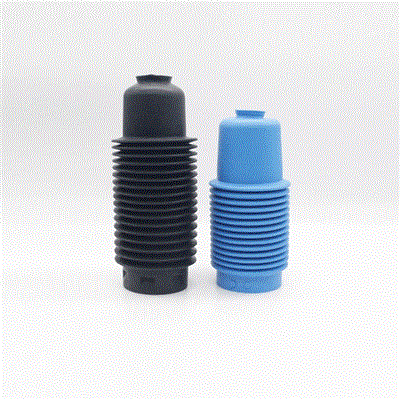
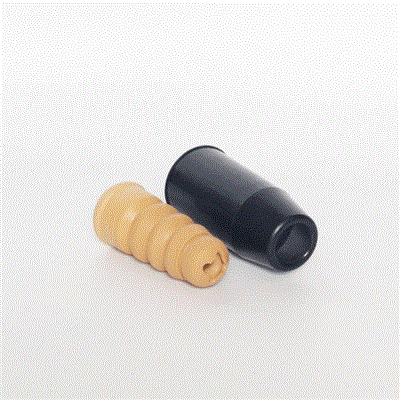
A dust cover, also called a shock dust boot, dust shield or strut bellows, is installed externally on the shock absorber piston rod, positioned above the oil seal. Its upper end mates with the piston rod and its lower end mates with the reservoir cylinder or connecting component. Compounds used in production include EPDM, nylon PA66, PU, NR, NBR and TPE, selected to suit the working temperature and the amount of flex the bellows has to survive.
Functions. It prevents external contaminants such as mud, dust and moisture from reaching the oil seal and the piston rod surface, which avoids scratching of the rod and damage to the seal. It also helps to block high temperatures and UV aging of the parts underneath it.
Service life. Design life of no less than 5 years or 80,000 km without cracking, hardening or deformation failure under conventional environmental conditions.
Quality standard. Manufactured to comply with IATF 16949 system requirements. Test items include hardness, tensile strength, ozone resistance and high and low temperature resistance from -40 C to +100 C.
Warranty. Warranty is provided with the complete shock absorber assembly. When the cover is sold separately, a 1 year or 50,000 km warranty is offered, covering material and manufacturing defects.
Customization. Moulds can be customized from customer supplied mounting dimensions, shape and colour, and different bellows profiles and material hardness adjustments are supported.
A dust cover looks simple, but it is a thin walled flexing part with a sealing bead at one end and an open skirt at the other. Small variations in wall thickness, cure state or bead geometry show up in service as early cracking or as a boot that will not stay seated. For a buyer evaluating a supplier, the useful question is not only which compound is offered but which process is used, how the tool is controlled and which measurements are taken on every batch. This page sets out how those points are normally structured so that a purchase specification, an audit checklist or a first article report can be written against them.
Thermoplastic elastomers such as TPE and nylon PA66 are normally injection moulded. Cycle times are short and the bellows profile can be moulded with tight dimensional control, so this route suits high volume programmes where the profile is fixed and the tool cost can be amortised.
Blow moulding produces a seamless tube that can be formed into a boot with closed ends or with a bead. Wall thickness is less uniform than injection moulding, so it is used where a low tool cost matters more than tight wall control, often for simple protective sleeves.
Thermoset rubbers such as EPDM, NBR and NR are usually compression or transfer moulded, because the compound cures by a chemical reaction rather than by cooling. Cure time, mould temperature and the venting of the cavity all have to be controlled, and the batch record should carry the cure system and the cure date so that a hardened or undercured batch can be traced.
| Process | Typical Materials | Tool Cost | Wall Control | Best Suited To |
|---|---|---|---|---|
| Injection moulding | TPE, nylon PA66 | Higher | Tight | High volume fixed profiles |
| Blow moulding | TPE, PU | Lower | Moderate | Simple sleeves and low volume |
| Compression moulding | EPDM, NBR, NR | Moderate | Good with tool care | Thermoset rubber bellows |
| Transfer moulding | NBR, HNBR type rubbers | Moderate | Good | Parts with inserts or tight beads |
The drawing is the control document for everything downstream. At minimum it should state the material and hardness, the upper bead profile and its groove engagement, the lower lip or collar dimensions, the free length, the number of ribs, the wall thickness at the fold, the vent hole size and position if one is fitted, and the colour. Dimensions that are critical to sealing should be marked as such so that they are measured on the first article and on sample batches.
Where a customer pays for a new tool, the commercial agreement should say who owns it and where it is stored, because a tool that is lost in a supplier change cannot be recovered later. In production, the tool should have a defined maintenance interval based on shot count, with records of polishing, vent cleaning and any repair to the bead area. Worn vents and polished beads are two of the most common reasons why a part that passed the first article begins to leak or to come loose later in the programme.
Two suppliers can both offer EPDM and still deliver parts with different service life, because polymer grade, filler loading and the cure system all move the result. The purchase specification should therefore name the compound by a supplier reference rather than by a generic family alone, and the batch record should state the polymer lot, the cure system and the cure date.
Ozone and UV attack are the two environmental effects that most often limit the life of a cover exposed to sunlight and to the ozone generated around electrical equipment. The compound should carry an antiozonant and a UV stabiliser package, and the supplier should be able to show ozone resistance test results rather than only a material certificate.
Rubber compounds continue to age in the warehouse. A shelf life should be stated, stock should be rotated first in first out, and material should be stored away from direct sunlight, ozone sources and heavy electrical plant.
| Test Item | Method | Frequency | Acceptance Basis |
|---|---|---|---|
| Hardness | Shore A durometer on a flat area | Each batch | Within the range on the drawing |
| Tensile strength | Tensile test on a moulded or cut sample | Each compound lot | Per the compound data sheet |
| Elongation at break | Same test as tensile, recorded together | Each compound lot | Per the compound data sheet |
| Ozone resistance | Ozone chamber at the agreed concentration | Type test and periodic | No cracking at the stated strain |
| Low temperature | Cold chamber down to -40 C | Type test and periodic | No cracking or stiffening failure |
| High temperature | Ageing oven up to +100 C | Type test and periodic | No hardening beyond the limit |
| Critical dimensions | Gauges and callipers on bead and lip | Per shift and per batch | Drawing tolerance, key dimensions measured |
| Visual and vent check | Visual inspection, vent hole probe | Every part | No flash on the bead, vent open |
Part weight is a quick indicator of whether the shot is filling correctly and whether the compound is consistent. A weight that drifts outside its band usually points to a change in compound viscosity or in mould temperature, both of which can also change the bead dimensions.
Approving the first part of each shift against a retained sample catches a tool that has shifted overnight or a compound lot that has changed. Keeping a retained sample for each production batch allows a later complaint to be compared against the parts that were actually shipped.
Where a vent is specified, it should be probed or flow checked rather than only inspected by eye. A blocked vent allows the bellows to pressurise in service, and a sealed vent is one of the harder faults to spot after assembly.
For thermoset compounds, an undercured part feels tacky and tears differently from a fully cured one. Simple checks such as a nail test or a hardness reading taken on the production floor give an early warning before the batch reaches final inspection.
Because a dust cover sits inside a suspension assembly that carries a warranty, traceability is a commercial requirement and not only a quality one. A workable package for a trade buyer normally includes a batch or date code moulded or printed on the part, a batch record holding the compound lot and the cure date, dimensional results for the critical features, and a certificate of conformance for the shipment. For new programmes, a first article inspection report with the marked critical dimensions and the material test results is the document that supports approval, and for automotive supply an inspection control plan and a process flow are normally requested as well.
Field failures are only useful if they are read back into the drawing. A cover that splits at a fold points to too few ribs or a wall that is too thin for the stroke. A cover that hardens and cracks points to a compound that is not rated for the temperature it actually sees. A cover that comes off the rod points to the bead engagement or to the clip. A cover worn on one side only points to fouling rather than to material. Recording the failure mode and the mileage or hours at failure lets the supplier change the profile or the compound on the next tool rather than replacing the same part repeatedly.
| Packing Method | Protection Given | Suitable For |
|---|---|---|
| Poly bag with part number | Dust and handling protection | Small orders and samples |
| Inner carton with dividers | Prevents bead deformation in transit | Carton quantities |
| Master carton with label | Part number, quantity, batch code | All export shipments |
| Pallet with stretch wrap | Moisture and movement protection | Container loads |
Labels should carry the part number, the quantity, the batch code and the production date, and the outer packaging should keep the bellows from being compressed against each other, because a cover stored under load can take a set in the folded position.
| Area | What to Ask |
|---|---|
| Quality system | Current IATF 16949 certificate and the scope it covers |
| Compound control | Named compound reference, cure system, batch records |
| Tooling | Tool ownership, maintenance interval and shot records |
| Testing | In house hardness, tensile, ozone and temperature capability |
| Traceability | Date coding method and how far back records are kept |
| Capacity | Press or mould count, shift pattern, typical lead time |
| Customisation | Ability to run a new profile from supplied dimensions |
Buyers who also source the surrounding parts will find the same questions useful for shock absorber parts generally, and for new profiles the tooling and first article route is described under custom moulded parts.
Service life depends more on the compound, the profile and the fit than on the process alone. Injection moulding gives tighter dimensional control for thermoplastic materials, while compression moulding is the normal route for thermoset rubbers such as EPDM and NBR, and both can meet the five year or 80,000 km design target when the part is specified correctly.
Hardness should be given as a Shore A range with the measurement method and the location on the part, normally a flat area away from ribs. A single number without a tolerance leaves too much room for variation between batches.
A certificate of conformance, the dimensional results for the critical features, the material test results and the batch code with the production date. For a new programme, a first article inspection report and an inspection control plan are normally added.
The usual causes are tool wear at the bead or the vents, a change of compound lot without a re approval, a cure time that was shortened to improve output, or a change in storage and handling. Periodic re testing against the retained first article sample is the practical control.
Bonpora Parts supplies dust covers and shock dust boots moulded in EPDM, NBR, NR, PU, TPE and nylon PA66, with the compound reference, hardness range, bead dimensions, bellows profile and vent details recorded for each part number, and with hardness, tensile, ozone and low temperature results available for the batch. If you are adding a cover to an existing range, send the mounting dimensions and the operating temperature and our engineers will match an existing tool or quote a new one. Start from the dust cover range, review the fitting procedure in the dust cover installation guide, compare compounds in the dust cover material and fitment guide, or contact our team with your specification and annual volume. Further references are listed on the dust cover selection and replacement guide and the products page.