sales@bonporaparts.com
0086-10-64988621
English
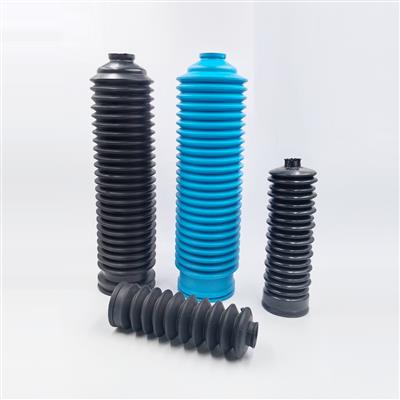
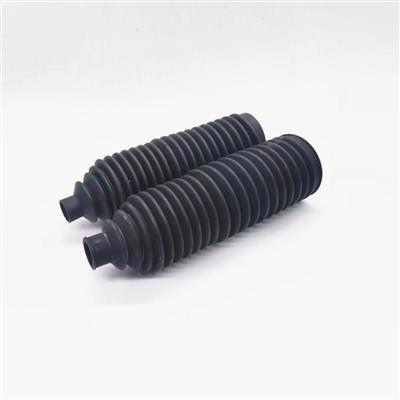
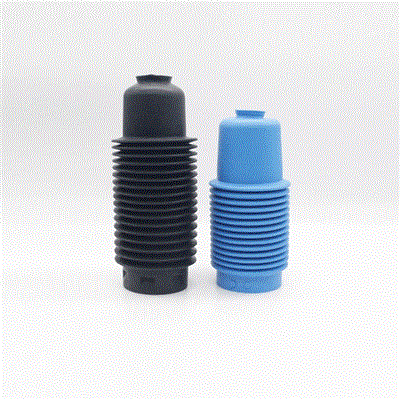
A dust cover, also called a shock dust boot, dust shield or strut bellow, is fitted externally on the shock absorber piston rod, above the oil seal. Its upper end mates with the piston rod and its lower end mates with the reservoir cylinder or the connecting component. Typical compounds include EPDM, nylon PA66, PU, NR, NBR and TPE, chosen to suit the working temperature, the oil exposure and the road surface.
The boot slides over the exposed section of the piston rod. The upper collar grips the rod or a mounting washer, while the lower lip rests on the reservoir tube or an adapter ring. Because the boot travels with the rod on every stroke, both fixings decide how well it stays centred.
The cover keeps contaminants such as mud, dust and moisture away from the oil seal and the piston rod surface. Grit trapped against the rod works like a lapping compound: each stroke scratches the chrome, and the scored surface then wears the oil seal lip from the inside. The cover also limits exposure to high temperature and UV radiation, which slows the ageing of the rubber components next to it.
Bonpora lists a design life of not less than five years or 80,000 km without cracking, hardening or deformation failure under conventional conditions. Service life depends on duty cycle, climate and damper condition, so the figure is a design target rather than a promise.
Production complies with IATF 16949 system requirements, with test items covering hardness, tensile strength, ozone resistance and high and low temperature resistance across roughly -40 degrees C to +100 degrees C. Warranty is normally supplied with the complete shock absorber assembly; sold separately, the offered terms are one year or 50,000 km covering material and manufacturing defects.
Moulds can be built to customer drawings for mounting dimensions, shape and colour, with different bellows profiles and compound hardness available. Custom tooling suits vehicles that are not covered by a catalogue reference, or distributors who need a private-label repair kit.
The cover is a sacrificial part. It absorbs abrasion, heat and chemical attack so that the piston rod and the oil seal do not, and it is normally renewed in the same service visit as the damper or the bump stop. When a cover fails early, the reason is usually visible on the part.
Fine grit blowing off a dry road surface collects inside the bellows. With each stroke the folds rub against one another and the trapped particles act as an abrasive paste. The first sign is a dull, chalky inner surface followed by splits at the fold crests. Vehicles on unsealed roads often reach that stage well before the design target.
Boots stored in daylight or parked outdoors develop fine cracks across the outer skin, and the compound hardens until it feels stiff rather than supple. A hardened boot no longer folds cleanly, so it splits at the crease instead of flexing. A weak anti-ozonant package shows this pattern across a whole batch within one season, which points to the compound rather than the fitment.
Where a cover sits near an exhaust run or a turbocharger downpipe, radiant heat accelerates hardening and shrinkage. Contact with engine oil, brake fluid or solvent softens many rubber grades and swells them until the collar no longer grips, so the material should follow the position rather than the price list.
A split or missing cover is often treated as cosmetic, yet the damper pays for it. Once grit reaches the rod, the chrome picks up scratches and the seal lip wears against a rough surface, so the damper starts to weep oil and loses damping force. Repairing a scored rod is rarely economic, which is why renewing a low-cost cover on time protects a much more expensive assembly.
| Compound | Typical position and use | Service notes | Watch-outs |
|---|---|---|---|
| EPDM | Road vehicles, general weather and ozone exposure | Good resistance to UV, ozone and water; wide temperature band | Limited resistance to mineral oil and fuel contact |
| NBR | Positions with oil mist or hydraulic fluid nearby | Good oil and abrasion resistance; moderate temperature band | Weaker ozone and UV resistance than EPDM |
| NR | Applications needing high elasticity at low cost | High tensile strength and rebound | Ages faster in ozone and heat; needs protection in the compound |
| PU | Heavy abrasion, off-road and commercial duty | Very good tear and cut resistance | Stiffer at low temperature; check cold-climate performance |
| TPE | Cost-controlled programmes and quick-fit kits | Consistent moulding, simple colour matching | Lower heat resistance than thermoset rubber grades |
| Nylon PA66 | Rigid shields, sleeves and clip-on carriers | Stiff, dimensionally stable, good at higher temperatures | Not a flexible bellows; used as a shield or support rather than a boot |
Two covers can look identical in a photograph and still differ by a few millimetres at the collar. Because the boot is soft, it is easy to compress a dimension by hand, so measure with the part relaxed.
| Measurement point | How to check it | Common mistake |
|---|---|---|
| Inside diameter at the upper collar | Push the collar over a taper gauge or measure the relaxed bore with calipers | Measuring a distorted collar and ordering an oversized bore |
| Inside diameter at the lower lip | Compare against the reservoir tube outside diameter | Confusing tube diameter with piston rod diameter |
| Overall free length | Lay the boot flat and measure without stretching it | Reading a stretched length from a boot that has been pulled off a rod |
| Bellows count and fold depth | Count folds and note whether the profile is straight or stepped | Assuming fold count does not matter when travel is long |
| Fixing type | Note whether the cover clips, rings, bonds or screws into place | Ordering a boot that has no way of staying on the damper |
The same model year can carry different dampers depending on trim, market and production plant, so a vehicle reference narrows the search but does not finish it. Confirm a damper part number from the removed unit, then check the collar diameters against the actual rod and tube. Where a catalogue lists a body size only, ask the factory for the drawing.
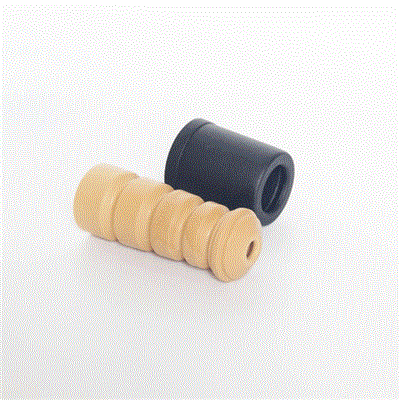
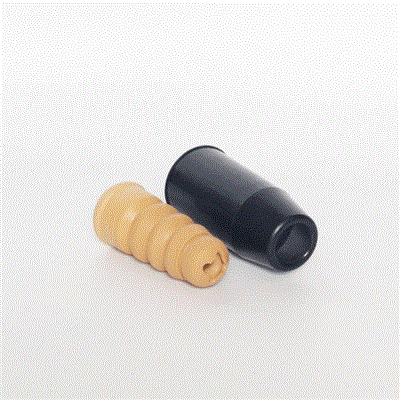
A dust cover is rarely the only item needed once the suspension is apart. Damper repairs commonly involve a bump stop, a top mount and a spring seat, and ordering them together avoids a second workshop visit. The range is listed under dust covers and shock absorber protection, with related components grouped in the shock absorber parts section.
| Condition found | Likely cause | Suggested action |
|---|---|---|
| Light surface cracks, still supple | Early ozone exposure | Record the mileage and re-check at the next service |
| Hard, chalky outer skin | UV and heat ageing | Replace the cover and review storage conditions for spare stock |
| Splits at the fold crests | Abrasion from trapped grit | Inspect the rod for scoring before refitting a new cover |
| Oil-soaked and swollen | Seal or hydraulic leak nearby | Trace the leak; the cover is a symptom rather than the fault |
| Collar stretched, boot rides up | Wrong bore or worn fixing | Measure the rod and collar, then confirm the correct reference |
| Boot missing entirely | Fitted without a cover or lost in service | Check the rod and oil seal, then fit a new cover in the same visit |
Suppliers quote faster when the enquiry carries the facts that decide tooling and compound. A dimension drawing, or a photograph with a ruler across the part, works better than a description alone, and the damper OE number removes most of the ambiguity. Add the expected annual volume and packing format.
Dust covers ship well in bulk, but many distributors sell them as part of a repair kit with the bump stop and the top mount. Kitting raises the unit value and reduces picking errors, and private-label bags can carry the distributor brand and the fitting position. Ask about the minimum order for a printed bag, since print setup is usually charged once.
For a programme running over several seasons, request the compound specification, the hardness range, the moulding tolerance and the results of ozone and temperature testing. Batch marking matters too: if a batch underperforms in the field, a traceable mark turns an argument into a replacement.
Yes. Dust cover, shock dust boot, dust shield and strut bellow all describe the flexible sleeve that sits over the damper piston rod. Naming varies between suppliers, so the drawing and the mounting dimensions are the reliable identifiers.
The design target quoted for this part is not less than five years or 80,000 km under conventional conditions. Covers exposed to abrasive roads, strong UV or radiant heat often fall short, so an inspection at every damper service is worthwhile.
Usually yes, provided the rod is unmarked and the oil seal is dry. If the rod is already scored or the damper is weeping oil, a new cover will not restore the assembly.
EPDM is a common choice for cold markets because it stays flexible across a wide temperature band and resists ozone and water. Polyurethane offers better abrasion resistance but stiffens at low temperature, so it suits positions where cut damage matters more.
Bonporaparts moulds dust covers and related elastomer parts for passenger cars, light commercial vehicles and heavy duty applications, and supports projects with drawing-based tooling, compound selection and batch traceability. Custom runs are handled through the custom parts service, where mounting dimensions, bellows profile, compound and colour can be set to the application. Send a sample or drawing with the damper reference and the expected volume, and the team will confirm the feasible compound and tooling route.